Baroque Fugue: Viola Sheet Music Preview

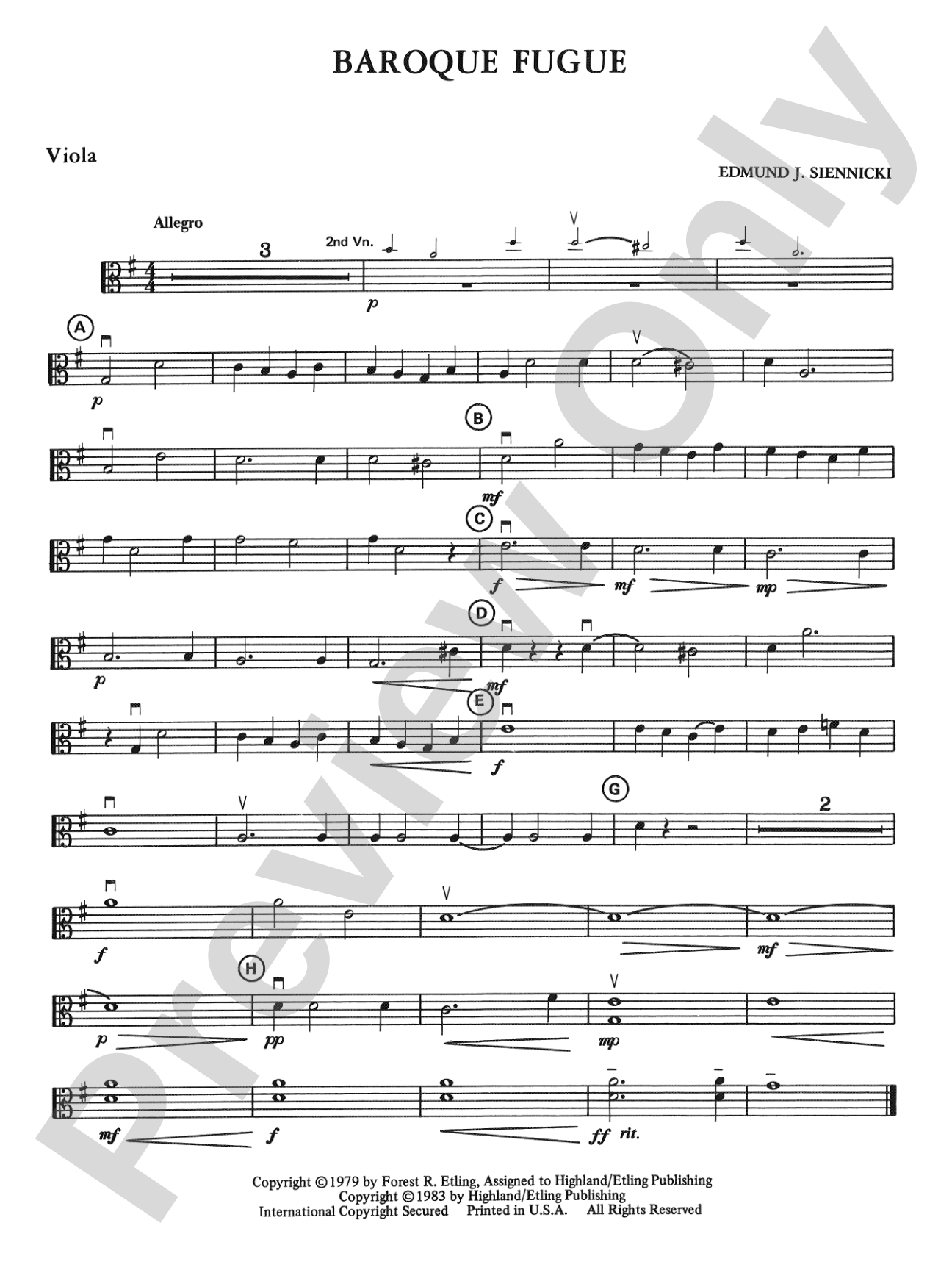
Baroque Fugue: Viola

By Edmund J. Siennicki

Grade: 2

Item: 00-PC-0000087_VA1

Digital Download
$5.99
Description
This title is available in MakeMusic Cloud.

Don't just read it, hear it, play along with it, and watch your students grow with it. In MakeMusic Cloud, Baroque Fugue: Viola comes alive with professional accompaniment, adjustable tempo, and built-in practice tools that turn solo practice into real progress.

Sample Audio
No sample audio found.
Sample Video
Additional Details
Series: Highland/Etling String Orchestra
Publisher: Alfred Music
Page Count: 72
SKU: 00-PC-0000087_VA1

More about this title

About the Composer: Edmund J. Siennicki

Edmund J. Siennicki

Edmund J. Siennicki's long career has been shaped by formative encounters and deep musical training. Born in Cleveland in 1920, he met pianist Ignacy Jan Paderewski at age 12, an experience that profoundly influenced his artistic direction. He earned his Bachelor's degree from Kent State University, where he composed Fight on for KSU, a piece still performed at university football games. His graduate studies at Teachers College, Columbia University included composition work with Herbert Elwell, electronic music study with Sergio Barroso, and consultation with Vincent Persichetti.

Siennicki's contributions to music education span decades. As a performer on bassoon and piano, and as a composer whose works have won National School Orchestra contests, he brought practical understanding to the classroom when he taught in Cleveland's junior high schools and later at Michigan and Kent State University. His catalog includes approximately 200 published compositions, and his work has been consistently recognized by ASCAP for two decades. He remains active as a composer, clinician, and advocate for music in schools.

Why we love this

Siennicki has written a Grade 2 fugue that actually teaches the form without oversimplifying it. Young string players hear clear subject entrances across the parts, gain tactile understanding of how voices interact, and experience the satisfaction of playing a genuine contrapuntal structure. The contest/festival designation means you have a piece that earns recognition while building real musicianship.

What to expect

A structured, orderly unfolding with the satisfying logic of Bach's era. The piece invites listeners into the puzzle of how four voices weave together, each strand identifiable yet interdependent. Young string players experience the intellectual thrill of genuine counterpoint written within their technical grasp.

Who it's for

String orchestra directors working with Grade 2 ensembles who want to introduce fugal writing and contrapuntal thinking without overwhelming their students. This piece suits groups preparing for contests or festivals, as well as directors looking for concert repertoire that teaches form organically through performance.

How to get the most out of it

  • Establish clarity in subject entrances by having students mark their cues and balance dynamics so the melodic line stays audible when it passes between parts.
  • Work through sections where two voices move together to develop ensemble intonation; these moments demand precise tuning since the harmonic movement becomes transparent.
  • Allow time for ensemble members to hear the full texture before rehearsal by playing a recording or having students listen to the score independently so they understand how their line fits into the whole.
  • Draw attention to episodes (passages between subject statements) and encourage string players to shape these connecting passages with slight dynamic variation to maintain forward motion.

How to use it

Place this on a concert or festival entry that celebrates form and compositional craft, perhaps alongside a Baroque movement arrangement or a later piece that employs similar structural ideas to show how these techniques evolved. It works well mid-rehearsal season once your ensemble has developed solid rhythmic control and basic intonation, since the musical payoff improves significantly with committed preparation.

Skills your students will build

  • Recognizing fugal subject statements and tracking voice entrances across parts
  • Balancing independent melodic lines while maintaining ensemble unity
  • Intonation within transparent two and three-voice textures
  • Understanding episode structure and how composers transition between subject statements
  • Following a conductor through imitative passages that require precise rhythmic alignment

You May Also Like