
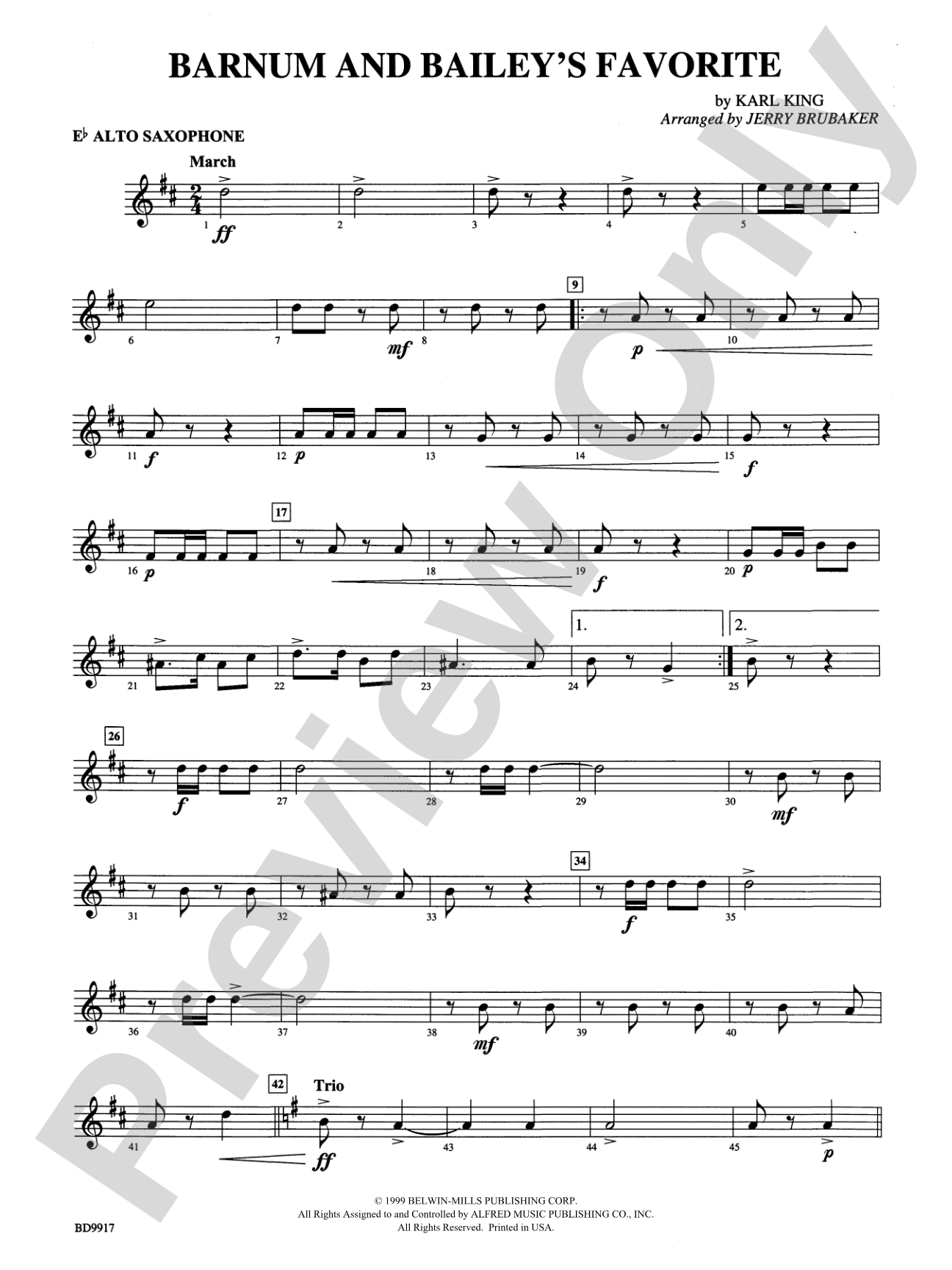

Barnum and Bailey's Favorite: E-flat Alto Saxophone
By Karl King / arr. Jerry Brubaker
Grade: 2 (Easy)
Item: 00-PC-0014662_AX1
$5.99
Pickup currently not available
Description
The kid in each of us loves the circus. Probably the finest musical work ever written to celebrate the "Greatest Show on Earth" is Karl King's classic march. Jerry Brubaker has carefully extracted the technical difficulties while keeping the most recognizable integrity of the work. Your audience will immediately recognize each of the beloved melodies. The spirit of the scoring is superlative! (1:56)


Don't just read it, hear it, play along with it, and watch your students grow with it. In MakeMusic Cloud, Barnum and Bailey's Favorite: E-flat Alto Saxophone comes alive with professional accompaniment, adjustable tempo, and built-in practice tools that turn solo practice into real progress.
Open in the Player
Jump straight in and assign it today.
Start Your Free Trial
Open this title and explore the full library in minutes.
Sample Audio
1
Audio File
--:--
0:00
0:00
Sample Video
Additional Details
Series:
Belwin Young Band
Publisher:
Alfred Music
Page Count:
218
SKU:
00-PC-0014662_AX1
More about this title
About the Composer: Karl King
Karl King (1891-1971) composed over 300 marches during his lifetime, establishing himself as one of the most prolific and celebrated march composers in American history. His works became staples of concert bands and military ensembles, and he served as director of the Ringling Bros. and Barnum & Bailey Circus Band for many years, where his deep understanding of popular appeal and orchestration flourished. King's marches combine memorable melodies with sophisticated harmonic language, making them accessible to developing ensembles while remaining musically substantial.
Why we love this
Jerry Brubaker's arrangement strips away unnecessary technical obstacles without sacrificing the character that makes this march so instantly recognizable. Grade 2 bands get to experience a genuine, audience-pleasing classic instead of a watered-down approximation, and the familiar melodies give students the confidence that comes from playing something they and their listeners actually know. This is the kind of piece that reminds young musicians why they love band in the first place.
What to expect
The energy of this march captures the spectacle and wonder of the circus itself, with spirited melodies that tumble over one another like acrobats. The familiar themes create an almost nostalgic pleasure, inviting the audience to experience the joy and color that King associated with Barnum and Bailey's greatest acts.
Who it's for
This arrangement is designed for concert bands at the Grade 2 level who want to program repertoire that connects immediately with audiences while building solid musicianship. Young musicians benefit from learning this march because it presents achievable technical challenges within the framework of a work that is genuinely rewarding to perform and hear.
How to get the most out of it
- Conduct with clear, energetic gestures that match the march's forward momentum; let the ensemble feel the parade-like confidence in your preparation.
- Balance the melody sections between upper woodwinds and brass so that each theme emerges distinctly without one section overwhelming the texture.
- Maintain steady articulation in the accompanying parts to give the piece its characteristic rhythmic drive, especially in the lower voices.
- Allow the familiar circus themes to breathe naturally rather than pushing for excessive tempo; audiences will recognize the melodies more readily when the line is clear and unhurried.
How to use it
Open a concert with this march to set an upbeat, accessible tone that engages your audience from the first note. It pairs well on mixed programs where you want to balance more serious concert repertoire with something joyful and immediately engaging, and it works especially well for pops concerts, community band performances, or spring concerts where celebratory energy suits the occasion.
Skills your students will build
- March form and phrasing structure
- Maintaining steady tempo and rhythmic precision in accompaniment figures
- Balancing independent melodic lines in the woodwind and brass sections
- Ensemble blend and intonation within a four-part harmonic texture
- Articulation control that supports clarity without stiffness