
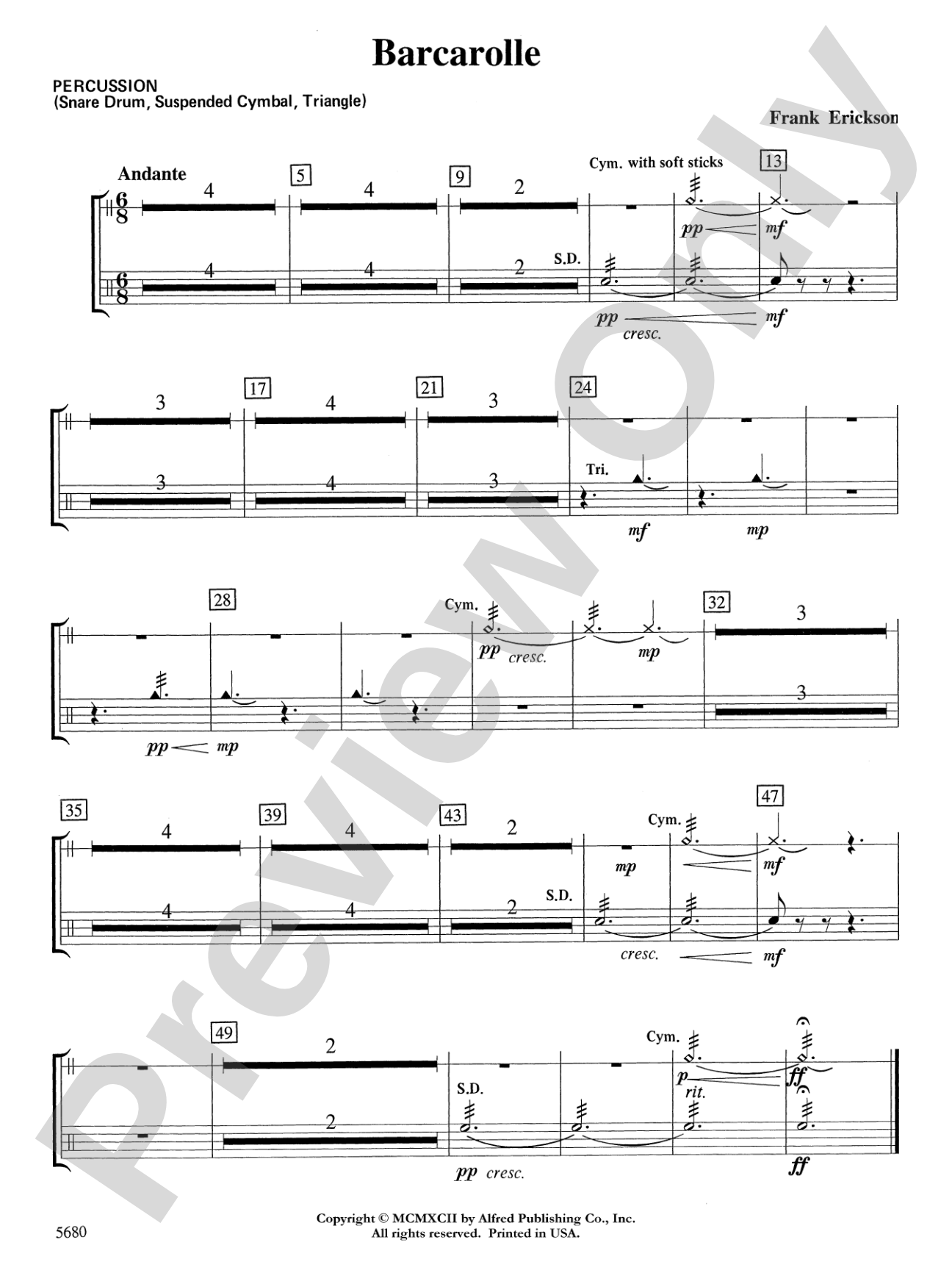

Barcarolle: 1st Percussion
By Frank Erickson
Grade: 3 (Medium)
Item: 00-PC-0001910_PC1
$3.00
Pickup currently not available
Description
The barcarolle was originally a boat song that was sung by Venitian gondoliers, characterized by the alternation of strong and light beats in 6/8 time. The highly expressive melody is first played by trumpets and is then interwoven with flutes, clarinets and other sections of the band. A timeless contribution to your concert band music library. Commissioned by the Hamilton, Ontario Massed Band Festival, 1992. (Grade 3---Medium)


Don't just read it, hear it, play along with it, and watch your students grow with it. In MakeMusic Cloud, Barcarolle: 1st Percussion comes alive with professional accompaniment, adjustable tempo, and built-in practice tools that turn solo practice into real progress.
Open in the Player
Jump straight in and assign it today.
Start Your Free Trial
Open this title and explore the full library in minutes.
Sample Audio
1
Audio File
--:--
0:00
0:00
Sample Video
No sample videos found.
Additional Details
Series:
Alfred Concert Band
Publisher:
Alfred Music
Page Count:
1
SKU:
00-PC-0001910_PC1
More about this title
About the Composer: Frank Erickson
Frank Erickson (1923-1996) was a prolific composer and arranger whose works became central to American concert band and wind ensemble repertoire. A graduate of the University of Minnesota, he composed over 150 works for band, orchestra, and choir, many of which remain standard choices for educational ensembles across the country. His gift for writing idiomatic, engaging music that remains musically substantial at accessible levels made him a favorite of directors navigating the middle grades.
Erickson understood the pedagogical arc of ensemble playing. His compositions typically balance melodic appeal with technical clarity, allowing students to focus on musicianship without being overwhelmed by technical demands. Works like Barcarolle demonstrate his ability to translate traditional musical forms into compelling band arrangements that hold both student and audience attention.
Why we love this
This arrangement transforms a traditional Venetian idiom into a showcase for expressive sectional writing that keeps all band voices engaged without requiring advanced technique. The alternating emphasis between trumpets and the woodwind choir gives your band a natural dramatic arc while building confidence in players learning to balance melody and accompaniment. It's substantial enough to program seriously without overshadowing younger ensembles on a festival rotation.
What to expect
Barcarolle evokes the gentle rocking of a gondola on still water, its 6/8 lilt creating an unhurried sense of motion. The melody possesses quiet dignity and warmth, passing from brass to woodwind like light moving across rippled water. Despite its brevity and accessibility, the piece conveys genuine expressivity and sophistication.
Who it's for
Grade 3 concert bands with solid intonation, consistent fundamental technique, and enough sectional confidence to manage texture changes without losing musical shape. Ensembles preparing for festival performance will find this compact piece rewarding, and directors seeking material that demonstrates expressive musicianship at modest technical demands will appreciate its efficiency.
How to get the most out of it
- Shape the 6/8 meter's inherent swing by letting beats 1 and 4 anchor the phrase, allowing beats 2, 3, 5, and 6 to move with rhythmic grace rather than mechanical precision.
- When trumpet melody passes to flutes and clarinets, ensure woodwind players match the expressive quality the brass established; this is not a restatement but a continuation of the same musical thought.
- Balance the accompaniment figures so they support without obscuring the melodic line; the characteristic gondolier rhythm should float beneath the tune rather than compete with it.
- Use the recorded accompaniment to establish the piece's lyrical pace, then gradually move to ensemble independence as tuning and phrasing solidify across sections.
How to use it
Program this as a set opener or closing piece on a festival concert where atmosphere and musical storytelling matter as much as technical display. Its single-page length and Grade 3 classification make it ideal for padding a concert alongside larger works without disrupting the program's pacing, and its commissioned origin for a massed band festival signals its durability in group performance contexts.
Skills your students will build
- Maintaining consistent pulse and swing feel in 6/8 meter
- Balancing melody and accompaniment across sections
- Responding to expressive direction changes while preserving rhythmic coherence
- Performing with legit musical character and interpretive awareness at modest technical levels