
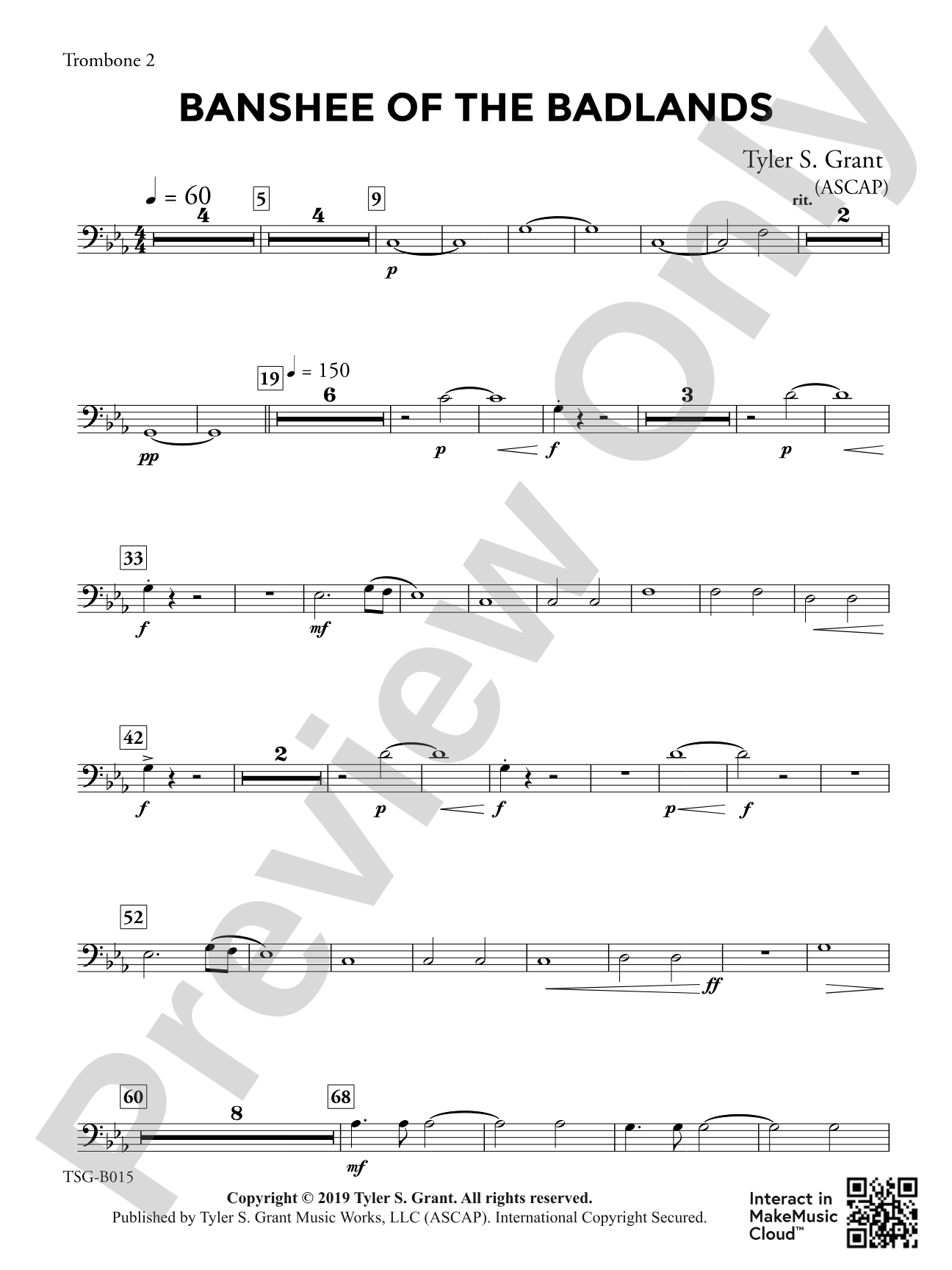

Banshee of the Badlands: 2nd Trombone
By Tyler S. Grant
Grade: 2
Item: 98-PC-TGB015_TN2
$4.50
Pickup currently not available
Description
Commissioned by the South Dakota All-State Band, Banshee of the Badlands by Tyler S. Grant depicts the grandeur and mystique of Badlands National Park. Ethereal textures juxtaposed with quick-paced sections take the performers and listeners through a journey into the Badlands in search of paranormal activity. Highly programmatic! (4:00)


Banshee of the Badlands: 2nd Trombone isn't in MakeMusic Cloud just yet...but it could be. Let us know you'd like to see it, and you'll help shape what comes next. In the meantime, start a free trial and dive into thousands of interactive titles your students can play along with today.
Request This Title
Tell us you want it.
Start Your Free Trial
Explore everything that's ready to play right now.
Sample Audio
1
Audio File
--:--
0:00
0:00
Sample Video
Additional Details
Series:
Tyler S. Grant Music Works
Publisher:
Tyler S. Grant Music Works, LLC.
SKU:
98-PC-TGB015_TN2
More about this title
About the Composer: Tyler S. Grant

Tyler S. Grant has built a reputation as a composer and arranger whose works regularly appear on all-state and honor ensemble rosters across the country. His compositions have won recognition including the Dallas Wind Symphony's 2014 "Call for Fanfares" Competition, and his music continues to be selected for prestigious venue performances ranging from Carnegie Hall to The Midwest Clinic. Since 2010, he has maintained a steady output of commissions and new publications for bands and orchestras.
Beyond the composer's chair, Grant actively conducts and clinics with school ensembles, having worked with over 100 programs across 15 states. He earned his bachelor's degree in instrumental music education from the University of Alabama, where he studied conducting with Randall Coleman, and has contributed to Alfred Music's Sound Innovations series. His diverse roles as conductor, clinician, and educator inform the accessibility and pedagogical soundness of his writing.
Why we love this
Banshee of the Badlands captures the cinematic scope of a specific landscape while remaining fully accessible at Grade 2. Grant's orchestration balances ethereal, atmospheric passages with driving rhythmic sections that keep students engaged through a four-minute arc without technical overreach. This is the kind of programmatic writing that holds audience attention and rewards careful rehearsal with genuine musical payoff.
What to expect
Banshee of the Badlands sweeps listeners through a landscape of red rock formations and sweeping vistas, alternating between moments of eerie calm and urgent forward motion. The music evokes both the natural beauty and the mysterious allure of the Badlands, creating an immersive experience that lingers long after the final note.
Who it's for
Grade 2 concert bands seeking a festival or contest piece with genuine programmatic depth and audience appeal. Students benefit from music that tells a clear story while reinforcing fundamental ensemble skills like balance, intonation, and stylistic contrast.
How to get the most out of it
- Shape the ethereal textures by conducting with clarity in the softer passages; students will respond with better intonation and blend when they can feel your gestural precision even at delicate dynamic levels.
- Establish a steady pulse in the quick-paced sections early in rehearsal so the transitions between moods feel intentional rather than abrupt.
- Encourage students to visualize the Badlands landscape during the programmatic journey; this shared mental image often produces more cohesive phrasing and interpretation than technical instruction alone.
How to use it
Program this as a concert or festival centerpiece that showcases your band's range of interpretive skills. The programmatic content and Grade 2 accessibility make it ideal for mid-season festival performance or as the memorable finale of a winter or spring concert where you want the audience to leave thinking about what they've heard.
Skills your students will build
- Contrast between ensemble textures (ethereal versus energetic writing)
- Dynamic control and sensitive intonation in soft passages
- Rhythmic precision in fast-paced sections with multiple meter divisions
- Expressive interpretation of program music
- Sectional independence within a cohesive ensemble sound