Banaha Sheet Music Preview

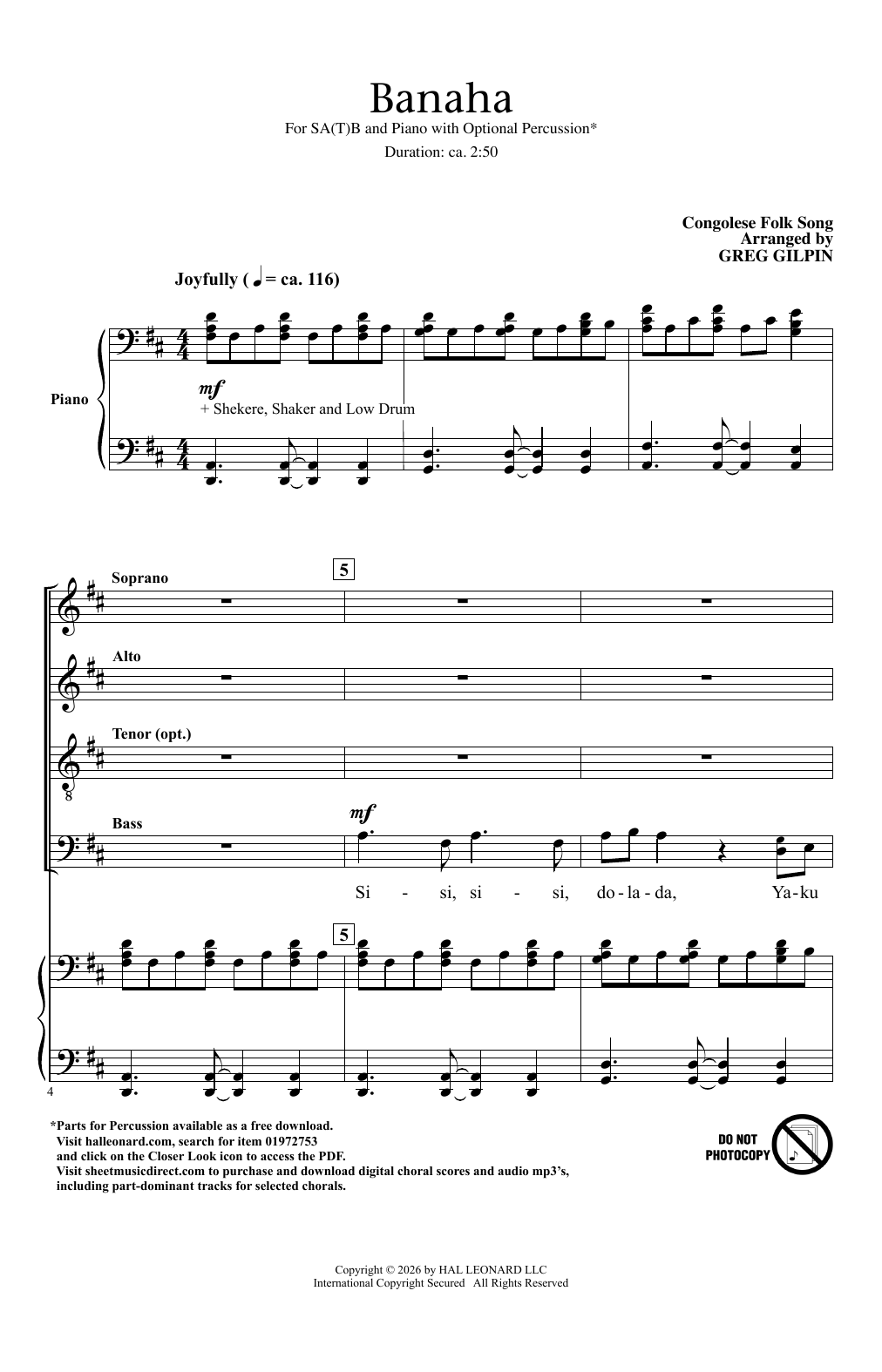
Banaha: SA(T)B Choral Octavo

As performed by Congolese Folk Song / Arranged by Greg Gilpin

Item: 35-DS01803325

Digital Download
$2.75
Description

Banaha: SA(T)B Choral Octavo isn't in MakeMusic Cloud just yet...but it could be. Let us know you'd like to see it, and you'll help shape what comes next. In the meantime, start a free trial and dive into thousands of interactive titles your students can play along with today.

Sample Audio
No sample audio found.
Sample Video
Additional Details
Publisher: Hal Leonard
Page Count: 15
SKU: 35-DS01803325

More about this title

About the Artist: Congolese Folk Song

Congolese folk music emerges from a rich oral tradition spanning multiple ethnic groups across the Democratic Republic of Congo and the broader Central African region. These songs carry the rhythmic complexity, call-and-response structures, and communal storytelling that define Central African musical practice, often rooted in work songs, celebrations, and ceremonial contexts that have been passed down through generations.

Why we love this

Greg Gilpin's arrangement opens the door to African musical traditions without requiring specialized instrumentation or extensive cultural background knowledge from your singers. The SA(T)B voicing and 15-page score make this accessible for mixed choirs at the high school and early college level, while the folk melody's inherent catchiness keeps singers engaged and audiences delighted.

What to expect

Banaha carries the warmth and communal spirit of a song born in celebration and work. The arrangement balances rhythmic vitality with harmonic richness, inviting singers to feel the pulse of Central African musical tradition while staying grounded in their own choral technique.

Who it's for

High school mixed choirs and college community choirs seeking to expand their cultural and stylistic range beyond European concert traditions. Directors looking for an accessible entry point into African folk music will find the SA(T)B voicing manageable for intermediate singers while still offering musical substance.

How to get the most out of it

  • Pay close attention to the rhythmic interlocking patterns Gilpin notates; they may feel syncopated compared to standard choral repertoire, so isolate these sections in rehearsal and count carefully.
  • The call-and-response structure benefits from clear character and energy in both the solo sections and full ensemble passages. Don't let the full choir sections become static.
  • Consider the placement of altos and tenors in the SA(T)B voicing. Gilpin likely uses the tenor line strategically, so balance these voices distinctly rather than treating them as secondary harmony.
  • Recorded accompaniment (if available with your license) can anchor the harmonic framework, but rehearse without it periodically so singers internalize the pulse independently.

How to use it

Feature this as part of a world music concert or a program celebrating global folk traditions. Its modest length and engaging character also make it valuable as a concert opener or encore that shifts the tone and reminds audiences that choral music lives far beyond the classical canon.

Skills your students will build

  • Reading and performing call-and-response structures
  • Understanding rhythmic patterns from non-Western musical traditions
  • Balancing independent vocal lines in SA(T)B texture
  • Singing with cultural awareness and appropriate stylistic energy

You May Also Like