
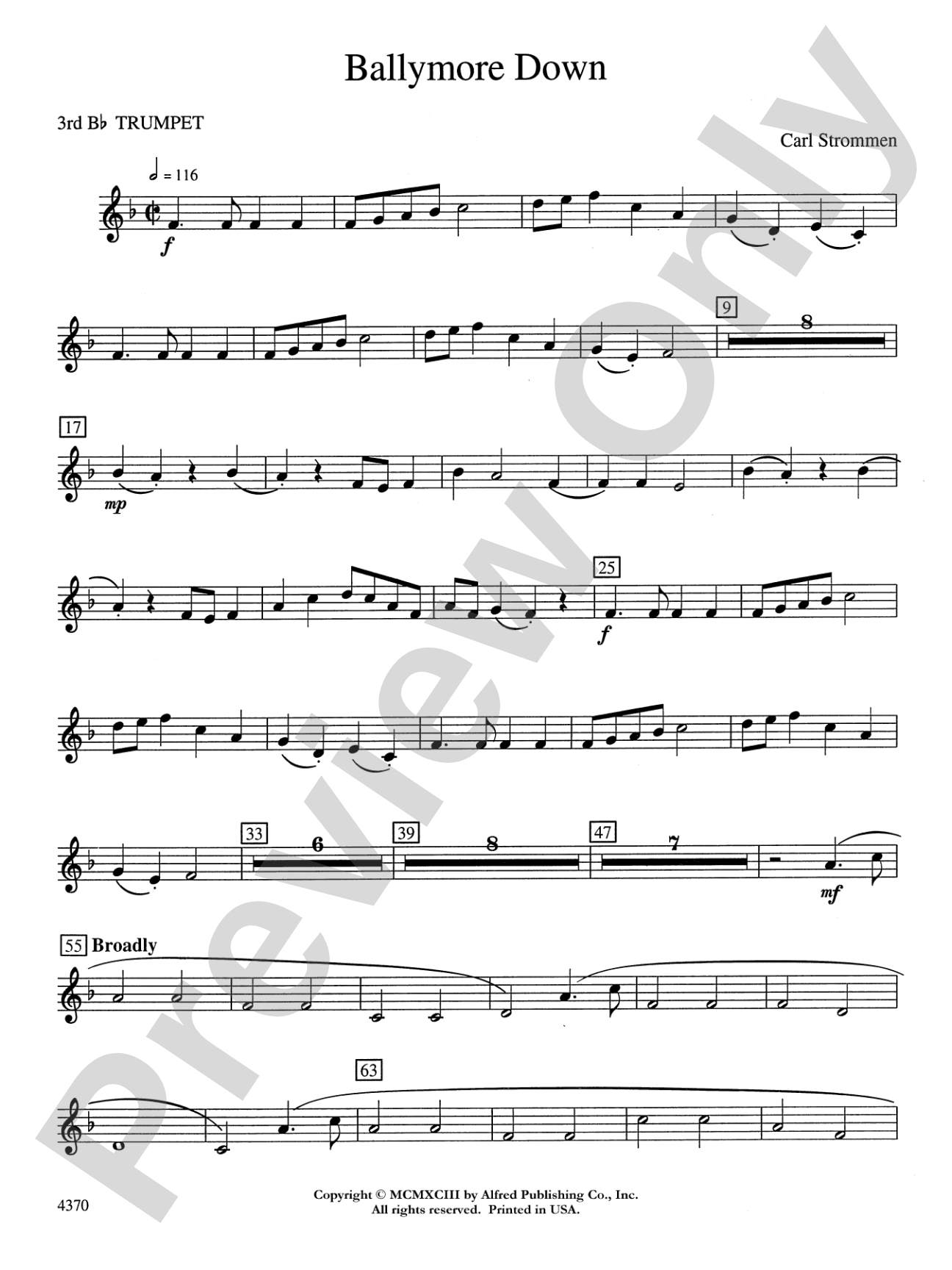

Ballymore Down: 3rd B-flat Trumpet
By Carl Strommen
Grade: 3 (Medium)
Item: 00-PC-0001863_T3
$5.99
Pickup currently not available
Description
This dramatic original composition features a light dance-like opening, broad sustained harmonies in the middle and a lively 6/8 ending. Reminiscent of Gustav Holst's vivid compositional style, three contrasting sections provide a great opportunity for students to explore differing styles within the same work. All notes are in a comfortable range for the developing band, making it possible to focus on the challenges provided by the stylistic and rhythmic changes.


Don't just read it, hear it, play along with it, and watch your students grow with it. In MakeMusic Cloud, Ballymore Down: 3rd B-flat Trumpet comes alive with professional accompaniment, adjustable tempo, and built-in practice tools that turn solo practice into real progress.
Open in the Player
Jump straight in and assign it today.
Start Your Free Trial
Open this title and explore the full library in minutes.
Sample Audio
1
Audio File
--:--
0:00
0:00
Sample Video
No sample videos found.
Additional Details
Series:
Growing Band Series
Publisher:
Alfred Music
Page Count:
2
SKU:
00-PC-0001863_T3
More about this title
About the Composer: Carl Strommen

Carl Strommen stands among the most recorded composer/arrangers working across concert band, orchestra, jazz ensemble, and vocal literature. His music appears regularly on concert programs, in broadcast media, and on film soundtracks, while his consistent output has earned him the annual ASCAP Standard Writers Award throughout his career.
Strommen holds a degree from City College of New York and maintains his connection to music education as an adjunct professor of orchestration and composition at C.W. Post Campus of Long Island University in Brookville, New York. He remains active as a clinician and commission writer, and divides his time between Long Island and Colorado.
Why we love this
Strommen crafts three genuinely distinct musical narratives within a single work, giving your students real experience managing tonal and rhythmic contrasts rather than variations on a single theme. The opening dance rhythm, sustained middle section, and brisk 6/8 finale create natural rehearsal segments, each with its own interpretive demands. At Grade 3, the comfortable ranges let your ensemble focus energy on style transitions and ensemble balance rather than scrambling for the notes.
What to expect
The opening dances with light energy and forward motion, then yields to rich, sustained harmonies that settle the ensemble into genuine lyricism. The finale arrives with celebratory vigor in compound meter, sending the piece home with buoyant momentum. The arc feels neither arbitrary nor forced, but rather like a natural emotional journey through contrasting moods.
Who it's for
This work suits developing concert bands working toward contest or festival performance. Directors programming Grade 3 concerts will find it accessible enough for reliable execution while musically substantial enough to hold an audience. Students encounter genuine compositional variety without technical overload.
How to get the most out of it
- Establish a crisp, bouncy articulation in the dance-like opening section to bring out the rhythmic playfulness and set clear character before the mood shifts.
- Shape the sustained harmonies with careful attention to dynamic contours; avoid letting the middle section flatten into static chords by planning your crescendos and releases phrase by phrase.
- Lock the ensemble on the metric shift into 6/8 by having the rhythm section (particularly timpani and bass parts) clearly define the new pulse before tutti entrances.
- Use the contrasting sections as opportunities to reinforce ensemble balance; students often neglect inner voices during lyrical passages, so voice the middle section to highlight secondary melodic lines.
How to use it
Program this as a mid-concert centerpiece to showcase your ensemble's stylistic range and control. The dramatic arc works well between a straightforward march and a reflective chorale, or pair it with contemporary works that similarly emphasize rhythmic character and harmonic color. It also makes an excellent festival choice, where adjudicators can hear how your band navigates compositional sophistication at an accessible difficulty level.
Skills your students will build
- Managing stylistic transitions and maintaining clear character across contrasting sections
- Reading and executing rhythmic patterns in both simple and compound meters (2/4 and 6/8)
- Balancing inner voices and harmonic texture during sustained, lyrical passages
- Coordinating ensemble pulse across metric changes
- Articulation and phrasing appropriate to dance-like material versus legato melodic writing