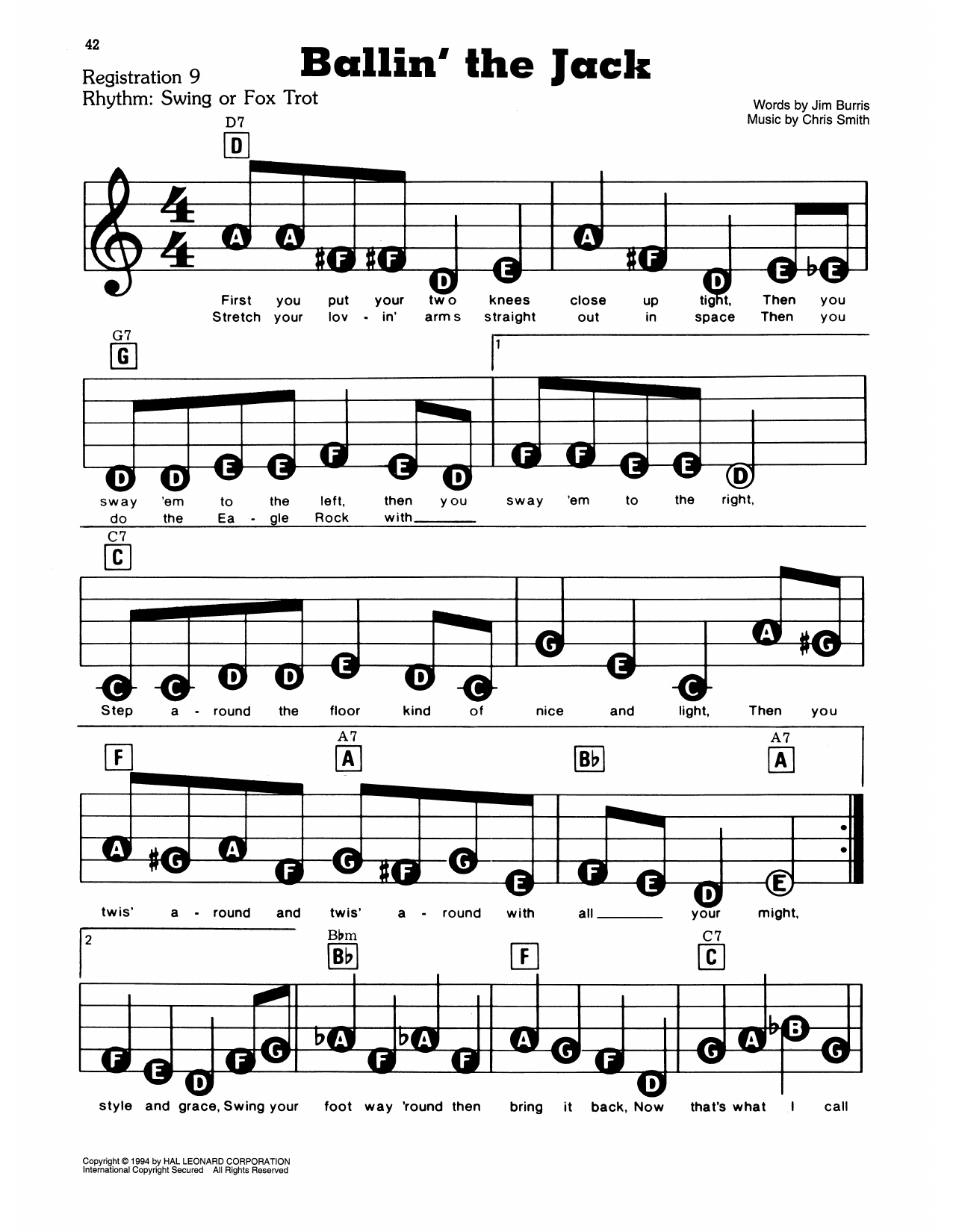
Ballin' The Jack Sheet Music Preview

Ballin' The Jack: E-Z Play Today

Item: 35-DS01303045

Digital Download
$4.99
Description

Ballin' The Jack: E-Z Play Today isn't in MakeMusic Cloud just yet...but it could be. Let us know you'd like to see it, and you'll help shape what comes next. In the meantime, start a free trial and dive into thousands of interactive titles your students can play along with today.

Sample Audio
No sample audio found.
Sample Video
Additional Details
Publisher: Hal Leonard
Page Count: 2
SKU: 35-DS01303045

More about this title

About the Creator

Ballin' the Jack emerged from the early twentieth century jazz and popular music scene, capturing the energy of a generation discovering syncopated rhythms and hot dance styles. The tune became a standard in both jazz and popular repertoire, recorded and reinterpreted by countless artists across decades. Its enduring presence in the Great American Songbook speaks to the infectious quality of its melody and the irresistible drive of its rhythm.

Why we love this

This E-Z Play arrangement strips away complexity without sacrificing character, making it accessible for pianists building repertoire in early jazz idioms. The two-page format respects realistic practice sessions, and the simplified voicings let students focus on capturing the swagger and bounce that define the piece.

What to expect

The piece radiates 1920s exuberance; there's a lightness and cheeky humor running through the melody that invites audience smiles. Rhythmically buoyant yet never frantic, it sits comfortably in that sweet spot between novelty song and genuine jazz standard.

Who it's for

Student pianists exploring standards and early jazz styles who need an arrangement that doesn't demand advanced harmonic or technical skills. This works equally well for beginners curious about swing repertoire and intermediate players preparing for community jazz ensembles.

How to get the most out of it

  • Establish a confident swing feel from the opening; resist playing it straight or mathematically. The pocket matters more than note-for-note precision.
  • Shape the melody with subtle dynamics to suggest the original's vaudeville roots. Lean slightly into the first note of each phrase, then taper toward the ends.
  • Keep left-hand accompaniment conversational rather than metronomic. A bit of rhythmic give-and-take creates the illusion of a small ensemble rather than a solo pianist.

How to use it

Pair this with other stride piano or early jazz standards to frame a concert set around American vernacular music. It also works as a solo warm-up in rehearsals or as an intermission piece that lets audiences reset and reset their energy.

Skills your students will build

  • Reading and executing swing eighth notes
  • Balancing melody projection with rhythmic accompaniment
  • Interpreting era-appropriate articulation and phrasing
  • Building left-hand independence in jazz comping patterns

You May Also Like