
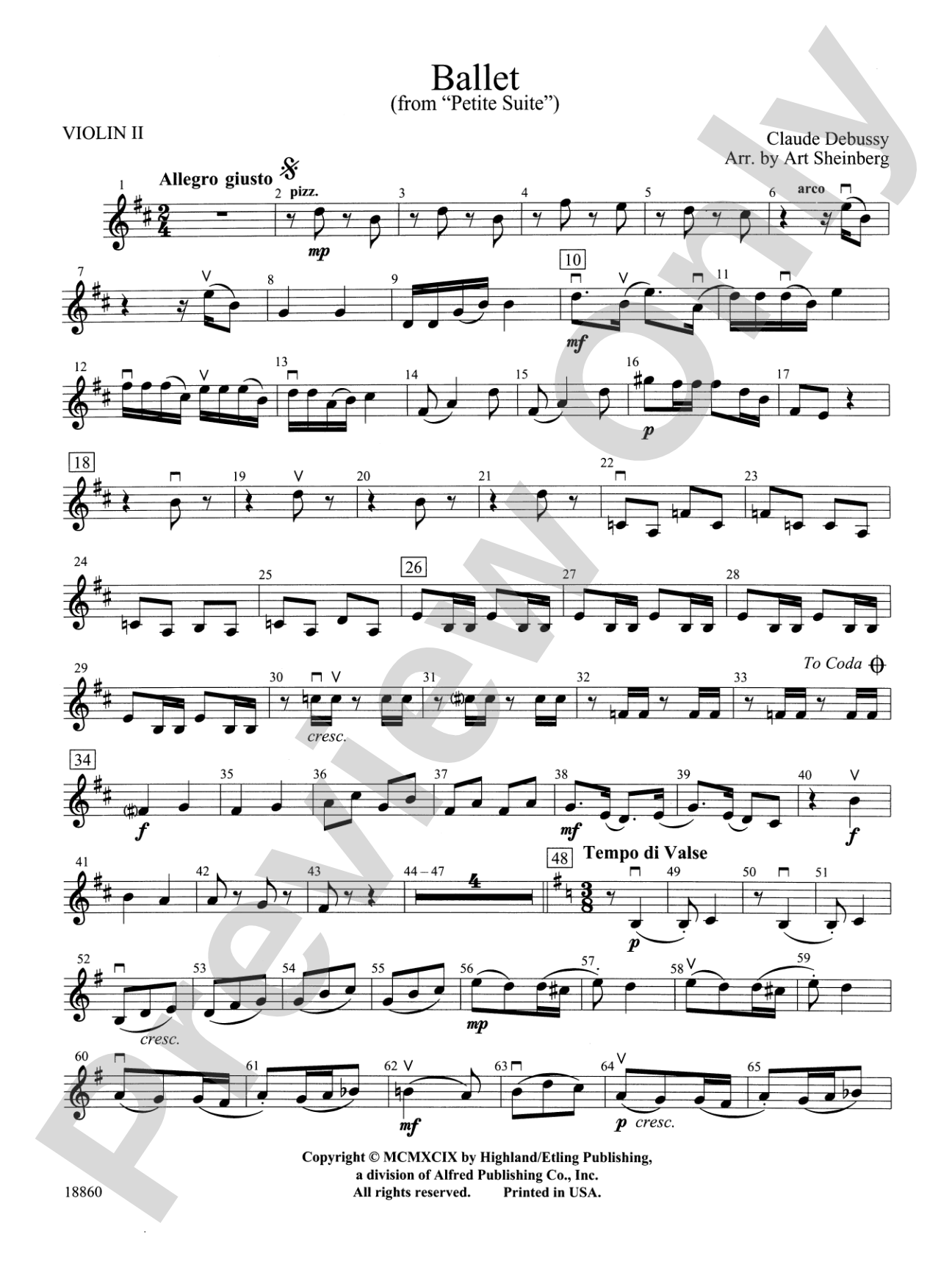

Ballet from Petite Suite: 2nd Violin
(from Petite Suite)
By Claude Debussy / arr. Art Sheinberg
Grade: 4
Item: 00-PC-0014788_VN2
$5.99
Pickup currently not available
Description
This lighthearted movement from Debussy's piano suite has been skillfully arranged for the advanced string orchestra with challenging parts for every section. The beautiful harmonies, exotic rhythms and rich colors will engage your students from the very first reading.


Don't just read it, hear it, play along with it, and watch your students grow with it. In MakeMusic Cloud, Ballet from Petite Suite: 2nd Violin comes alive with professional accompaniment, adjustable tempo, and built-in practice tools that turn solo practice into real progress.
Open in the Player
Jump straight in and assign it today.
Start Your Free Trial
Open this title and explore the full library in minutes.
Sample Audio
1
Audio File
--:--
0:00
0:00
Sample Video
No sample videos found.
Additional Details
Series:
Highland/Etling String Orchestra
Publisher:
Alfred Music
Page Count:
124
SKU:
00-PC-0014788_VN2
More about this title
About the Composer: Claude Debussy
Claude Debussy (1862-1918) fundamentally reshaped how composers approached harmony, orchestration, and form. His piano works are central to the modern repertoire, prized for their innovative use of sonority and their liberation from strict harmonic convention. For string orchestra students, his music offers a masterclass in color and texture; the impressionistic techniques that define pieces like Petite Suite teach young musicians to listen for subtle shifts in timbre and balance rather than relying on obvious dramatic gestures.
Debussy's influence on music education extends far beyond his original compositions. His piano suite Petite Suite has been arranged countless times because its charming melodies and accessible harmonic language make it ideal for introducing advanced students to impressionistic concepts. The piece rewards conductors and players who attend to nuance, dynamics, and the relationships between voices rather than surface-level execution.
Why we love this
Art Sheinberg's arrangement opens this delightful Debussy movement to an ensemble that rarely gets to perform genuine masterworks at this level. The writing respects Debussy's original voice while giving every section of your string orchestra meaningful, engaging material. At Grade 4, it strikes the rare balance of being sophisticated enough to challenge accomplished players while remaining accessible enough to bring the piece to life without excessive rehearsal.
What to expect
Sunlight filtered through water, or silk catching light in an unexpected direction. The music dances with playful energy while maintaining an underlying sophistication; it suggests both refinement and genuine joy. Impressionistic colors bloom and fade, never settling into obvious harmonic destinations.
Who it's for
Advanced high school string orchestras and college preparatory programs seeking repertoire that develops musicianship alongside technical skill. Conductors preparing students for All-State festivals or competitions will find this piece both rewarding to teach and impressive in performance.
How to get the most out of it
- Shape the phrasing around the harmonic changes rather than the bar line. Debussy's impressionistic harmony often shifts subtly within a phrase, and your ensemble will sound more refined when the bow changes and dynamic swells follow the underlying color changes.
- Commit fully to the dynamic range. The contrast between passages marked pp and those marked mf creates the shimmer and sparkle that define this arrangement. Timidity flattens the impressionistic colors.
- Balance the parts so that inner voices remain audible. Sheinberg has distributed Debussy's original harmonies across multiple instrumental lines; players need to understand whether they are carrying the primary voice, supporting the harmony, or providing textural color in any given moment.
- Approach the exotic rhythmic figures with clarity and precision. The lighthearted character depends on rhythmic accuracy; sloppy ensemble will bury the charm.
How to use it
Program this as a contrast piece in a concert featuring larger-scale works; its brevity and charm provide a necessary breath between heavier repertoire. It also fits elegantly on a festival entry where a mature arrangement of recognized material demonstrates both the quality of your ensemble and your students' interpretive depth.
Skills your students will build
- Recognizing and executing impressionistic harmonic color through balance and tone control
- Reading and executing ensemble passages where harmonic responsibility is distributed across multiple parts
- Sustaining phrasing and dynamic shape across phrase boundaries marked by harmonic rather than melodic landmarks
- Precision in rhythmic figures that create character and sparkle
- Listening for inner voices and maintaining transparency in multi-layered textures