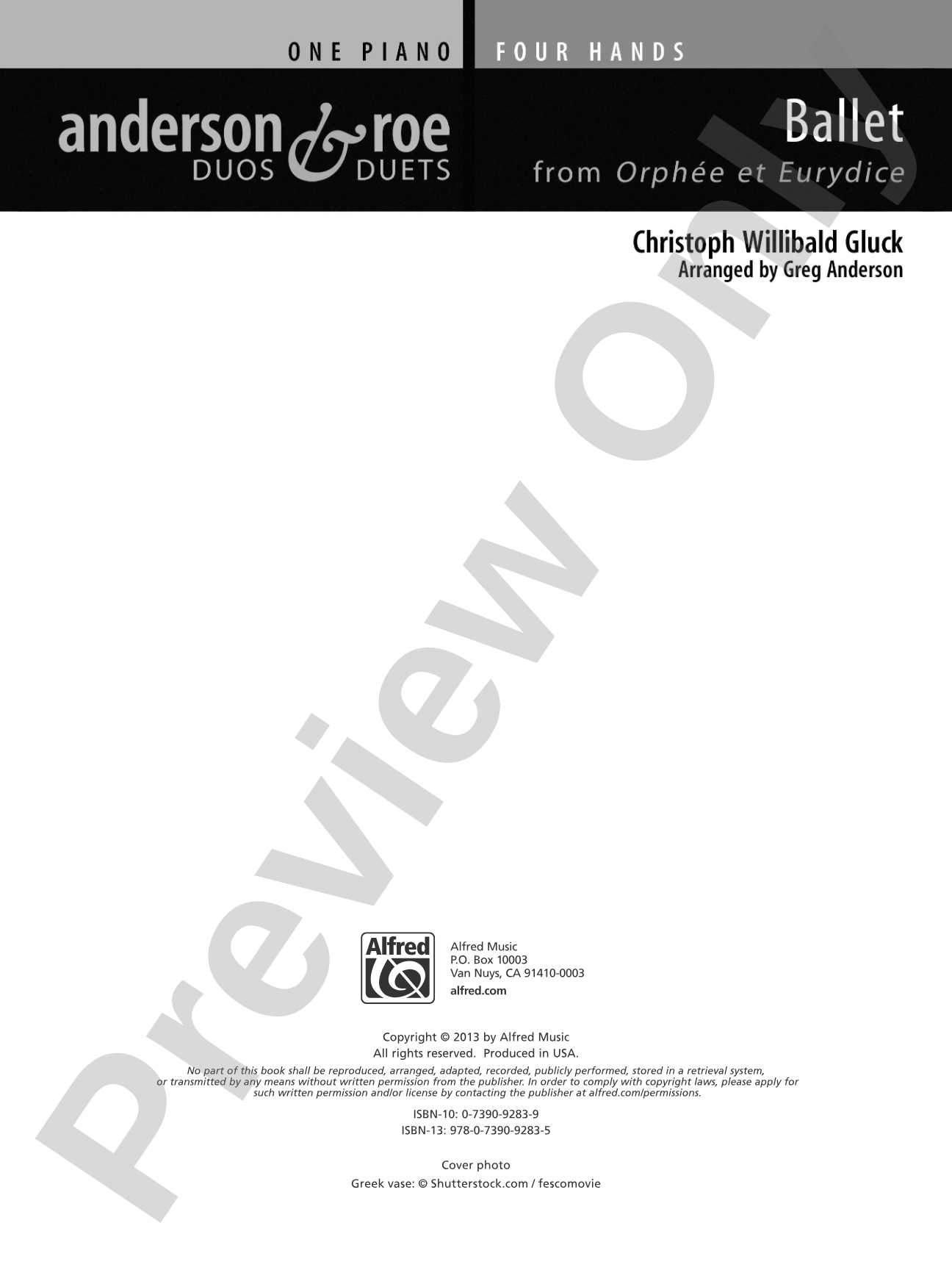
Ballet from Orphée et Eurydice - Piano Duet (1 Piano, 4 Hands): Piano Duets & Four Hands
By Christoph Willibald Gluck / arr. Greg Anderson
Level: Advanced
Item: 00-PB-0000652
Pickup currently not available
Related Items
Ballet from Orphée et Eurydice: Piano Duet (1 Piano, 4 Hands) Book |
$4.99
|
View |
Description
The Anderson & Roe Duos & Duets series features inspiring arrangements as performed by the duo---from settings of treasured opera melodies to medleys of popular movie music. The pieces are edited with fingering and other directions that facilitate rehearsal and performance, making them accessible for advancing students as well as for concert performers.
"Ballet" from Orfée et Eurydice is an enchanting masterpiece. Composed by early-Classical composer Christoph Willibald Gluck, its haunting melody reflects on the tragic Greek myth of Orpheus and his failed attempt to bring his wife Eurydice back from the dead. The slow, lyrical arrangement for one piano, four hands, requires careful balance between the primo and secondo parts, as well as delicate choreography between the players' hands. A Federation Festivals 2016-2020 selection. A Federation Festivals 2020-2024 selection.
Ballet from Orphée et Eurydice - Piano Duet (1 Piano, 4 Hands): Piano Duets & Four Hands isn't in MakeMusic Cloud just yet...but it could be. Let us know you'd like to see it, and you'll help shape what comes next. In the meantime, start a free trial and dive into thousands of interactive titles your students can play along with today.
Tell us you want it.
Explore everything that's ready to play right now.
Sample Audio
Sample Video
Additional Details
More about this title
About the Composer: Christoph Willibald Gluck
Christoph Willibrand Gluck (1714, 1787) revolutionized opera by stripping away the ornamental excess of his contemporaries and restoring dramatic clarity to the form. His reform operas, including Orfeo ed Euridice, established principles of musical expression that prioritized the text and emotional truth over vocal display. Gluck's influence extended far beyond his lifetime, shaping how composers approached the relationship between music and narrative.
For music educators, Gluck represents a pivotal moment in Western music history when composers began asking what an orchestra or keyboard could express with restraint and purpose. His melodies reward careful phrasing and reward listeners who pay attention to subtle harmonic shifts.
Why we love this
Anderson's arrangement captures the emotional restraint that makes Gluck's original so affecting, and the duet format demands the kind of collaborative listening that transforms two pianists into a single musical voice. Programming this piece signals to your audience that you're offering substance alongside virtuosity, and it gives your advanced students an opportunity to perform repertoire with genuine historical weight at the recital level.
What to expect
The piece unfolds like a walk through a garden in failing light. The melody carries echoes of the Greek myth's tragedy without indulging in sentimentality, while the harmonic language shifts subtly beneath it, suggesting loss and resignation. Playing it requires both pianists to inhabit a space of quiet introspection.
Who it's for
Advanced pianists preparing for festival competitions or recitals who want to move beyond contemporary showpieces into the classical repertoire. Duet partners seeking material that combines technical accessibility with genuine artistic substance will find the Anderson and Roe edition invaluable for its thoughtful fingerings and clear editorial guidance.
How to get the most out of it
- Balance the primo and secondo voices as if you're conducting a dialogue rather than playing separate parts. The haunting quality depends on both players hearing each other's phrasing in real time.
- Take time in rehearsal to map the hand choreography between players. Gluck's slow tempo makes cramped hand positions feel awkward; clarity in spatial planning translates directly to musical confidence.
- Shape the melody with restraint. Early-Classical taste favors suggestion over statement; let silence matter as much as the notes you play.
How to use it
Place this as a centerpiece in a recital that explores the intersection of myth and music, or pair it with other Gluck selections to showcase the composer's elegant restraint. It also works as a striking encore that leaves audiences contemplating something real rather than dazzled by technical display.
Skills your students will build
- Balancing dual melodic lines while maintaining independence between primo and secondo parts
- Shaping long phrases with minimal dynamic marking and expressive restraint
- Coordinating hand placement and traffic between two players sharing one instrument
- Interpreting early-Classical style through careful attention to articulation and phrasing over ornament