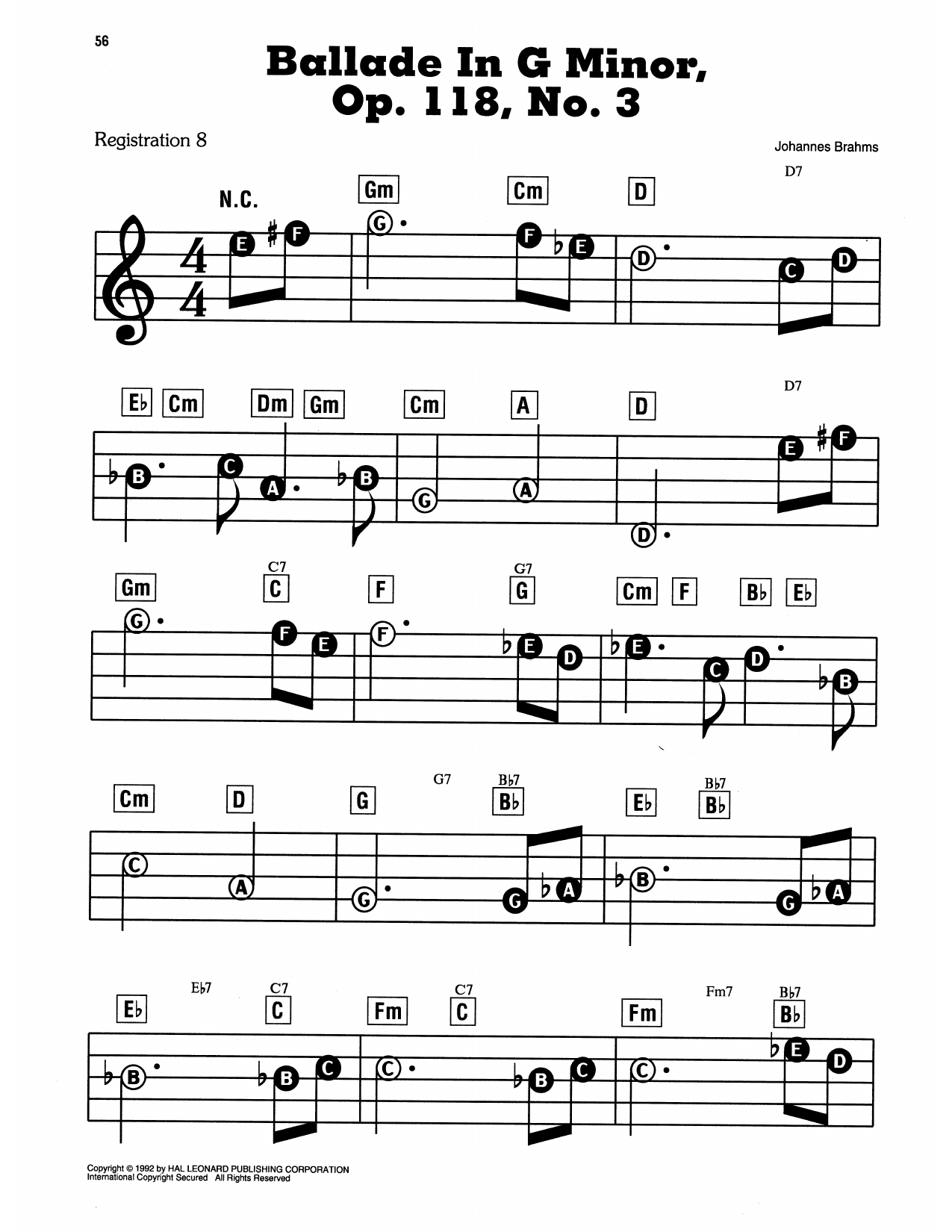
Ballade In G Minor, Op. 118, No. 3 Sheet Music Preview

Ballade In G Minor, Op. 118, No. 3: E-Z Play Today

By Johannes Brahms

Item: 35-DS01874723

Digital Download
$4.99
Description

Ballade In G Minor, Op. 118, No. 3: E-Z Play Today isn't in MakeMusic Cloud just yet...but it could be. Let us know you'd like to see it, and you'll help shape what comes next. In the meantime, start a free trial and dive into thousands of interactive titles your students can play along with today.

Sample Audio
No sample audio found.
Sample Video
Additional Details
Publisher: Hal Leonard
Page Count: 2
SKU: 35-DS01874723

More about this title

About the Composer: Johannes Brahms

Johannes Brahms (1833–1897) stands among the most significant composers of the Romantic era, bridging 19th-century classical forms with the expressive depth his contemporaries demanded. His late piano works, including the ballades, represent the culmination of a lifetime spent refining harmonic language and structural integrity; these pieces contain some of his most introspective and technically sophisticated writing for solo piano.

For music educators, Brahms remains essential repertoire. His works demand both intellectual engagement and emotional maturity from students, rewarding careful practice with music that reveals new layers through repeated study. The ballades in particular showcase how a master composer sustains tension across larger formal structures, making them invaluable models for understanding 19th-century aesthetics.

Why we love this

This simplification preserves the essential harmonic and melodic character of Brahms's original while making the piece accessible to intermediate pianists who might otherwise never experience this music. The E-Z Play format removes technical barriers without dumbing down the artistic content, allowing students to engage with authentic repertoire and build their understanding of Brahms's mature compositional voice.

What to expect

The G minor tonality carries a contemplative, searching quality that draws listeners inward. The ballade unfolds with a narrative arc of yearning and resolution, its expressiveness rooted in Brahms's gift for making intimate material feel both personal and universal.

Who it's for

Intermediate pianists ready to move beyond simplified arrangements into genuine Brahms, and students building a foundation in Romantic-era repertoire. Teachers seeking an accessible entry point to ballades and character pieces will find this format eliminates technical obstacles without compromising musical substance.

How to get the most out of it

  • Balance the left hand accompaniment so it supports rather than overwhelms the melody. Brahms wrote these voices to interact, not to create hierarchy.
  • Attend to the minor key's introspective quality by allowing rubato to emerge naturally from the phrase shapes rather than imposing it artificially.
  • Shape longer phrases by thinking in terms of breath and repose. These romantic-era structures benefit from a vocalist's approach to phrasing.

How to use it

Pair this with other simplified Romantic character pieces to create a thoughtful recital set, or use it as a stepping stone for students preparing to tackle the original version. Its modest length and manageable technical demands make it ideal for student recitals or as a complement to more contemporary works in a mixed program.

Skills your students will build

  • Reading harmonic progressions characteristic of 19th-century Romantic style
  • Sustaining longer melodic phrases across multiple systems
  • Balancing melody and accompaniment with nuanced dynamics
  • Understanding formal structure in the ballade genre

You May Also Like