Ballad for Peace: 3rd Trombone Sheet Music Preview

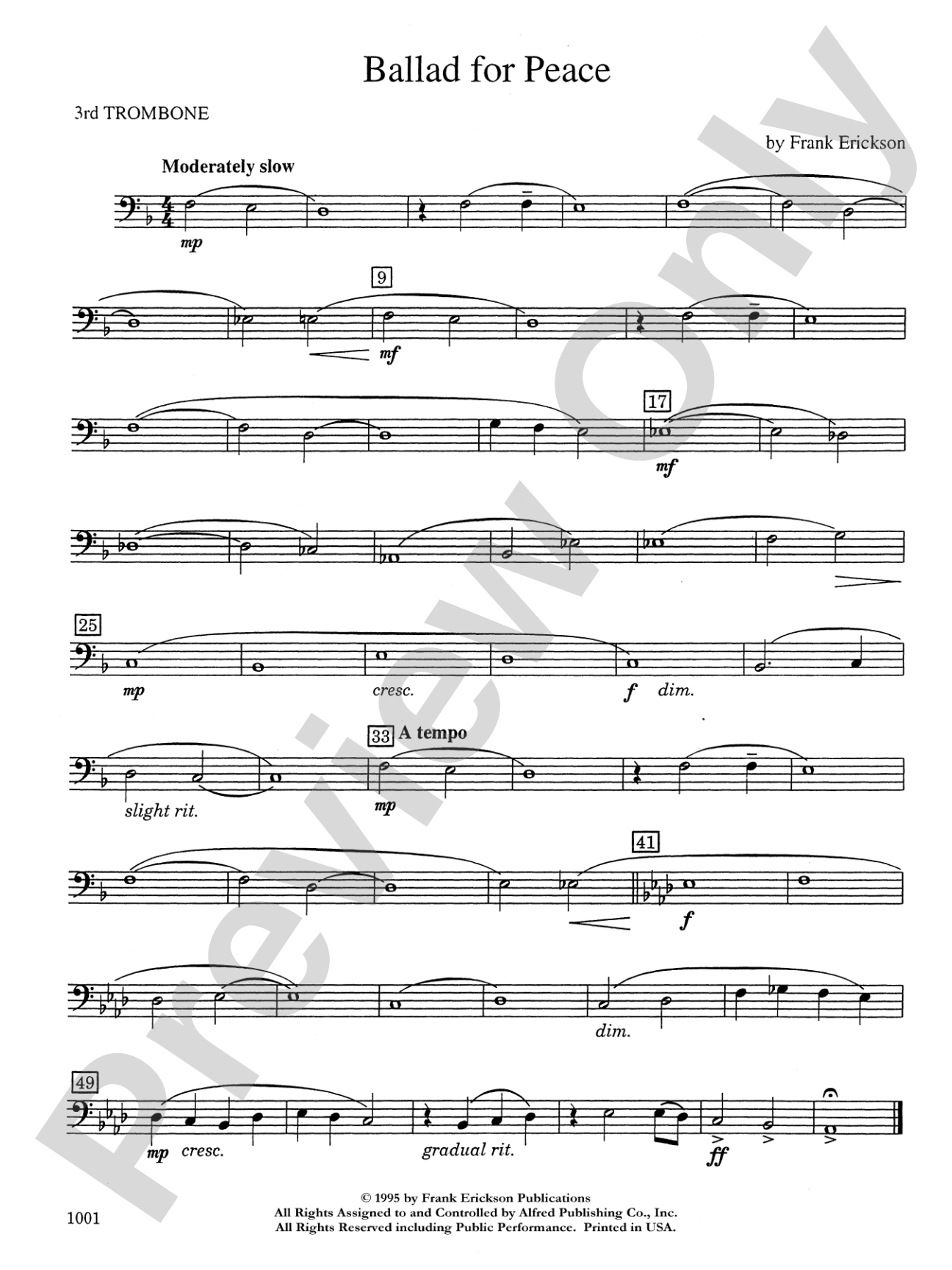
Ballad for Peace: 3rd Trombone

By Frank Erickson

Grade: 2 (Easy)

Item: 00-PC-0001627_TN3

Digital Download
$3.00
Description
The word "peace has many connotations: "a state of tranquility or quiet, freedom from war and harmony among neighbors", and more personally, "freedom from disquieting thoughts and emotions". This piece was written in an attempt to express ideas such as these. The form is similar to the composer's earlier Balladair (AABCAA) with a modulation leading to a final extended statement of the opening melody, serving as a codetta.

Don't just read it, hear it, play along with it, and watch your students grow with it. In MakeMusic Cloud, Ballad for Peace: 3rd Trombone comes alive with professional accompaniment, adjustable tempo, and built-in practice tools that turn solo practice into real progress.

Sample Audio
No sample audio found.
Sample Video
Additional Details
Series: Frank Erickson Publications
Publisher: Alfred Music
Page Count: 134
SKU: 00-PC-0001627_TN3

More about this title

About the Composer: Frank Erickson

Frank Erickson (1923-2013) was an American composer and educator whose concert band works became staples in school programs across the country. His gift for melody and accessible orchestration made him a trusted voice for directors seeking music that engaged young musicians without sacrificing artistic substance.

Why we love this

Erickson's formal clarity and gift for long-lined melody make this a natural teaching piece for bands ready to sustain musical phrases with shape and intention. The modulation and extended restatement ask something meaningful of the ensemble without overwhelming Grade 2 capabilities, and the thematic material is memorable enough that students leave the rehearsal humming.

What to expect

The music opens with quiet contemplation, a gentle melody that suggests both calm and inward reflection. As the piece unfolds through its familiar AABCAA form, it builds gradually toward a moment of deeper conviction, then returns home with new understanding, leaving the ensemble and audience in a place of genuine musical satisfaction.

Who it's for

This score and parts set is for middle school and developing high school bands seeking repertoire that balances accessibility with musical integrity. Directors will find a piece that teaches ensemble balance and phrase shaping while remaining engaging for young players.

How to get the most out of it

  • Shape the opening melody as a singing line, not a recitation. Even at Grade 2, students can learn to breathe the phrase and release notes with intention rather than mechanical precision.
  • Balance the inner voices during the middle section (B and C material). This is an opportunity to ensure all parts feel equally important, not just melody and bass.
  • Use the modulation as a dramatic moment. A slight ritardando into the key change helps the ensemble feel the harmonic shift and prepares them for the climactic restatement of the opening theme.
  • Let the codetta breathe at the end. Resist the urge to rush; the final statement of the melody deserves the same care and weight as the opening.

How to use it

Program this as a contrasting centerpiece in a concert of mixed tempos and moods, or pair it with a more energetic work to create dynamic variety. Its moderate length and accessible idiom make it suitable for early-season programming when you're still building ensemble cohesion.

Skills your students will build

  • Sustaining long melodic lines with consistent tone and phrasing
  • Reading and balancing AABCAA form across an ensemble
  • Responding to harmonic modulation and tracking key changes
  • Ensemble balance in sections with active inner voice writing
  • Interpreting composer's intentions through tempo and dynamic contrast

You May Also Like