
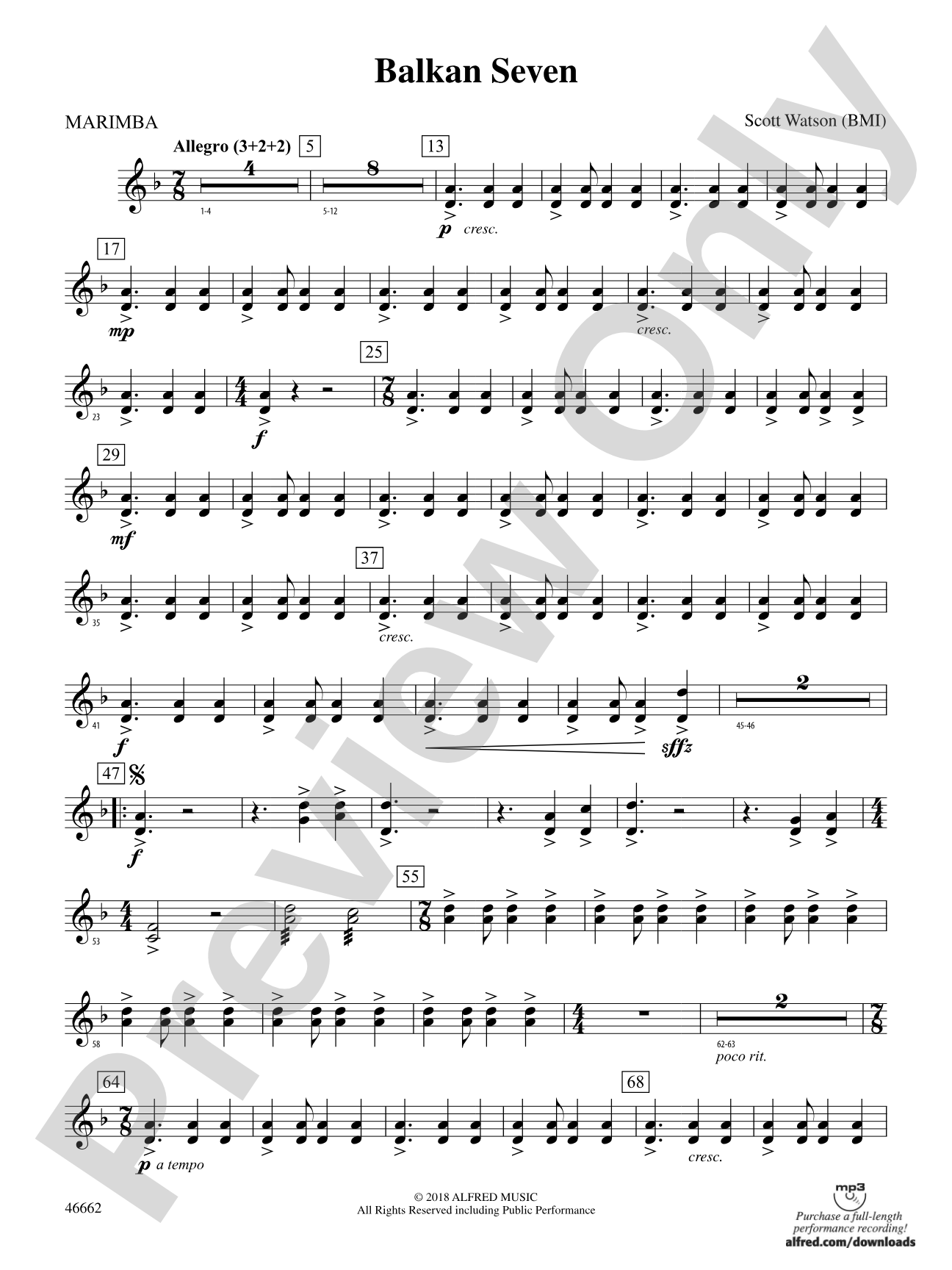

Balkan Seven: Mallets
By Scott Watson
Grade: 3 (Medium)
Item: 00-PC-0018092_M1
$3.00
Pickup currently not available
Description
"Balkan Seven" gets its inspiration from the lively dances of the Balkan region of Southeastern Europe encompassing Greece, Bulgaria, Macedonia, Serbia, and Croatia. 7/8 is the most popular uneven dance rhythm in all of Balkan music, especially in Macedonia, where a line dance with a 3+2+2 subdivision is prevalent.


Don't just read it, hear it, play along with it, and watch your students grow with it. In MakeMusic Cloud, Balkan Seven: Mallets comes alive with professional accompaniment, adjustable tempo, and built-in practice tools that turn solo practice into real progress.
Open in the Player
Jump straight in and assign it today.
Start Your Free Trial
Open this title and explore the full library in minutes.
Sample Audio
1
Audio File
--:--
0:00
0:00
Sample Video
Additional Details
Series:
Young Symphonic
Publisher:
Alfred Music
Page Count:
280
SKU:
00-PC-0018092_M1
More about this title
About the Composer: Scott Watson

Scott Watson brings three decades of classroom experience to his work as a composer and educator. After leading instrumental programs in the Parkland School District (Allentown, PA), he moved into higher education as Associate Professor of Music at Cairn University, where he continues to shape music pedagogy and composition. His catalog of over 120 published works spans concert band, string orchestra, and chamber ensembles across all difficulty levels, drawing equally from contemporary concert music and the practical demands of the rehearsal room.
Watson's compositions have reached audiences at major venues including the Academy of Music in Philadelphia, the Midwest Clinic in Chicago, and the White House. As an exclusive composer and clinician for Alfred Publications, he contributes to their Sound Innovations series and regularly leads workshops and guest conducting residencies for honor bands and festivals. He is also the author of Using Technology to Unlock Musical Creativity (Oxford University Press, 2011), reflecting his commitment to helping educators integrate contemporary tools with musical learning.
Why we love this
Watson has crafted a Grade 3 piece that takes a genuine musical structure (7/8 meter and Balkan rhythmic conventions) and makes it accessible without oversimplifying it. Directors get a concert piece that sounds sophisticated and cultural, not a diluted educational exercise. The 3+2+2 subdivision model common in Macedonian dance traditions gives students a real rhythmic puzzle to solve, building their understanding of asymmetrical meters through authentic music rather than abstract drills.
What to expect
Bright, propulsive, and genuinely alive. The 7/8 meter creates a forward momentum that never quite settles, mirroring the stepping patterns of Balkan line dances where the rhythm is both intricate and inevitable. Underneath runs the warmth of regional folk melody and harmony, giving the piece an earthy confidence even as its meter keeps listeners slightly off balance.
Who it's for
Band directors teaching Grade 3 ensembles who want to introduce uneven meters through culturally grounded music rather than abstract rhythm studies. It works equally well for groups preparing for fall concert programming or festival competition; the piece has both musical substance and the novelty factor that keeps audiences engaged.
How to get the most out of it
- Let the 3+2+2 subdivision sit with the ensemble for a full rehearsal before adding tempo. Understanding the internal pulse of the 7/8 measure prevents the piece from sounding rushed or unstable.
- Emphasize the line dance character by keeping the texture lean in early sections. The piece draws from traditional folk movement; too much orchestral weight dulls its kinetic energy.
- Highlight the regional instrumentation balance that Watson built into the score. Balkan folk traditions favor wind and percussion colors; let those voices lead rather than pushing a full harmonic accompaniment.
- Build tempo gradually across the rehearsal sequence. This piece rewards students who understand why the rhythm needs breathing room before it can truly dance.
How to use it
Open a concert with this piece to signal that your program celebrates music beyond the Western European canon. Its moderate length and Grade 3 demands make it ideal for mixed-difficulty concert bands that include newer students alongside veterans. It also sits perfectly in a festival or contest set where you want an audience-friendly opener with enough musical integrity to impress adjudicators.
Skills your students will build
- Reading and performing 7/8 meter and subdividing uneven rhythms (3+2+2 pattern)
- Recognizing folk music idioms and balkan cultural musical contexts
- Maintaining ensemble pulse in asymmetrical time signatures
- Articulating clear phrasing in music designed for dance and movement
- Blending regional wind and percussion colors to support authentic folk instrumentation