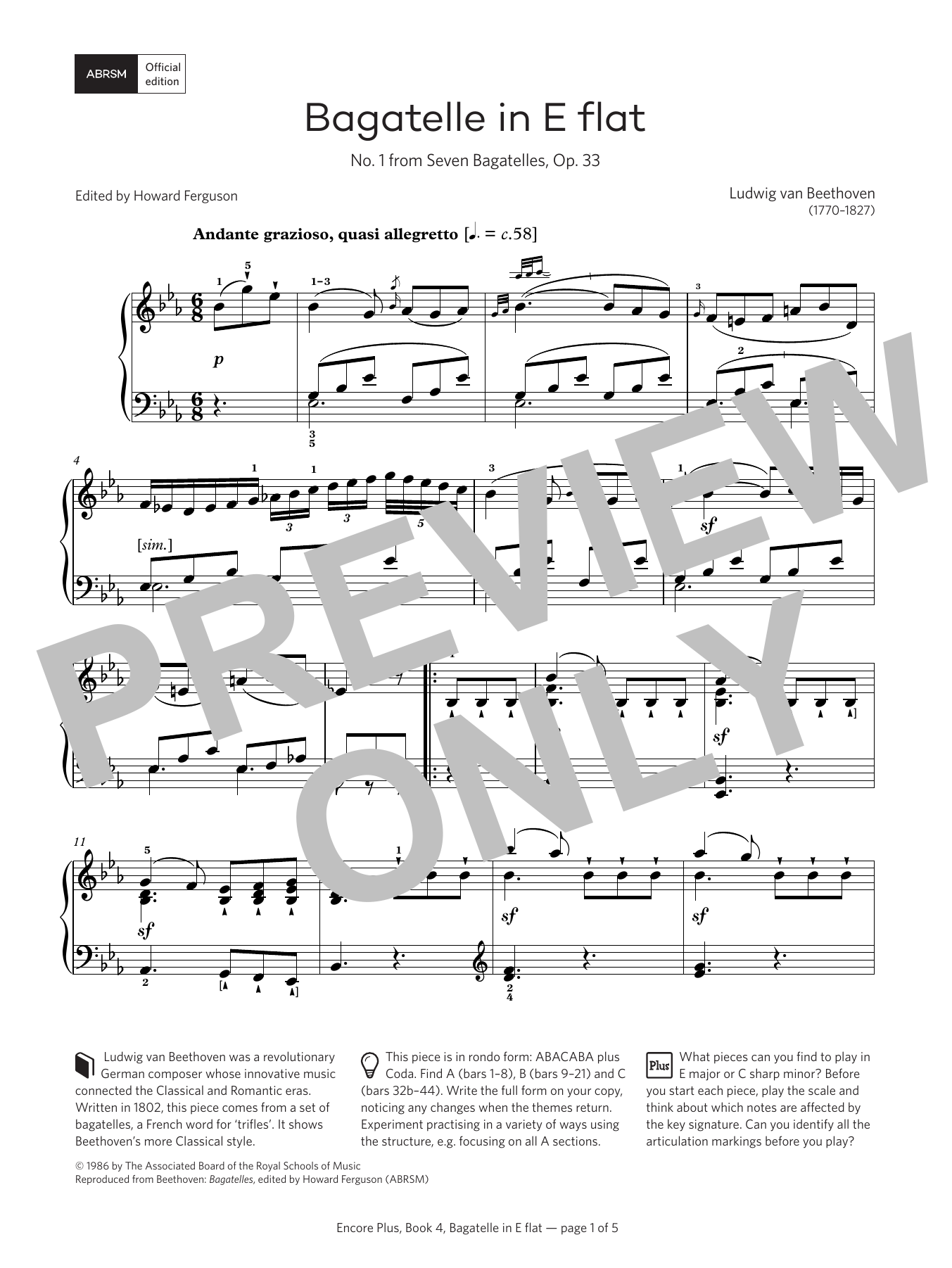
Beethoven wrote dozens of bagatelles across his career, treating these short piano works as serious artistic statements rather than throwaway pieces. His later bagatelles in particular reveal a composer uninterested in conventional virtuosity, instead mining profound musical ideas from deceptively modest forms.
Why we love this
This bagatelle rewards the kind of interpretive thinking that separates capable players from musicians. The piece demands attention to voicing and line management in ways that feel both achievable and genuinely musical for an intermediate student.
What to expect
Lyrical and introspective without sentimentality. The piece unfolds like a conversation with itself, exploring a gentle theme through subtle harmonic shifts and textural variations. There's a sense of quiet confidence throughout, never hurried and never precious.
Who it's for
Grade 7 pianists ready to move beyond technical exercises into music that asks for genuine musical choices. This works well for students preparing for competitions or recitals who need repertoire with substance but reasonable technical demands.
How to get the most out of it
Balance the melody across both hands; the tune weaves between registers, and clarity requires deliberate voice leading rather than simply playing what's written.
Shape each phrase with the harmonic rhythm. The underlying pulse is stable, but the emotional weight lives in how you voice chord changes and approach cadential moments.
Let silence breathe. Beethoven spaces ideas with intention here, and the rests matter as much as the notes.
How to use it
Pair this with other Beethoven short works on a recital to show his range across styles and periods. It also serves as a bridge between Classical sonata forms and Romantic miniature writing, making it valuable in music history curricula or as an introduction to late-period Beethoven.
Skills your students will build
Voicing and voice independence across both hands
Harmonic analysis and phrase architecture in Classical forms
Pedal coordination for textural clarity
Sustaining lyrical lines while managing accompaniment figures
Interpretation choices within Classical aesthetic principles
You May Also Like
Scan to Complete Your Purchase
Use your phone's camera to scan the code below
You'll log in on your phone and the order will be added to your account