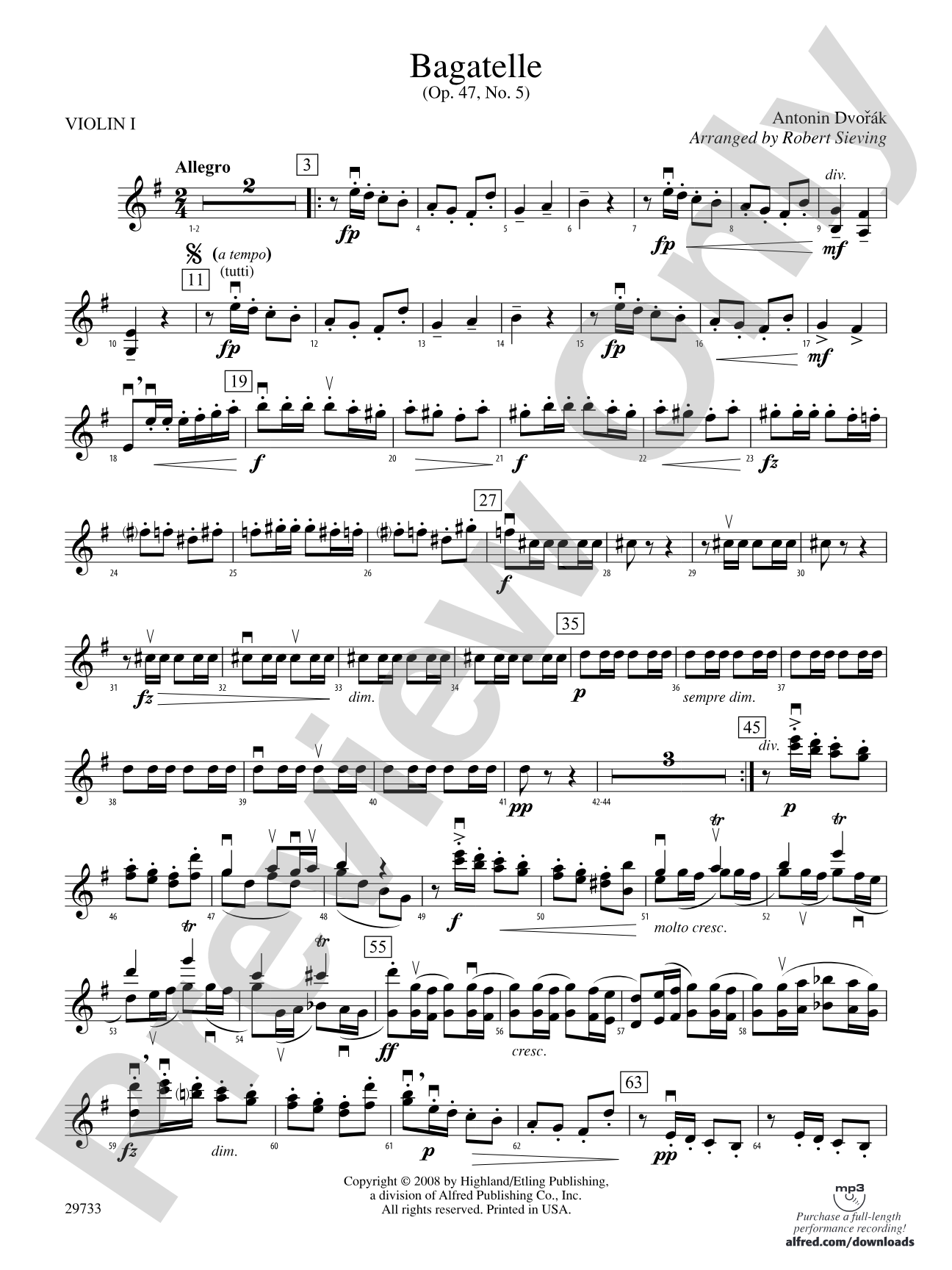
Bagatelle (from Op. 47, No. 5): 1st Violin Sheet Music Preview

Bagatelle (from Op. 47, No. 5): 1st Violin

By Antonín Dvorák / arr. Robert Sieving

Grade: 3.5

Item: 00-PC-0001586_VN1

Digital Download
$5.99
Description
Charming! This light and flowing Antonín Dvorák arrangement maintains the rhythmic drive characteristic of Slavic folk music. (4:30)

Don't just read it, hear it, play along with it, and watch your students grow with it. In MakeMusic Cloud, Bagatelle (from Op. 47, No. 5): 1st Violin comes alive with professional accompaniment, adjustable tempo, and built-in practice tools that turn solo practice into real progress.

Sample Audio
0:00
0:00
Sample Video
Additional Details
Series: Highland/Etling String Orchestra
Publisher: Alfred Music
Page Count: 114
SKU: 00-PC-0001586_VN1

More about this title

About the Composer: Antonin Dvorák

Antonín Dvořák (1841-1904) stands as one of the most performed composers in the orchestral canon, a Czech master whose gift for melody and orchestration shaped the Romantic era. His music draws deeply from Slavic folk traditions while engaging the full sophistication of European classical forms, making him an essential figure for string musicians to study and perform.

Dvořák's prolific output includes nine symphonies, concertos, chamber works, and countless smaller pieces that balance technical rigor with immediate emotional accessibility. For young orchestras, his music offers both the joy of playing deeply satisfying melodies and the challenge of realizing rich harmonic language and authentic cultural style.

Why we love this

Robert Sieving captures the essence of Dvořák's original without oversimplifying the voice-leading, so your students encounter genuine compositional craft rather than a hollow adaptation. The rhythmic energy keeps orchestras engaged and makes rehearsal efficient, while the Slavic character gives young players a window into musical traditions beyond the German symphonic mainstream.

What to expect

Buoyant and unpretentious, this arrangement sparkles with the lightness of a genuine folk melody caught in a sophisticated musical frame. There's an infectious energy throughout, the rhythmic drive of Eastern European dance rhythms channeled through the warm, blended sound of strings.

Who it's for

String orchestras at the late intermediate level will find a piece that feels rewarding without requiring advanced technique. Contest and festival programs benefit especially from this work, where its tuneful character and brisk pacing create a strong impression on adjudicators and audiences alike.

How to get the most out of it

  • Shape the phrasing in long arcs rather than beat-by-beat; the folk-music roots ask for a lyrical sensibility even in faster passages.
  • Balance the lower strings carefully to support harmonic movement without drowning out the melodic line; Slavic folk arrangements often thicken the middle voices.
  • Maintain rhythmic precision in syncopated figures; the folk character lives in the specific rhythmic inflections, not in relaxed interpretation.

How to use it

Pair this with a heavier Romantic work or a contemporary piece to showcase the stylistic range of your orchestra; its brevity and charm make it ideal as a second-half opener or closing encore. It also works beautifully in a program exploring cultural influences in Western classical music or as a complementary piece to other Dvořák chamber or orchestral selections.

Skills your students will build

  • Stylistic awareness of Slavic folk idioms within European classical form
  • Maintaining rhythmic precision in syncopated folk-inspired rhythms
  • Balancing multiple inner voices to support harmonic movement
  • Lyrical phrasing and long-line playing across sectional boundaries

You May Also Like