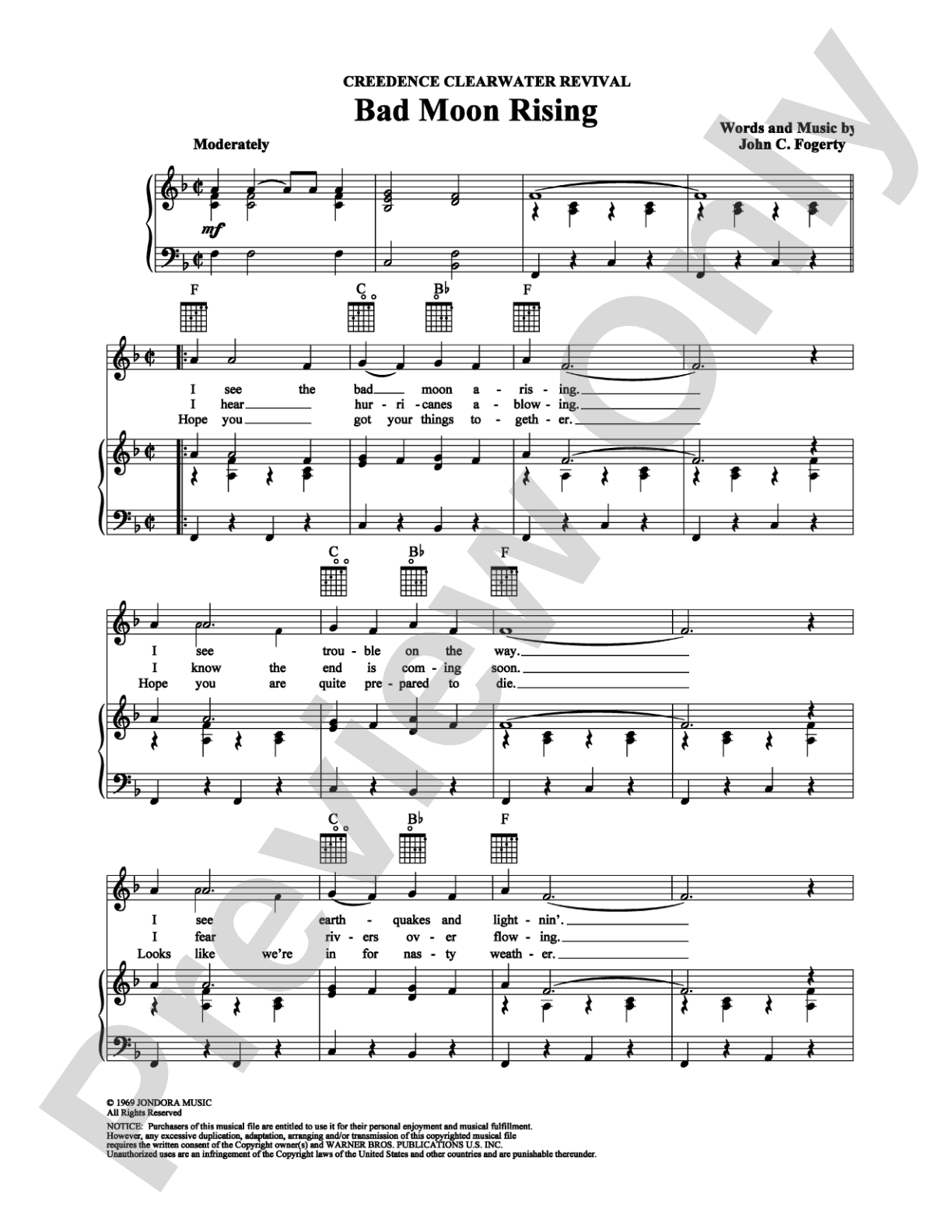
Bad Moon Rising: Piano/Vocal/Chords Digital Sheet Music

Bad Moon Rising: Piano/Vocal/Chords Digital Sheet Music

Creedence Clearwater Revival, John Fogerty

Item: 00-PS-0007408

Digital Download
$3.99
Description

Bad Moon Rising: Piano/Vocal/Chords Digital Sheet Music isn't in MakeMusic Cloud just yet...but it could be. Let us know you'd like to see it, and you'll help shape what comes next. In the meantime, start a free trial and dive into thousands of interactive titles your students can play along with today.

Sample Audio
No sample audio found.
Sample Video
Additional Details
SKU: 00-PS-0007408

More about this title

About the Artist: Creedence Clearwater Revival

Creedence Clearwater Revival emerged from El Sobrante, California, in 1967 as one of the defining rock bands of the late 1960s and early 1970s. Led by John Fogerty's distinctive vocals and songwriting, the band crafted a sound rooted in swamp rock, blues, and roots music that resonated across generations. Their catalog of hits remains a staple of American popular music and offers rich material for music students exploring rock composition and arrangement.

The band's influence on music education extends beyond their commercial success. Their straightforward song structures, memorable melodies, and accessible chord progressions make their work ideal for teaching contemporary music literacy and performance in both classroom and private studio settings.

Why we love this

This arrangement captures the swagger and groove that made the original iconic without overcomplicating the pianist's role. The chord-melody approach lets singers and pianists lock into the song's infectious rhythm while maintaining focus on vocal delivery and ensemble balance. It's a crowd-pleaser that rewards solid musicianship from everyone involved.

What to expect

Propulsive and slightly ominous, with an undercurrent of swagger. The original's swamp rock atmosphere translates through straightforward, driving harmonies that invite the vocalist to deliver the story with attitude and presence.

Who it's for

Pianists preparing for rock repertoire auditions or recitals, singers exploring popular music standards, and educators building contemporary music literacy in their studios or choirs. This arrangement works equally well for solo performance or collaborative coaching sessions.

How to get the most out of it

  • Lock the piano groove into a steady, understated feel rather than playing it too densely; the chords should support the vocal line without competing for attention.
  • Emphasize the rhythmic pocket of the original recording by keeping the left hand propulsive but minimal, allowing space for the voice to land its phrasing.
  • Work the chord voicings so they sit comfortably under the vocalist's range; adjust inversions as needed to maintain clarity in the middle register.
  • Pay attention to the dynamics implied by the original arrangement; this song's power comes from controlled intensity, not volume alone.

How to use it

Schedule this for a contemporary music showcase or popular music recital where it can anchor a set of rock and roots-influenced material. It also serves as an excellent piece for demonstrating how rock standards transfer into concert settings without losing their essential character.

Skills your students will build

  • Reading chord symbols and interpreting them in a contemporary context
  • Balancing accompaniment texture with vocal prominence
  • Internalizing rhythmic pocket and groove in a non-classical idiom
  • Interpreting dynamics and articulation from a recorded reference
  • Collaboration between vocalist and pianist in popular music styles

You May Also Like