

Bad Attitude: Jazz Ensemble Conductor Score & Parts
By Michael Sweeney
Grade: 1.5
Item: 35-PK01229621
$40.00
Pickup currently not available
Buy Extra Parts (Digital PDF Download)
| Product | Price | Quantity |
|---|---|---|
| Bad Attitude - Full Score | $6.00 | |
| Bad Attitude - Alto Sax 1 | $6.00 | |
| Bad Attitude - Alto Sax 2 | $6.00 | |
| Bad Attitude - Tenor Sax 1 | $6.00 | |
| Bad Attitude - Tenor Sax 2 | $6.00 | |
| Bad Attitude - Baritone Sax | $6.00 | |
| Bad Attitude - Trumpet 1 | $6.00 | |
| Bad Attitude - Trumpet 2 | $6.00 | |
| Bad Attitude - Trumpet 3 | $6.00 | |
| Bad Attitude - Trombone 1 | $6.00 | |
| Bad Attitude - Trombone 2 | $6.00 | |
| Bad Attitude - Trombone 3 | $6.00 | |
| Bad Attitude - Guitar | $6.00 | |
| Bad Attitude - Piano | $6.00 | |
| Bad Attitude - Bass | $6.00 | |
| Bad Attitude - Drums | $6.00 | |
| Bad Attitude - Vibes | $6.00 |
Parts Added to Cart!
Description
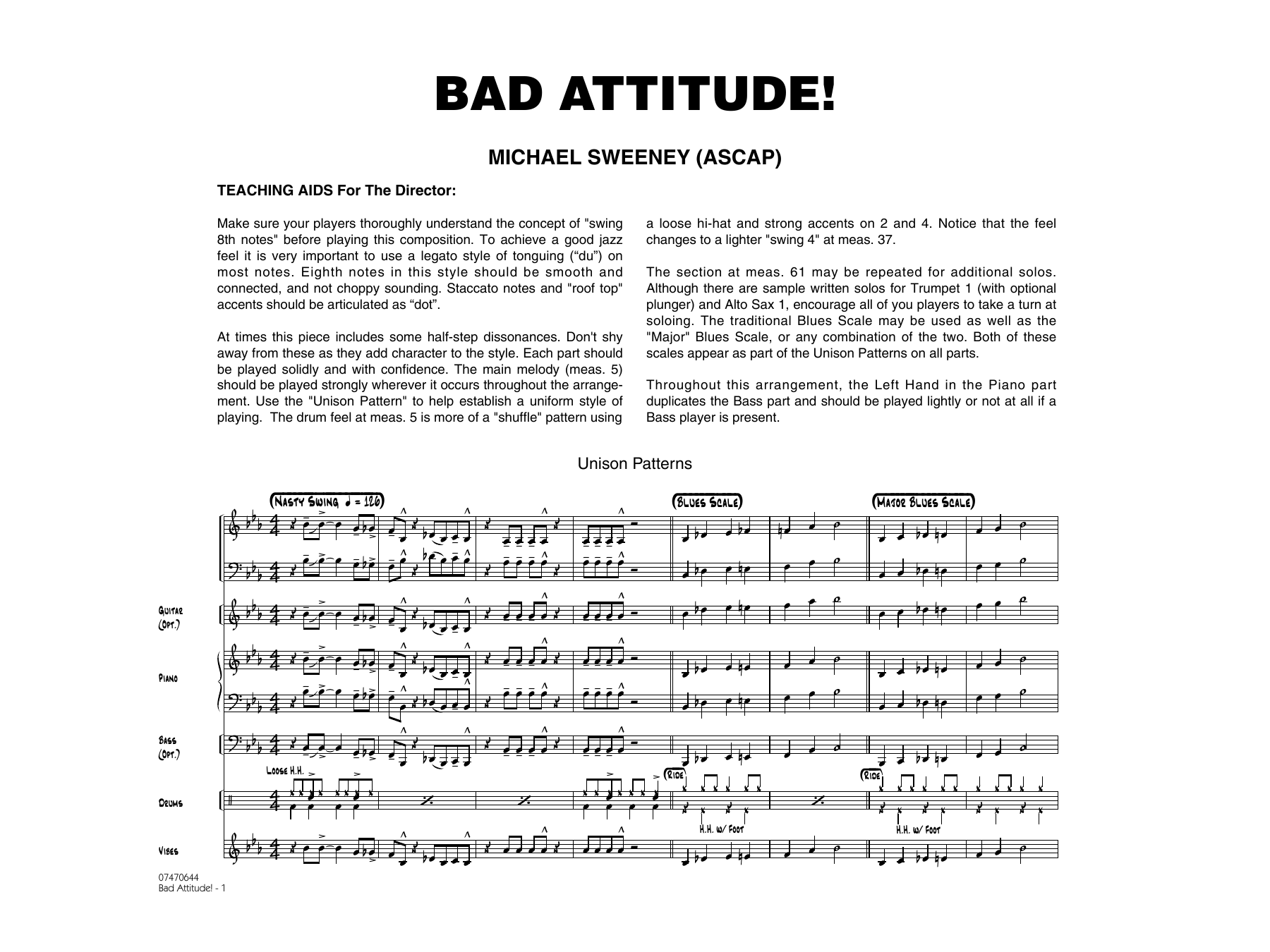
Here's a fun original swing tune with a bit of an edge! Michael Sweeney again shows his understanding of this easy level in this well-written blues that features some minor dissonances for spice and a melody that really swings. Includes sample solos for alto and trumpet, but you can have anyone solo. Your band will sound great playing this one!


Bad Attitude: Jazz Ensemble Conductor Score & Parts isn't in MakeMusic Cloud just yet...but it could be. Let us know you'd like to see it, and you'll help shape what comes next. In the meantime, start a free trial and dive into thousands of interactive titles your students can play along with today.
Request This Title
Tell us you want it.
Start Your Free Trial
Explore everything that's ready to play right now.
Sample Audio
No sample audio found.
Sample Video
No sample videos found.
Additional Details
Publisher:
Hal Leonard
SKU:
35-PK01229621
More about this title
About the Composer: Michael Sweeney
Michael Sweeney has shaped jazz education through accessible, idiomatic writing that respects young players' capabilities without condescending to them. His arrangements and originals appear on stages and in practice rooms across the country, trusted by directors who need music that teaches ensemble concepts while staying genuinely fun to play.
Sweeney's particular gift lies in understanding exactly what Grade 1 and 2 ensembles can execute musically. He writes with clarity about harmonic color and rhythmic precision, never sacrificing craft for simplicity.
Why we love this
Sweeney crafts this original with real bite. The minor dissonances give young players something to listen for beyond the basic swing feel, and the included alto and trumpet solos provide clear solo models while leaving room for whoever wants to step forward. A tune that sounds mature without requiring mature technique.
What to expect
A rhythm section sitting in a small club, confident and loose. The melody walks in cool and unhurried, with just enough harmonic shadow underneath to make you sit up and pay attention. There's no strain here; the 'attitude' comes from restraint and phrasing, not effort.
Who it's for
Beginning jazz ensembles and early Grade 2 groups ready for original material that goes beyond the standard play-along. Directors working with players who respond well to contemporary idiom and appreciate when swing groove is treated as its own skill.
How to get the most out of it
- Establish the swing eighth-note feel in a few warm-up choruses before rehearsing the melody. Getting the pocket right matters more than tempo precision at this level.
- Have soloists listen to the recorded accompaniment in sections during rehearsal. Hearing how their range sits against the comp will build confidence for performance.
- Shape the minor sonorities with dynamic control rather than rhythmic pushiness. Let the dissonances breathe so the 'attitude' comes through as cool rather than clashing.
- Run the head several times with the full ensemble before moving to solos. Locking the melody line together creates the foundation that makes any solo sound good.
How to use it
Place this in a jazz concert alongside two or three standards to show how original writing sits in the repertoire. It pairs well with functional warm-up tunes early in the set and gives the audience a sense of your ensemble's contemporary voice.
Skills your students will build
- Reading and sustaining a swing eighth-note feel over an entire piece
- Voice leading through minor harmonic color without losing pitch precision
- Trading choruses and listening to other musicians while soloing
- Balancing ensemble blend when soloists step forward
- Phrasing melody with space and relaxation rather than driving rhythm