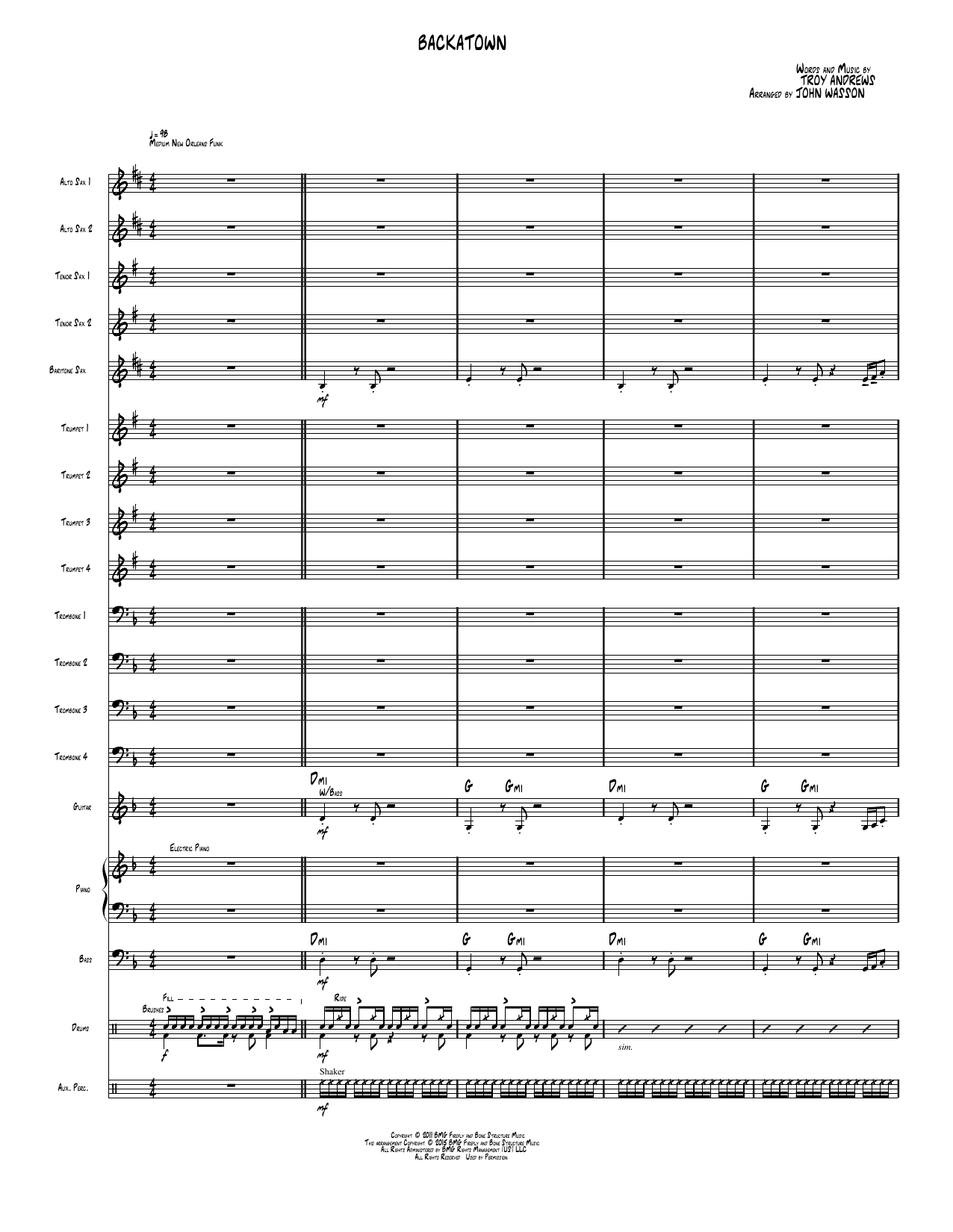
Backatown Sheet Music Preview

Backatown: Jazz Ensemble Conductor Score & Parts

By Troy Andrews / Arranged by John Wasson

Grade: 3

Item: 35-PK00426993

Digital Download
$45.00

Buy Extra Parts (Digital PDF Download)

Product Price Quantity
Backatown - Full Score $45.00

Parts Added to Cart!

Description
Backatown

Backatown: Jazz Ensemble Conductor Score & Parts isn't in MakeMusic Cloud just yet...but it could be. Let us know you'd like to see it, and you'll help shape what comes next. In the meantime, start a free trial and dive into thousands of interactive titles your students can play along with today.

Sample Audio
No sample audio found.
Sample Video
Additional Details
Publisher: Hal Leonard
SKU: 35-PK00426993

More about this title

About the Composer: Troy Andrews

Troy Andrews, known professionally as Trombone Shorty, is a New Orleans native who has become one of the most vital voices in contemporary jazz and funk. His music bridges traditional New Orleans brass traditions with modern hip-hop and R&B sensibilities, creating a sound that feels both rooted in history and urgently present. As a composer and bandleader, Andrews has earned Grammy recognition and a devoted following by refusing to separate jazz from its street-level energy and cultural context.

Why we love this

This arrangement captures the infectious groove and street-level swagger of Andrews' sound without demanding a virtuosic ensemble. John Wasson's Grade 3 scoring keeps the essential character intact while making it accessible to high school players still building their jazz vocabulary. It's the kind of piece that reminds students why they love playing jazz in the first place.

What to expect

Street energy wrapped in big-band sophistication. There's a bounce and attitude here that feels modern, yet every phrase traces back to the brass traditions of New Orleans. The arrangement moves with purpose, never settling into predictable patterns.

Who it's for

High school jazz ensembles looking for contemporary material with serious musical roots. This works equally well for bands new to jazz as for more experienced groups wanting to expand beyond traditional swing repertoire.

How to get the most out of it

  • Establish the groove pocket first. The rhythm section needs to lock into the New Orleans funk feel before worrying about precision; this music lives in the space between the beats.
  • Balance the horn fills so they sit behind the melody without disappearing. The ensemble voices should support, not compete with, the main line.
  • Let the recorded accompaniment serve as a reference for phrasing and dynamic shape, but encourage your band to find their own swagger once they understand the basic structure.

How to use it

Program this on a concert celebrating modern jazz voices or pairing classical composers with their contemporary inheritors. It also makes an excellent warm-up piece for units on funk harmony and rhythmic elasticity. The accessibility means it won't dominate rehearsal time while still teaching genuine jazz concepts.

Skills your students will build

  • Funk and New Orleans rhythm feels (syncopation beyond swing eighth notes)
  • Playing with rhythmic independence between melody and accompaniment
  • Interpreting jazz articulation and phrasing marks in a contemporary idiom
  • Listening for groove and pocket rather than metronomic precision
  • Understanding how traditional jazz vocabulary evolves in modern contexts

You May Also Like