Baciai Per Aver Vita Sheet Music Preview

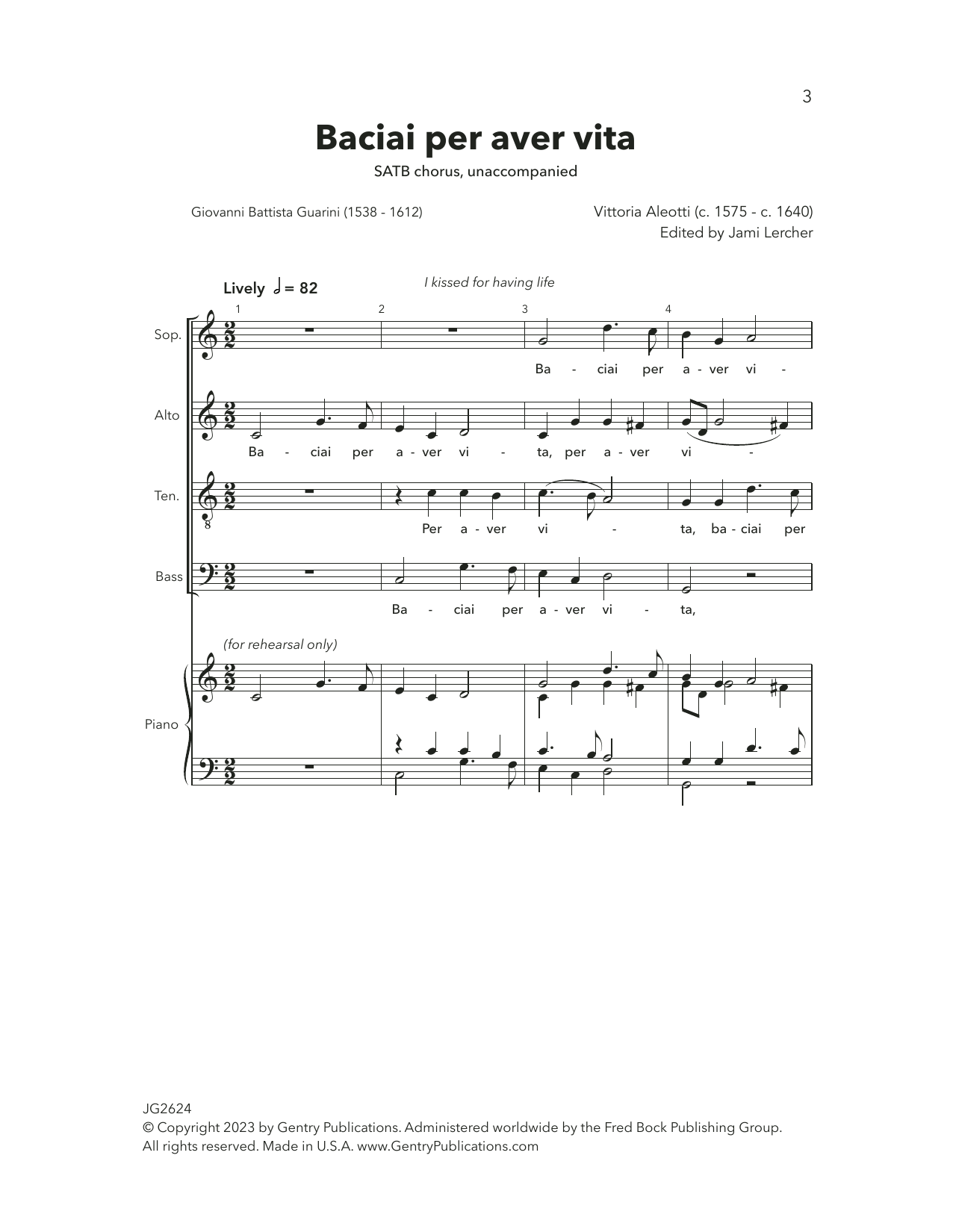
Baciai Per Aver Vita: SATB Choral Octavo

By Vittoria Aleotti / By Giovanni Battista Guarini / Edited by Jami Lercher

Item: 35-DS01126595

Digital Download
$3.35
Description

Baciai Per Aver Vita: SATB Choral Octavo isn't in MakeMusic Cloud just yet...but it could be. Let us know you'd like to see it, and you'll help shape what comes next. In the meantime, start a free trial and dive into thousands of interactive titles your students can play along with today.

Sample Audio
No sample audio found.
Sample Video
Additional Details
Publisher: Hal Leonard
Page Count: 11
SKU: 35-DS01126595

More about this title

About the Composer: Vittoria Aleotti

Vittoria Aleotti (c. 1575–after 1620) was one of the few female composers whose work survived the Renaissance, and one of the first women to have music published under her own name. A singer and musician at the court of Ferrara, she composed both sacred and secular vocal music that demonstrated technical fluency and expressive sophistication. Her secular works, including madrigals and polyphonic songs, reveal a composer fully engaged with the musical language of her time.

Aleotti's legacy matters to music educators because her existence and output challenge historical narratives about composition and authorship. Programming her work places underrepresented voices in the concert hall and reminds singers that the tradition they inherit was shaped by women whose contributions were often obscured or attributed to others.

Why we love this

This secular polyphonic song pairs Aleotti's Renaissance craftsmanship with a text by one of Italy's most celebrated poets, giving your singers access to a work that combines historical significance with genuine musical interest. The setting sits comfortably for SATB voices while maintaining the melodic grace and harmonic sophistication that made Renaissance vocal music so enduring. Programming Aleotti moves beyond tokenism and becomes a teaching moment about who actually wrote the music we sing.

What to expect

The text invokes the paradox of love and vitality—"baciai per aver vita" suggests that kissing gives life, a deeply human and sensual conceit expressed through the cool, balanced symmetry of Renaissance counterpoint. The music captures both the urgency of desire and the formal restraint of its era, creating a tension that keeps the piece feeling alive rather than antiquarian.

Who it's for

This octavo suits advanced high school choirs and college chamber ensembles with solid sight-reading skills and experience with Renaissance polyphony. It works equally well for singers preparing for madrigal festivals or directors seeking to expand their secular repertoire beyond the standard German and English traditions.

How to get the most out of it

  • Shape each phrase through its natural text accents rather than applying uniform phrasing; let the Italian syllables and word stress guide your interpretation.
  • Balance the soprano line without letting it overshadow the inner voices, which often carry important harmonic and contrapuntal material.
  • Approach the cadences with slight breath room and clarity; Renaissance harmonic language sometimes rewards a fractional pause that lets the ear register the resolution.
  • Consider using a keyboard continuo or lute reduction if available; these works were often performed with instrumental support, and even a modest accompaniment can anchor pitch and add period-appropriate color.

How to use it

Pair this with other Renaissance secular works to build a thematic concert segment on love and courtship across centuries, or use it as a concert opener that immediately signals intellectual engagement with early vocal literature. Its moderate length and accessibility make it an ideal choice for a chamber concert or an evening devoted to women composers and neglected voices in the canon.

Skills your students will build

  • Renaissance text declamation and phrasing in Italian
  • Reading and balancing independent polyphonic lines in SATB texture
  • Harmonic awareness in modal and early tonal contexts
  • Collaborative listening and blend across voice parts
  • Stylistic interpretation of secular Renaissance vocal music

You May Also Like