Bach: Various Short Preludes and Fugues Sheet Music Preview

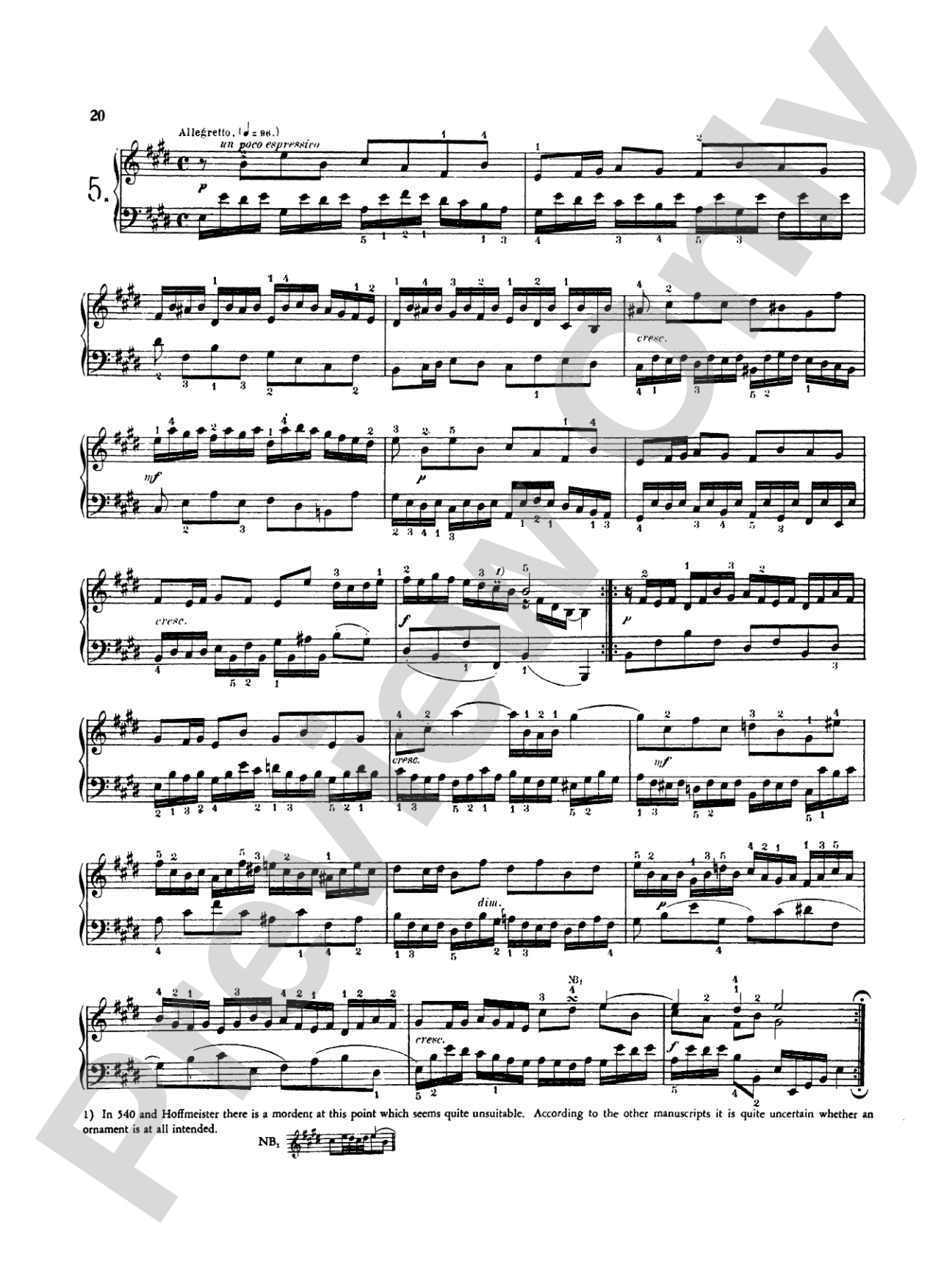
Bach: Various Short Preludes and Fugues

By Johann Sebastian Bach / ed. Hans Bischoff

Item: 00-PC-0004948

Digital Download
$0.99
Description
Contents: I, Twelve Preludes * II, Six Little Preludes * III, A Little Fugue in C Minor in Two Voices * IV, Fugue in C Major * V, Fugue in C Major * VI, Fugue in D Minor * VII, Fugue in E Minor * VIII, Fugue in A Minor * IX, Fugue in A Major * X, Prelude and Fughetta in D Minor * XI, Prelude and Fughetta in E Minor * XII, Prelude and Fugue in E-Flat Major * XIII, Prelude and Fugue in A Minor.

Don't just read it, hear it, play along with it, and watch your students grow with it. In MakeMusic Cloud, Bach: Various Short Preludes and Fugues comes alive with professional accompaniment, adjustable tempo, and built-in practice tools that turn solo practice into real progress.

Sample Audio
No sample audio found.
Sample Video
Additional Details
Series: Kalmus Edition
Publisher: Alfred Music
Page Count: 52
SKU: 00-PC-0004948

More about this title

About the Composer: Johann Sebastian Bach

Johann Sebastian Bach (1685-1750) fundamentally shaped Western music through his mastery of counterpoint, harmonic language, and formal architecture. His output spans sacred and secular genres, but his keyboard works remain cornerstones of piano pedagogy and performance, revered equally by students discovering polyphony and concert artists exploring interpretive depth.

Why we love this

This collection pairs the clarity of Bach's shortest preludes with the intellectual satisfaction of his fugues, making it ideal for pianists who need accessible entry points into Baroque counterpoint without sacrificing musical substance. The range of keys and voice counts (notably the two-voice Little Fugue in C Minor) creates natural scaffolding for advancing technique and analytical thinking. Programming these pieces signals serious musical intent while remaining practical for recitals, competitions, and studio repertoire building.

What to expect

These pieces embody Baroque order without coldness: mathematical counterpoint that somehow sings, harmonic logic that feels inevitable, and architectural forms that reveal new proportions with each listening. Moving from a delicate prelude into its paired fugue is like watching a simple melodic seed unfold into a complete musical argument.

Who it's for

Piano students preparing for entrance exams, competitions, or degree-level studies will find both accessible scaffolding and material worthy of deep study. Teachers building a core Baroque repertoire for students in grades 8 and beyond will appreciate the range of difficulty and the pedagogical value of side-by-side preludes and fugues.

How to get the most out of it

  • Approach each prelude as a study in voice independence rather than lyrical singing; even the shortest ones demand clarity between lines, not pedal-blurred chords.
  • In the fugues, trace the subject and counter-subject entries before you learn the full piece, then let that map guide your voice leading at the keyboard.
  • Differentiate the Preludes and Fughetta pairs from their standalone counterparts by listening to how the fughetta functions as a tonal and structural answer, not just a continuation.
  • Use a steady, unforced tempo that lets the harmonic rhythm breathe; rushing these pieces obscures their logic and tires the hands unnecessarily.

How to use it

Feature a prelude and its paired fugue as a single unit on a recital to demonstrate structural and stylistic contrast within a single composer's voice. The two-voice Little Fugue in C Minor works exceptionally well as a bridge piece between intermediate and advanced repertoire in a teaching studio or competitive festival. Alternatively, program several short preludes in succession to highlight Bach's range of texture and key within a focused, efficient program segment.

Skills your students will build

  • Voice independence and clarity in two-, three-, and four-part texture
  • Subject identification, transformation, and tracking across fugal entries
  • Baroque articulation and phrasing without modern pedal dependency
  • Harmonic analysis and functional chord progression
  • Keyboard independence and hand coordination across multiple contrapuntal lines
  • Ornamentation and embellishment appropriate to Baroque style

You May Also Like