Bach: Two and Three-Part Inventions (Ed. Hans Bischoff) Sheet Music Preview

Bach: Two and Three-Part Inventions (Ed. Hans Bischoff)

By Johann Sebastian Bach / ed. Hans Bischoff, translated by Alexander Lipsky

Item: 00-PC-0004345

Digital Download
$0.99
Description
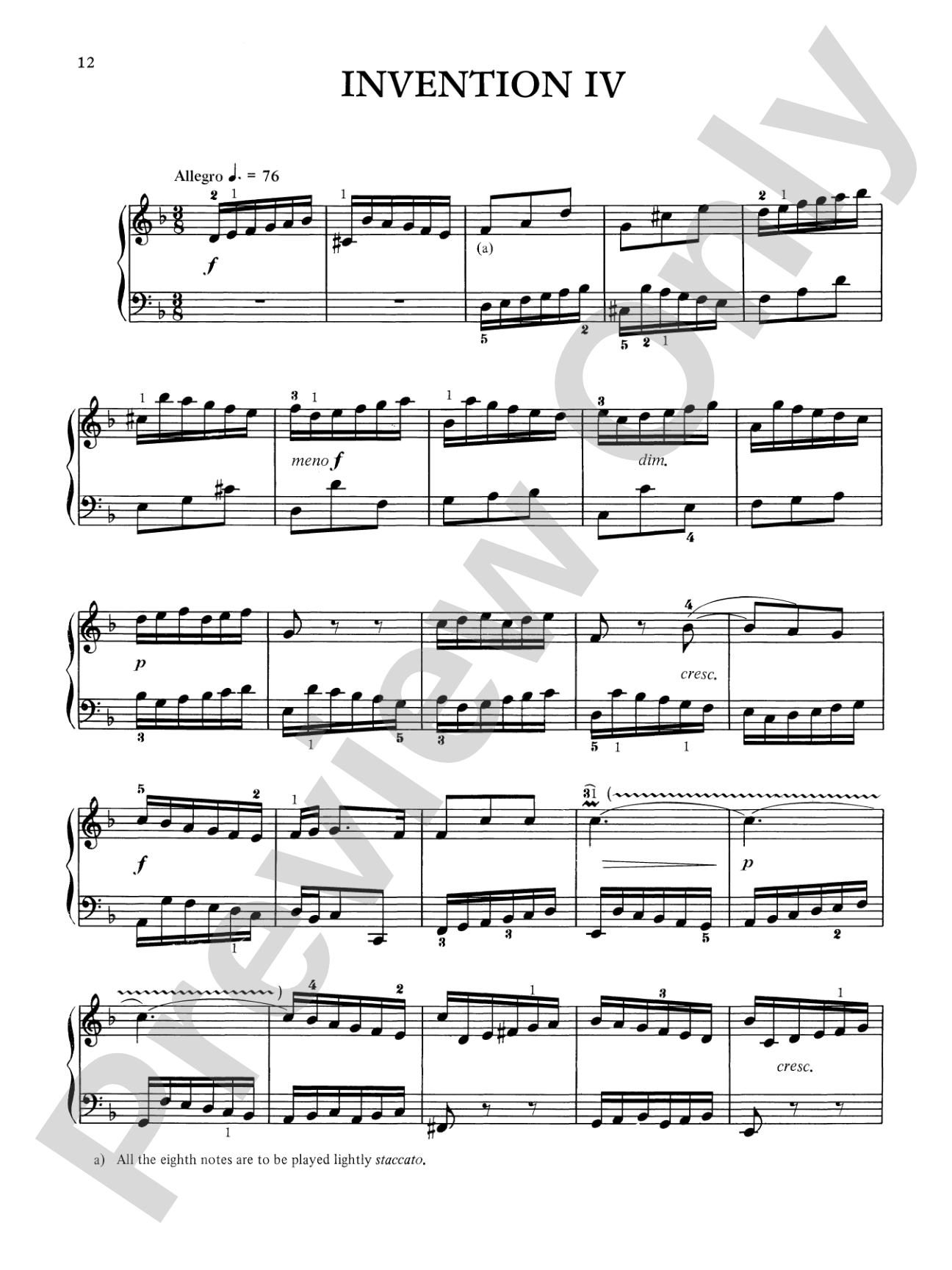
This edition, edited by Dr. Hans Bischoff and translated by Alexander Lipsky includes a three-page preface with a table of embellishments. Inside are Inventions I-XV, and Sinfonias I-XV.

Don't just read it, hear it, play along with it, and watch your students grow with it. In MakeMusic Cloud, Bach: Two and Three-Part Inventions (Ed. Hans Bischoff) comes alive with professional accompaniment, adjustable tempo, and built-in practice tools that turn solo practice into real progress.

Sample Audio
No sample audio found.
Sample Video
Additional Details
Series: Kalmus Edition
Publisher: Alfred Music
Page Count: 68
SKU: 00-PC-0004345

More about this title

About the Composer: Johann Sebastian Bach

Johann Sebastian Bach (1685-1750) fundamentally shaped keyboard music through his systematic exploration of compositional techniques. His inventions and sinfonias represent some of the most pedagogically valuable music ever written, deliberately constructed to teach both technique and counterpoint while maintaining artistic integrity.

Bach's work as a teacher informed everything he composed for keyboard. He understood that students learn fastest when solving genuine musical problems, not practicing abstractions. These pieces remain central to piano pedagogy because they refuse the false choice between technical development and artistic growth.

Why we love this

This Bischoff edition gives you the complete two and three-part inventions in one accessible volume with practical editorial guidance. The three-page embellishments table directly addresses one of the biggest hurdles students face with baroque ornamentation, transforming confusion into clarity. You get all 30 pieces in a single, affordable digital file that works across all your teaching platforms.

What to expect

Each invention presents a single musical idea unfolding across two distinct voices, creating conversations between hands where both participants deserve equal attention. The three-part sinfonias deepen this challenge by introducing a third character into the dialogue, requiring your ears and fingers to track multiple independent paths without losing sight of the harmonic architecture beneath them. The writing is transparent but never simple, inviting you to discover how much musical substance Bach packed into elegant, economical lines.

Who it's for

Students progressing through intermediate to early advanced piano repertoire who need rigorous training in voice leading and baroque style. Teachers building comprehensive countrapuntal curricula for private students or group instruction. Pianists preparing for music theory exams, conservatory auditions, or performance programs that require solid baroque foundations.

How to get the most out of it

  • Address embellishments first by referring to the preface table; knowing exactly which notes constitute a trill or turn removes interpretive guesswork and lets you focus on voice independence
  • Shape each melodic line as if you were singing it, even when both hands weave around each other; this prevents the mechanical separation that derails contrapuntal clarity
  • Practice hands separately until you can hear the harmonic progression, then combine hands with that harmonic awareness intact rather than merging them prematurely
  • Adjust tempo based on which invention or sinfonia you're playing; three-part writing naturally requires slightly more space than two-part work to reveal all three lines distinctly

How to use it

Assign these progressively through the year as students develop their technical and theoretical foundations, since mastery of earlier inventions directly prepares them for later ones. Incorporate individual pieces into student recitals to balance contemporary and romantic repertoire with the architectural clarity of baroque writing. Use them as a bridge between method book exercises and full sonatas, giving students authentic baroque compositional language before tackling larger formal structures.

Skills your students will build

  • Voice independence and tracking multiple simultaneous lines
  • Baroque ornamentation recognition and execution
  • Harmonic function in baroque contexts
  • Contrapuntal independence between hands
  • Articulation and phrasing in linear writing
  • Mastery of dance-based rhythmic patterns in baroque style

You May Also Like