

Bach: Twenty Three Easy Pieces (Ed. Mugellini)
By Johann Sebastian Bach / ed. Bruno Mugellini
Item: 00-PC-0004753
$0.99
Pickup currently not available
Description
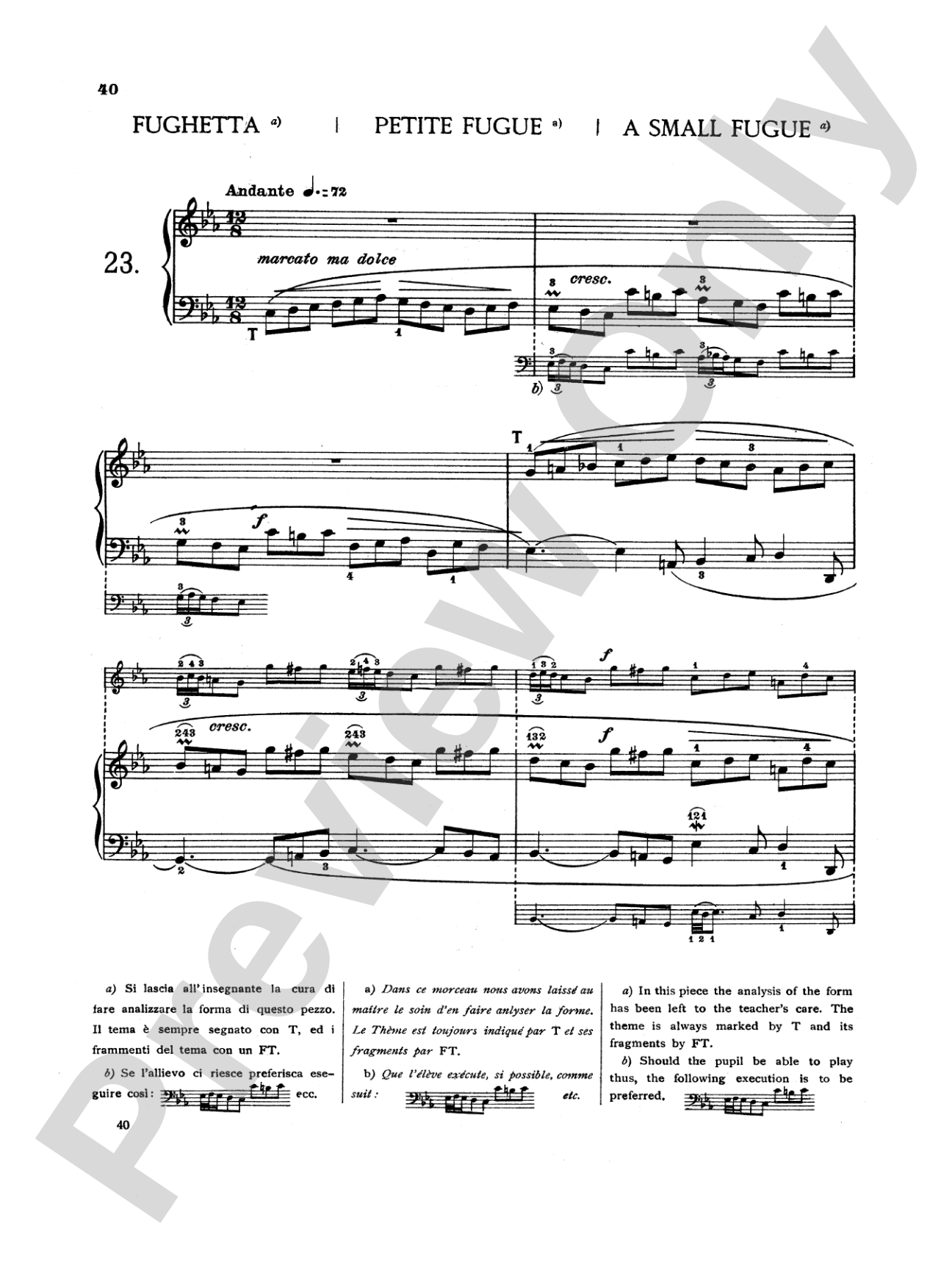
This collection of easier pieces by Johann Sebastian Bach, edited by Bruno Mugellini, "aims at initiating the pupil in the study of the works of this great composer." Historical and performance notes are included in English, French, and Italian language, 42 pages. Includes: Bourree (Suite in B Minor) * Bourree (Suite in E Major) * Courante (French Suite in C Minor) * Fantasia in C Minor * Short Fugue in C Minor * Gigue (Partita in A Major) * Minuet (French Suite in B Minor) * Minuet (French Suite in C Minor) * Polonaise (French Suite in E Major) * Prelude in A Minor (12 Short Preludes) * Prelude in C Major (12 Short Preludes) * Prelude in C Major (6 Short Preludes) * Prelude in C Major (12 Short Preludes) * Prelude in C Minor (12 Short Preludes) * Prelude in C Minor (6 Short Preludes) * Prelude in D Minor (12 Short Preludes) * Prelude in D Minor (6 Short Preludes) * Prelude in E Major (6 Short Preludes) * Prelude in E Minor (6 Short Preludes) * Prelude in E Minor (12 Short Preludes) * Prelude in F Major (12 Short Preludes) * Prelude in G Minor (12 Short Preludes) * Trio from Minuet in G Minor (12 Short Preludes).


Don't just read it, hear it, play along with it, and watch your students grow with it. In MakeMusic Cloud, Bach: Twenty Three Easy Pieces (Ed. Mugellini) comes alive with professional accompaniment, adjustable tempo, and built-in practice tools that turn solo practice into real progress.
Open in the Player
Jump straight in and assign it today.
Start Your Free Trial
Open this title and explore the full library in minutes.
Sample Audio
No sample audio found.
Sample Video
No sample videos found.
Additional Details
Series:
Kalmus Edition
Publisher:
Alfred Music
Page Count:
48
SKU:
00-PC-0004753
More about this title
About the Composer: Johann Sebastian Bach
Johann Sebastian Bach (1685-1750) stands as the culminating figure of the Baroque era and one of history's most influential composers. His output spans sacred and secular works across virtually every musical form of his time, from the monumental Mass in B Minor to intimate keyboard works that remain central to music education today. Bach's systematic exploration of harmonic language, counterpoint, and structural architecture laid the foundation for Western classical music that followed.
For pianists and students, Bach's works offer unparalleled training in voice leading, independence of hands, and musical architecture. His keyboard pieces progress logically from simple to complex, making them ideal for building foundational skills while exposing students to the harmonic and contrapuntal language that shaped everything that came after.
Why we love this
Mugellini's selection and editorial hand make this collection an exceptionally thoughtful introduction to Bach's keyboard writing. The progression moves logically through shorter preludes, dances, and other forms that develop hand independence and voice clarity without overwhelming technique, while the multilingual notes provide historical context that deepens interpretation and helps students understand what they're learning.
What to expect
These pieces evoke the clarity and order of the Baroque court, where dance forms carried grace and intelligence, and every line mattered equally. Even the simpler preludes reveal Bach's architectural mind; there's clarity and purpose beneath every note, a sense that the music is built rather than composed.
Who it's for
This book serves intermediate pianists ready to engage seriously with Bach's writing but not yet prepared for the complete Forty-Eight Preludes and Fugues. Teachers who want to build student facility with Baroque counterpoint and voice independence in a structured, progressive sequence will find these twenty-three pieces invaluable. It's also suitable for students exploring Bach across multiple genres before specializing in keyboard works.
How to get the most out of it
- Shape each phrase with clear voice leading rather than thinking of left and right hands separately. Imagine the individual lines as independent singers, even in simpler pieces.
- Approach the French Suite movements (Bourree, Courante, Minuet, Polonaise) with their original dance character intact. A sense of pulse and style helps unlock the music's elegance.
- In the preludes, resist the urge to rush. Bach's figurations often serve harmonic purposes; allow the harmony to breathe so listeners hear the architecture beneath the figuration.
- Use Mugellini's performance notes as a starting point for interpretation. Period-appropriate ornamentation and articulation choices significantly shape how students understand Bach's musical language.
How to use it
Curate a recital program around these pieces by grouping them by form (preludes together, dances together) or key center to create coherence. They also work exceptionally well as teaching repertoire within a studio curriculum, where they can anchor study of Baroque style and voice leading while students progress through other genres. Shorter selections are ideal for solo recitals or school assemblies when time is limited.
Skills your students will build
- Voice independence and clarity through two- and three-part writing
- Baroque articulation and ornamentation appropriate to dances and keyboard works
- Harmonic analysis and recognition of Bach's cadential language
- Hand coordination and independence at moderate tempos
- Sight-reading fluency across multiple keys and textures
- Understanding of form through dances (Bourree, Courante, Minuet, Polonaise) and fixed forms (Prelude, Fugue)