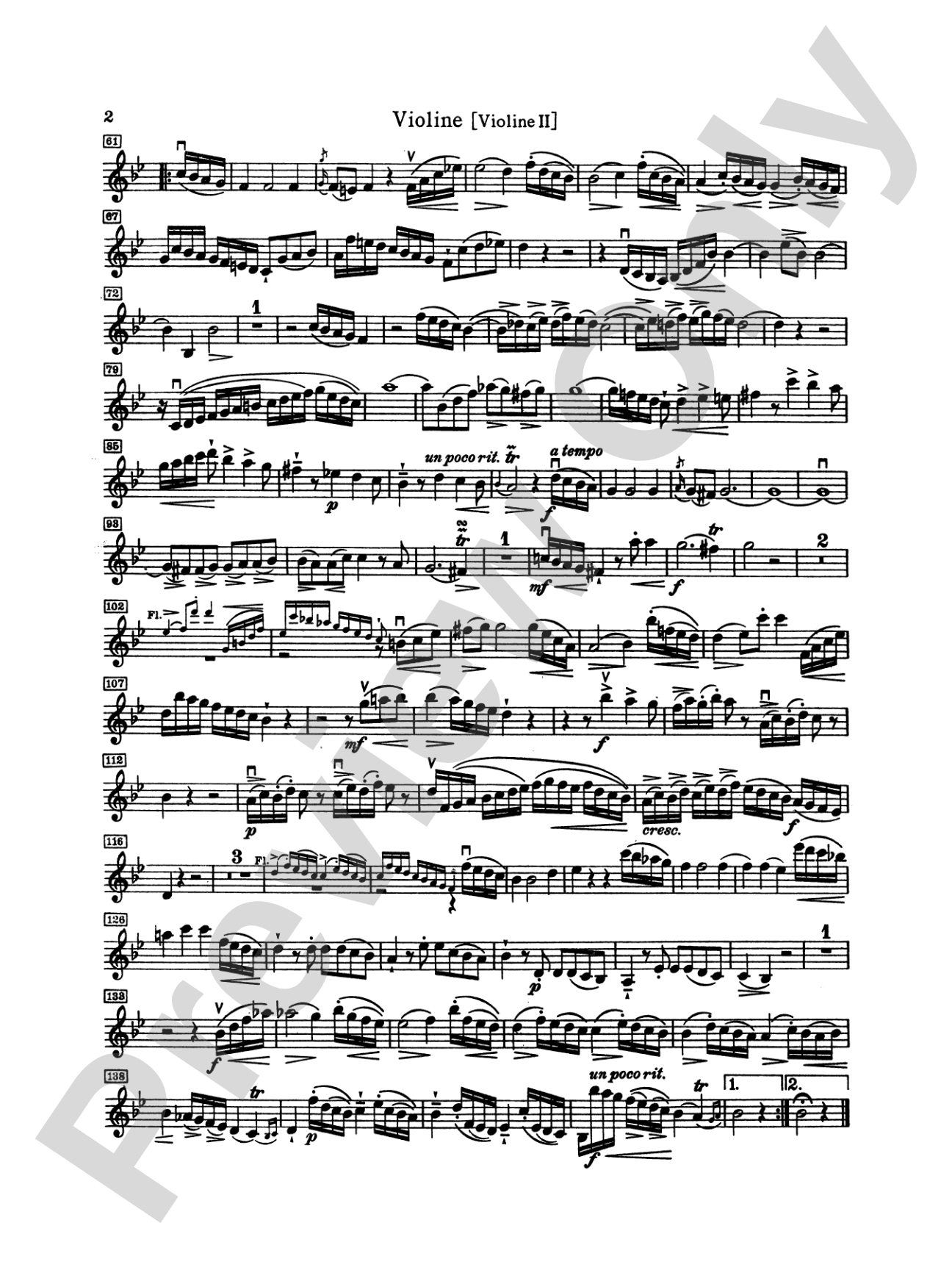
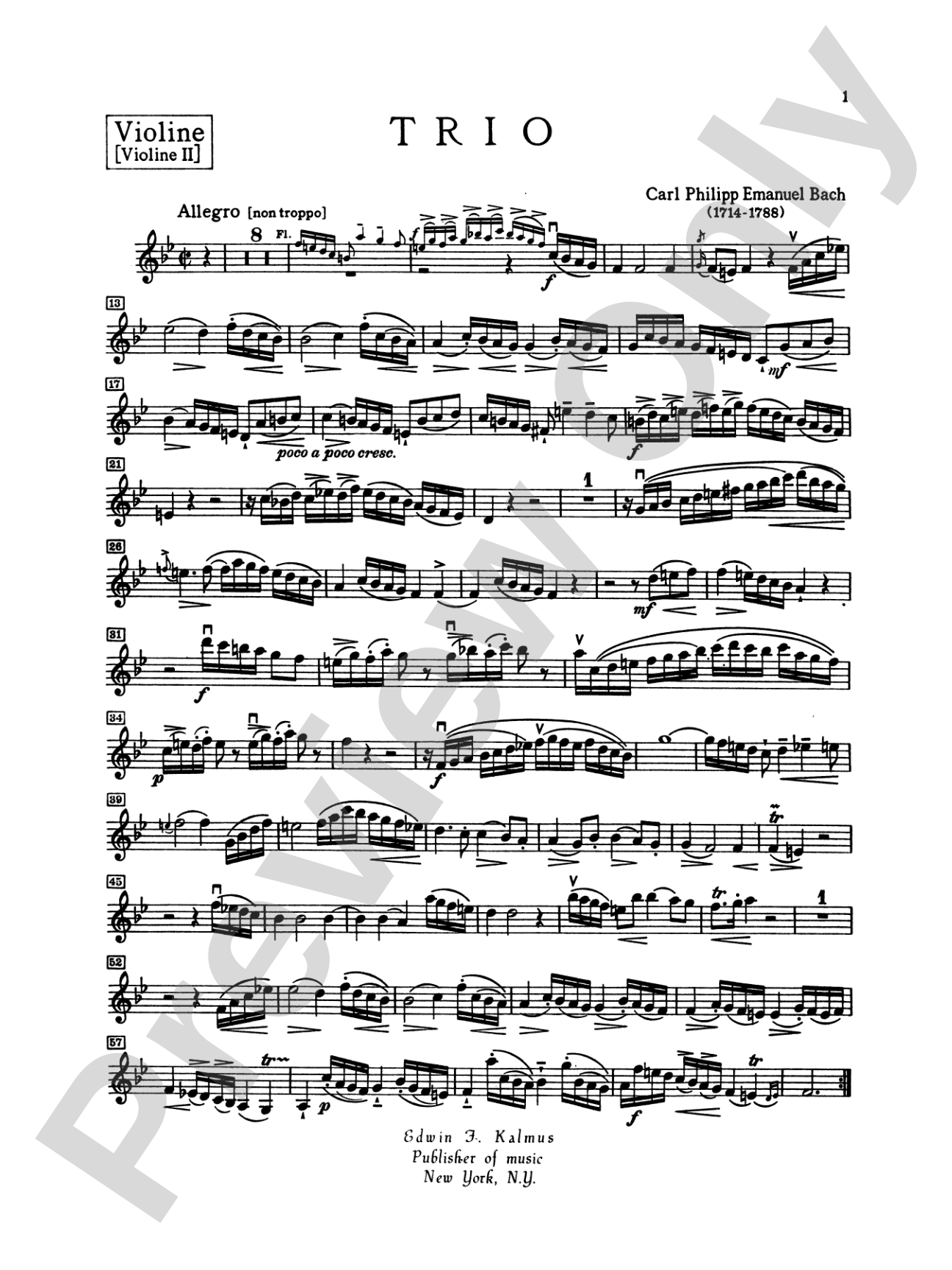
Bach: Trio in B flat Sheet Music Preview

Bach: Trio in B flat

By Carl Philipp Emanuel Bach

Item: 00-PC-0011034

Digital Download
$2.99
Description
A String trio for 2 Violins and Cello composed by Carl Philipp Emanuel Bach. A Federation Festivals 2020-2024 selection.

Don't just read it, hear it, play along with it, and watch your students grow with it. In MakeMusic Cloud, Bach: Trio in B flat comes alive with professional accompaniment, adjustable tempo, and built-in practice tools that turn solo practice into real progress.

Sample Audio
No sample audio found.
Sample Video
Additional Details
Series: Kalmus Edition
Publisher: Alfred Music
Page Count: 24
SKU: 00-PC-0011034

More about this title

About the Composer: Carl Philipp Emanuel Bach

Carl Philipp Emanuel Bach (1714-1788) was the most prolific and adventurous of J.S. Bach's sons, and his influence on the development of Classical style rivals that of any other 18th-century composer. Working primarily in Berlin and Hamburg, C.P.E. Bach wrote over 1,000 works across nearly every genre, from keyboard music to symphonies, and he fundamentally shaped how composers thought about expression, harmony, and instrumental color.

His trio sonatas and chamber works occupy a crucial position in music history: they bridge the Baroque counterpoint of his father with the galant and proto-Classical idioms emerging in mid-century Europe. For string players, his chamber works remain essential studies in the marriage of linear independence and harmonic sophistication. His treatise on keyboard playing became the most influential instruction manual of its time, revealing a mind deeply committed to teaching musicians how to achieve expressive power.

Why we love this

This trio sits at the exact intersection of technical challenge and musical reward that makes chamber music festivals worthwhile. The writing demands genuine ensemble listening and individual voice independence from each player, yet the harmonic language remains accessible enough that younger advanced players can grasp the architecture rather than simply execute the notes.

What to expect

The music moves between courtly formality and intimate conversation, with sudden harmonic turns that feel both elegant and slightly unpredictable. There's a tautness to the writing that keeps the ear engaged; nothing sprawls or repeats mechanically, yet the classical proportions feel inevitable once you've heard them.

Who it's for

Advanced young string players preparing for chamber music festivals, intermediate to advanced community ensembles seeking substantial Baroque-era literature, and musicians exploring the transition between Baroque counterpoint and Classical form. This trio demands secure intonation and ensemble discipline, making it ideal for players with at least 5-6 years of serious study.

How to get the most out of it

  • Treat each voice as a soloist: C.P.E. Bach's trio texture is fundamentally about three characters in conversation, not accompanimental writing. Ensure the second violin and cello have the same tonal presence as the first violin, even when they're playing supporting material.
  • Shape phrases across the bar line rather than within it. The phrasing often contradicts the metrical grid, so agree on breath points and phrase arcs before locking onto rhythmic subdivisions.
  • Use the opening material as a fingerprint for character consistency. Return to its articulation, tempo, and dynamic shaping throughout the movement to create structural coherence.
  • Balance the keyboard-derived harmonic language with string sonority: avoid the transparency that works for harpsichord accompaniment and instead let the harmonic movement breathe through full bowing and sustained lines.

How to use it

Pair this with other C.P.E. Bach chamber works or other mid-century German composers (Quantz, Graun) to create a thematic concert on Classical roots. For festivals, it serves equally well as a warm-up to heavier Romantic literature or as a standalone feature that showcases chamber music discipline. The Federation Festivals selection means it's well-suited to competitive programming in the 2020-2024 seasons.

Skills your students will build

  • Independence of three equal voices in non-homophonic textures
  • Balance of harmonic awareness with linear clarity
  • Phrasing across metric boundaries and baroque-to-classical harmonic language
  • Intonation and vibrato control in sustained harmonic movement
  • Ensemble listening and rhythmic coordination without a conductor
  • Understanding of Bach family style and historical context of chamber music transition

You May Also Like