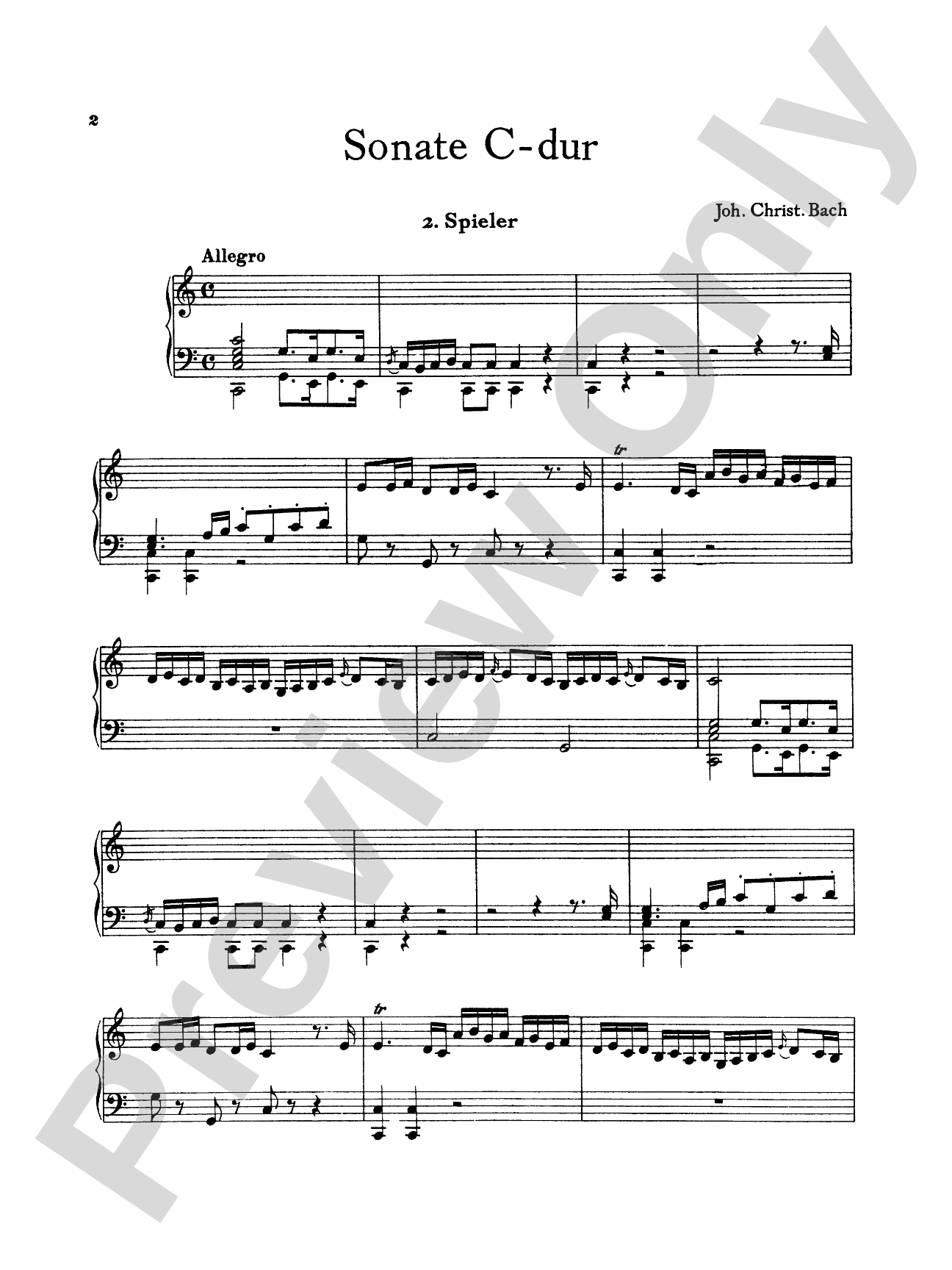
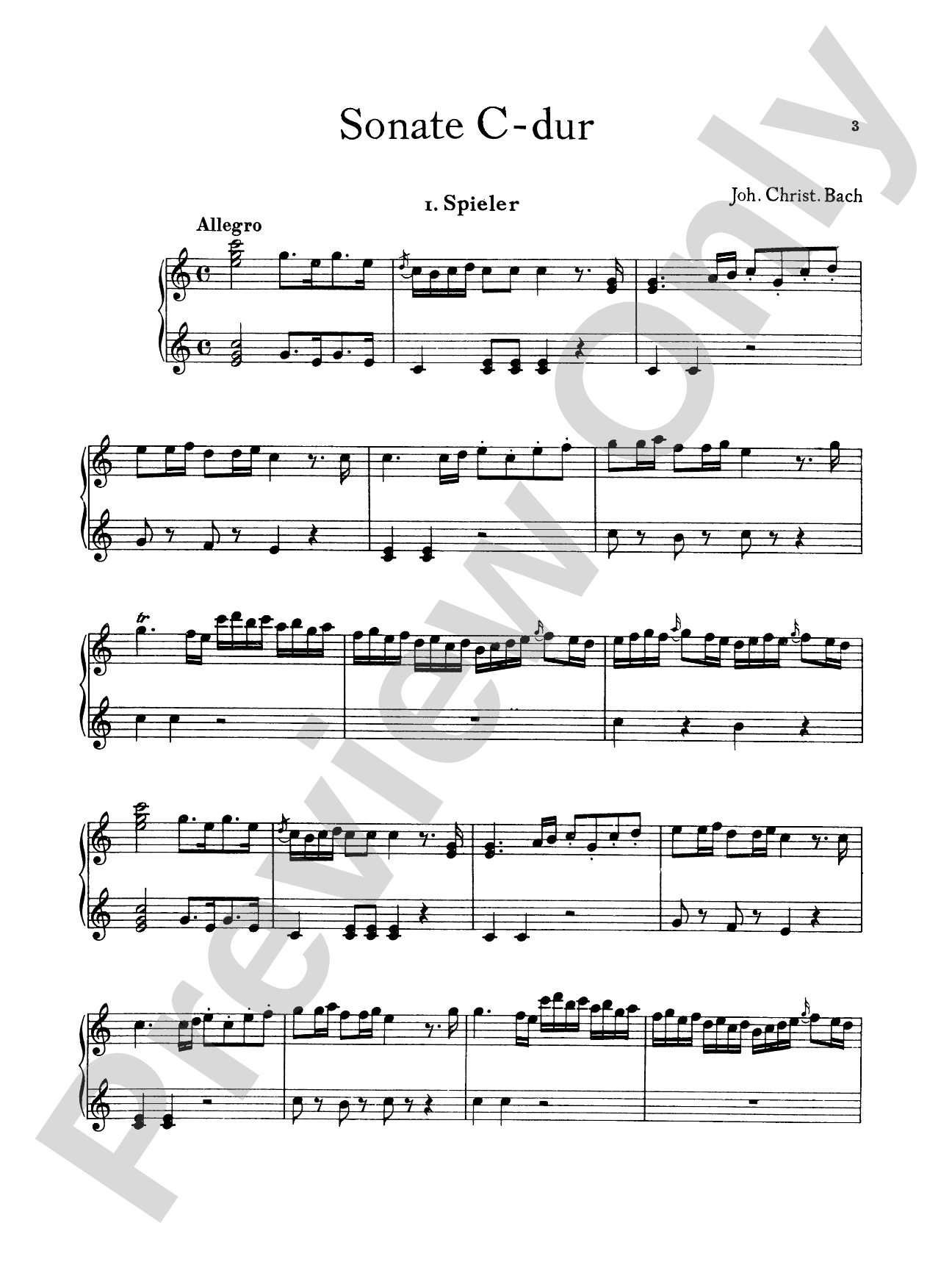
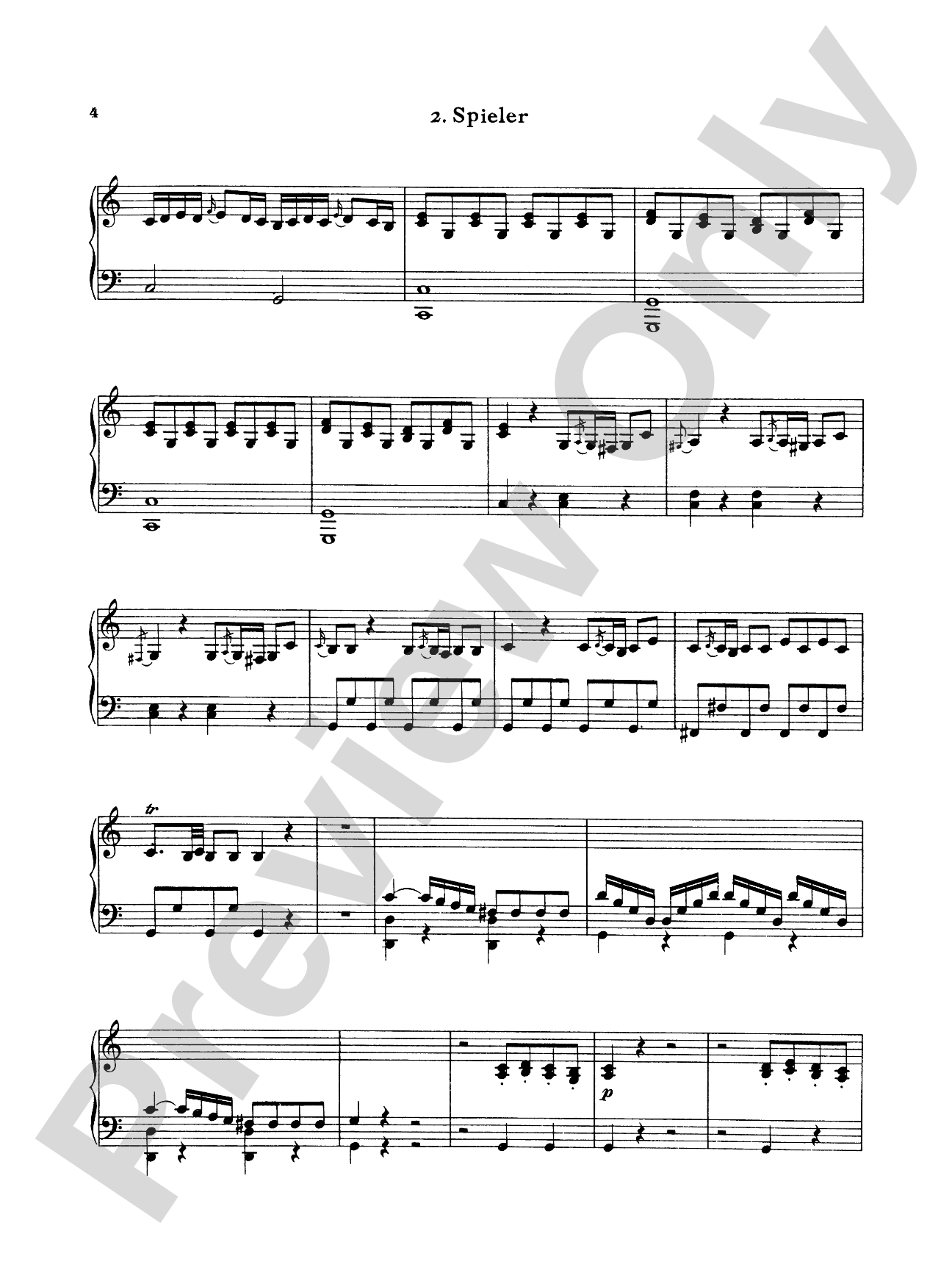
Bach: Sonata in C Major Sheet Music Preview

Bach: Sonata in C Major

By Johann Christian Bach

Item: 00-PC-0004754

Digital Download
$6.99
Description
A Piano Duet for 1 Piano, 4 Hands, composed by Johann Christian Bach.

Don't just read it, hear it, play along with it, and watch your students grow with it. In MakeMusic Cloud, Bach: Sonata in C Major comes alive with professional accompaniment, adjustable tempo, and built-in practice tools that turn solo practice into real progress.

Sample Audio
No sample audio found.
Sample Video
Additional Details
Series: Kalmus Edition
Publisher: Alfred Music
Page Count: 20
SKU: 00-PC-0004754

More about this title

About the Composer: Johann Christian Bach

Johann Christian Bach (1735-1782) was the youngest son of J.S. Bach and became one of the most influential composers of the galant style. Based primarily in London from 1762 onward, he championed the Classical idiom that would define the era, moving away from his father's counterpoint toward melody-driven forms with lighter accompaniment. His sonatas and concertos were widely published and performed across Europe, making him a bridge between Baroque mastery and Classical clarity.

Why we love this

This sonata sits at the sweet spot where serious musicianship meets genuine fun. J.C. Bach's writing is elegant without being austere, and the four-hand format creates natural dialogue between partners rather than the hollow sound of many duet arrangements. Teachers love it because students actually want to play it.

What to expect

Graceful and conversational. J.C. Bach's melodies are singable and approachable, but his harmonic thinking is sophisticated. You feel the intelligence of the writing without the weight of Baroque density or Romantic drama.

Who it's for

Intermediate to advanced pianists who are ready to explore duet literature beyond simplified arrangements. This works well for partners of roughly equal technical ability who want to build ensemble listening skills while engaging with authentic Classical repertoire.

How to get the most out of it

  • Balance the melody between primo and secondo hands rather than letting the primo dominate throughout. Sonata writing assumes both players listen actively to the harmonic and contrapuntal conversation.
  • Establish a steady tempo at the outset and maintain it. This Classical idiom depends on predictable phrasing, and rubato here feels out of place.
  • Pay attention to dynamic markings as structural signposts. They're not decorative; they articulate form and create shape across movements.

How to use it

Pair this with other Classical-era duet works to build a concert set, or program it as a bridge between Baroque and early Romantic repertoire. It also works beautifully in a collaborative recital context where two pianists want to demonstrate ensemble musicianship without abandoning serious musicianship.

Skills your students will build

  • Four-hand coordination and independent part awareness
  • Reading two independent melodic lines simultaneously
  • Sonata form recognition and interpretation
  • Period-appropriate articulation and phrasing in the Classical style
  • Listening to and balancing with a partner at the same instrument

You May Also Like