
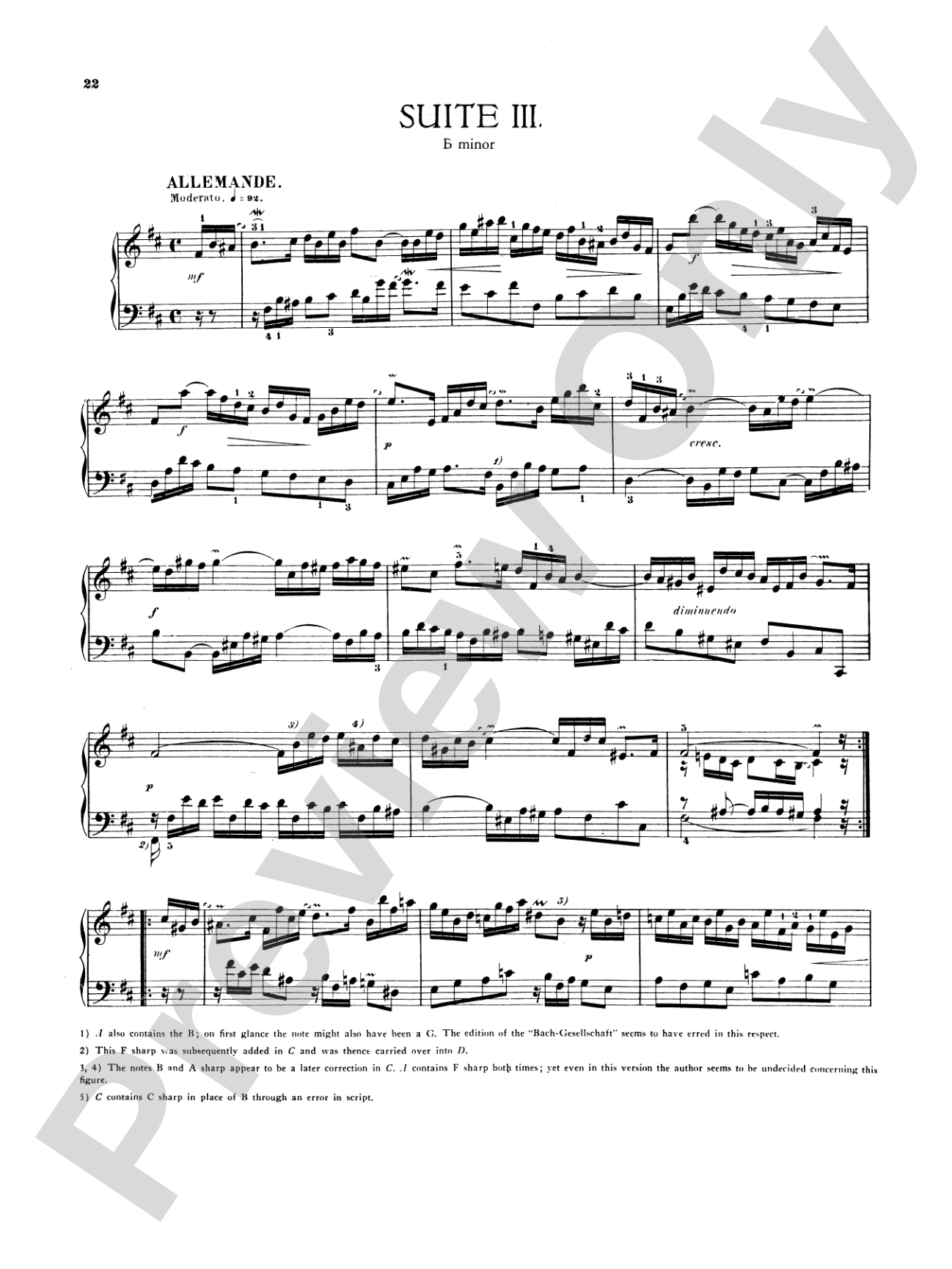
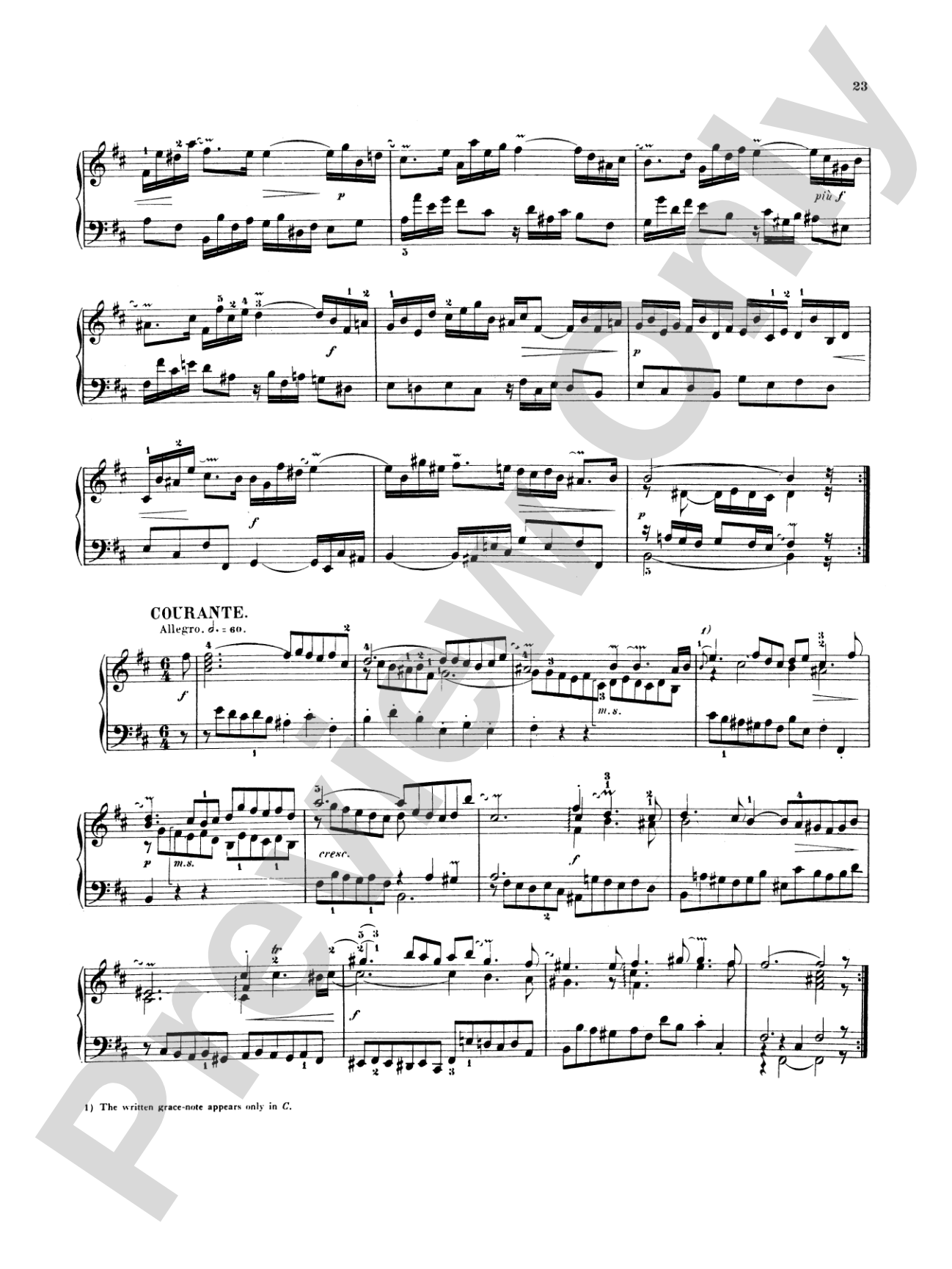

Bach: Six French Suites (Ed. Hans Bischoff)
And Two Suites in A Minor and E-flat Minor
By Johann Sebastian Bach / ed. Hans Bischoff
Item: 00-PC-0004335
$0.99
Pickup currently not available
Description
Each of Bach's six French suites is written in a different key with no harmonic relationship to one another, unlike most of his other works. Within each suite, all of the movements are in the same key and follow standard binary form. In the traditional Baroque suite, there are four movements: Allemande, Courante, Sarabande, and Gigue. However, Bach also includes lesser-used dances such as the Polonaise, Bourée, and Air. Noted Bach expert Dr. Hans Bischoff edited this collection. Titles: No. 1 in D Minor * No. 2 in C Minor * No. 3 in B Minor * No. 4 in E-flat Major * No. 5 in G Major * No. 6 in E Major * Suite in A Minor * Suite in E-flat Major.


Don't just read it, hear it, play along with it, and watch your students grow with it. In MakeMusic Cloud, Bach: Six French Suites (Ed. Hans Bischoff) comes alive with professional accompaniment, adjustable tempo, and built-in practice tools that turn solo practice into real progress.
Open in the Player
Jump straight in and assign it today.
Start Your Free Trial
Open this title and explore the full library in minutes.
Sample Audio
No sample audio found.
Sample Video
No sample videos found.
Additional Details
Series:
Kalmus Edition
Publisher:
Alfred Music
Page Count:
64
SKU:
00-PC-0004335
More about this title
About the Composer: Johann Sebastian Bach
Johann Sebastian Bach (1685-1750) was a German Baroque composer and organist whose vast output spans nearly every genre of his era. His music combines mathematical precision with profound emotional depth, establishing compositional techniques that would influence Western music for centuries. Bach's keyboard works remain foundational to piano pedagogy and performance, valued equally for their technical demands and spiritual content.
Why we love this
These six suites showcase Bach's mastery of dance form and his ability to craft entirely distinct harmonic worlds within a single collection. The inclusion of lesser-known dances alongside the standard Allemande-Courante-Sarabande-Gigue sequence gives performers access to Bach's full palette of Baroque dance styles without the extreme demands of the English or German suites. Hans Bischoff's editing provides clarity for modern pianists navigating the figured bass and articulation conventions of the original.
What to expect
Moving through these suites is like wandering through six different Baroque ballrooms, each with its own emotional climate and architectural logic. The music flows between courtly elegance, intricate counterpoint, and moments of intimate cantability, offering both intellectual satisfaction and the simple pleasure of well-crafted melodic lines. Each key center brings its own sonic character; the minor keys carry a contemplative weight while the major keys project clarity and grace.
Who it's for
Advanced pianists preparing for recitals, competitions, or diploma exams will find a comprehensive exploration of Bach's suite writing across multiple tonal centers. Students studying Baroque style, keyboard history, or counterpoint benefit from direct engagement with Bach's varied approaches to melodic ornamentation, harmonic rhythm, and dance characterization within a unified collection.
How to get the most out of it
- Observe the binary form structure in each movement; the repeat signs are integral to both musical architecture and performance tradition.
- Shape each dance's characteristic rhythm and tempo as a self-contained entity within the suite framework; the contrast between movements sustains listener engagement across the entire sequence.
- Approach the figured bass realizations thoughtfully; Bach's underlying harmonies often contain voice-leading that becomes more apparent when you listen to how the realization supports the melody.
- Use the variety of dance styles to explore different touch qualities: the Allemande's measured dignity requires sustained legato, while the Gigue's faster counterpoint demands clarity and articulation.
How to use it
Present a single suite as a complete recital work that showcases both technical facility and interpretive range within the Baroque tradition. Alternatively, extract contrasting movements from different suites to build a program that demonstrates Bach's orchestration of keyboard texture across varied dance forms. These suites work particularly well as a bridge between early-level Bach (inventions, small preludes) and the more ambitious English or Goldberg Variations.
Skills your students will build
- Binary form analysis and navigation
- Baroque ornamentation and articulation conventions
- Rhythmic characterization of dance styles (Allemande, Courante, Sarabande, Gigue, Polonaise, Bourée, Air)
- Voice independence and contrapuntal clarity across multiple keyboard textures
- Harmonic function within figured bass realizations
- Tonal center establishment and key-specific fingering approaches