Bach's Lunch: 2nd Violin Sheet Music Preview

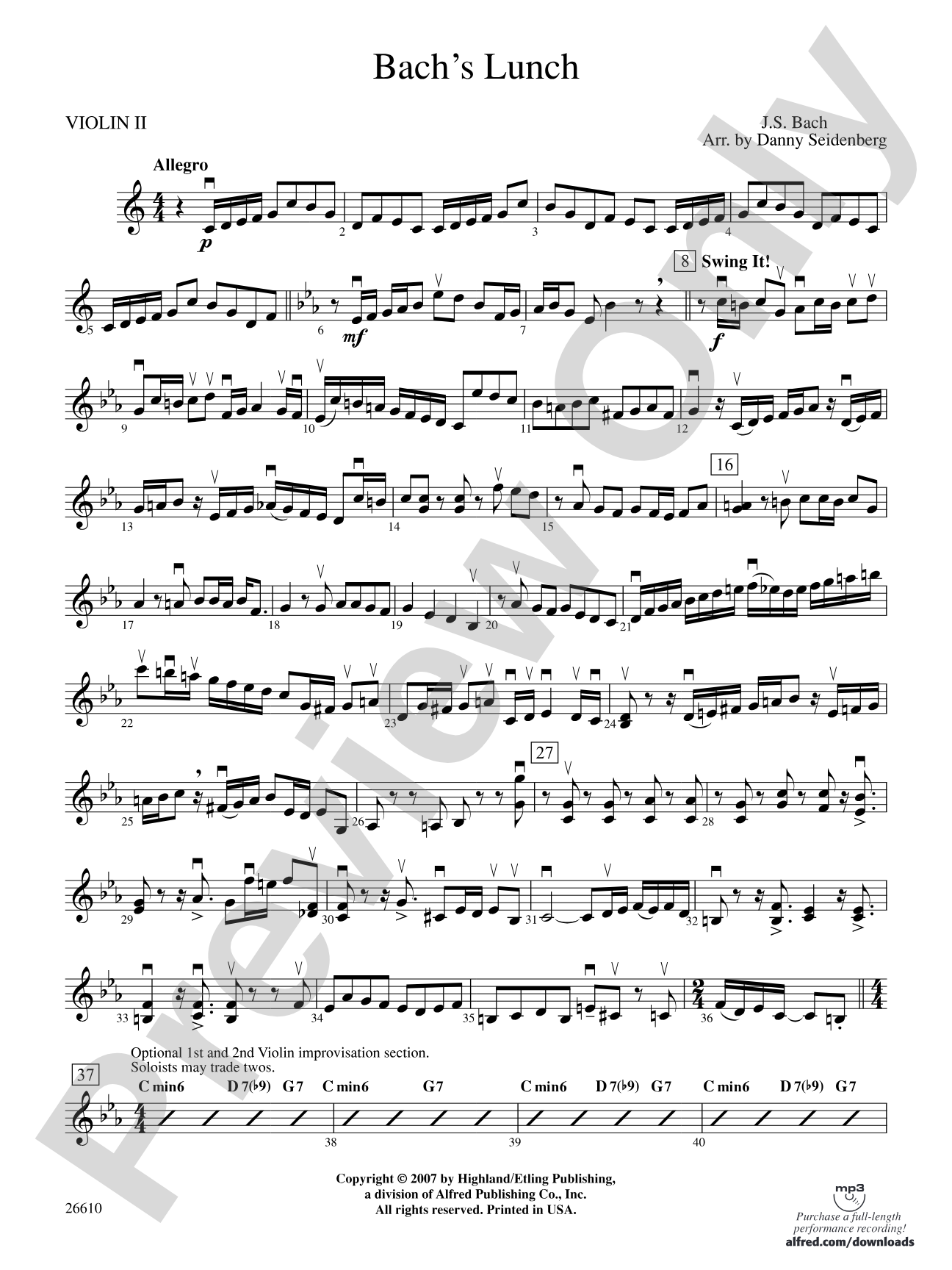
Bach's Lunch: 2nd Violin

[Johann Sebastian Bach] / arr. Danny Seidenberg

Grade: 4

Item: 00-PC-0001115_VN2

Digital Download
$5.99
Description
A slightly swung version of Bach's Double Violin Concerto! As played by the Turtle Island String Quartet and now cleverly arranged for school orchestras by Danny Seidenberg, a former member, this piece will open new doors to Bach's music for your students! Encourage the optional improvisation, or use the included written-out solos.

Don't just read it, hear it, play along with it, and watch your students grow with it. In MakeMusic Cloud, Bach's Lunch: 2nd Violin comes alive with professional accompaniment, adjustable tempo, and built-in practice tools that turn solo practice into real progress.

Sample Audio
0:00
0:00
Sample Video
Additional Details
Series: Highland/Etling String Alternatives
Publisher: Alfred Music
Page Count: 62
SKU: 00-PC-0001115_VN2

More about this title

About the Composer: Johann Sebastian Bach

Johann Sebastian Bach (1685–1750) stands as one of history's most influential composers, whose mastery of counterpoint and harmonic language shaped everything that followed. His sacred and secular works for diverse ensembles reveal an inexhaustible gift for melody and structural brilliance, making his music endlessly adaptable and rewarding for musicians of all levels.

Why we love this

Danny Seidenberg's arrangement reveals why the Turtle Island String Quartet chose this concerto as a foundation for their swung interpretations: Bach's melodic lines and dialogue between voices translate beautifully to a slightly relaxed, contemporary feel without losing an ounce of his architectural integrity. Grade 4 orchestras gain immediate access to music they might otherwise encounter only as an academic exercise, and the dual option of improvised or written-out solos lets you meet your ensemble exactly where it is.

What to expect

Light and conversational, with two solo voices trading bright ideas over a walking accompaniment. The swing inflection adds a contemporary air that feels neither frivolous nor forced, inviting listeners to hear familiar contrapuntal logic through a slightly different lens while maintaining the refinement and clarity Bach's music demands.

Who it's for

String orchestra directors at the Grade 4 level who want to expand their students' relationship with Baroque masterworks beyond textbook arrangements. Players who thrive on melody and part independence will engage deeply with Bach's voice-leading, and ensemble members at this level have the technical foundation to execute both the written and improvisational elements.

How to get the most out of it

  • Balance the two solo voices carefully during the opening unison passage so both lines remain audible as they separate into dialogue.
  • Approach the swing feel as a gentle sway rather than a dramatic rhythmic shift; Bach's contrapuntal clarity remains paramount.
  • If you use the written-out solos, treat them as fully notated lines deserving the same attention you'd give any principal part. If you encourage improvisation, establish boundaries and harmonic anchors in rehearsal beforehand.
  • Shape phrases in the ritornello sections with longer breath lines to honor Bach's original architectural proportions.

How to use it

Schedule this early in a concert to showcase your orchestra's versatility and set a tone of musical sophistication and playfulness. It pairs naturally with other Bach arrangements or with contemporary works that engage with classical forms, and it serves as a bridge for audiences unfamiliar with Baroque repertoire.

Skills your students will build

  • Baroque counterpoint and voice independence
  • Interpreting historical repertoire with contemporary inflections
  • Solo line projection and principal part responsibility
  • Optional: improvisation within harmonic frameworks
  • Listening to and responding to other string sections in real time

You May Also Like