
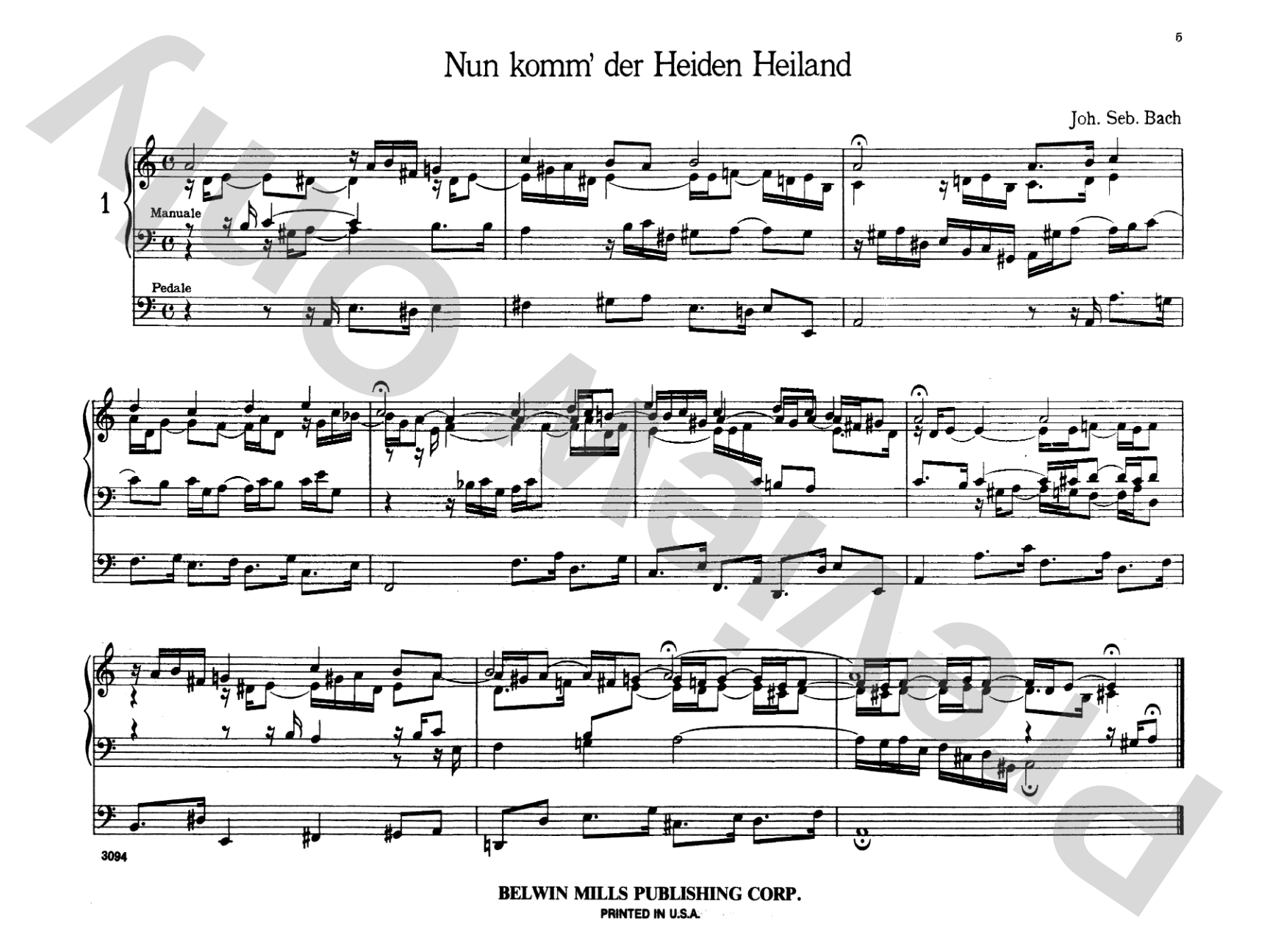

Bach: Organbook (Orgelbuchlein): Organ Comb Bound Book
By Johann Sebastian Bach
Item: 00-PK-0002874

$15.99
Pickup currently not available
Buy Extra Parts (Digital PDF Download)
Parts Added to Cart!
Related Items
Organbook (Orgelbuchlein): Organ Comb Bound Book |
$15.95
|
View |
Description
Arranged for Christmas, Easter and Passion. The comb binding creates a lay-flat book that is perfect for study and performance.


Don't just read it, hear it, play along with it, and watch your students grow with it. In MakeMusic Cloud, Bach: Organbook (Orgelbuchlein): Organ Comb Bound Book comes alive with professional accompaniment, adjustable tempo, and built-in practice tools that turn solo practice into real progress.
Open in the Player
Jump straight in and assign it today.
Start Your Free Trial
Open this title and explore the full library in minutes.
Sample Audio
No sample audio found.
Sample Video
No sample videos found.
Additional Details
Series:
Kalmus Edition
Publisher:
Alfred Music
Page Count:
56
SKU:
00-PK-0002874
More about this title
About the Composer: Johann Sebastian Bach
Johann Sebastian Bach (1685, 1750) was a master of contrapuntal writing and harmonic invention whose influence shaped centuries of musical practice. His work at the Weimar court and later in Leipzig produced some of the most structurally sophisticated music in the Western canon, and his keyboard works remain fundamental to the training of serious musicians.
Bach's organ compositions are distinguished by their architectural precision and spiritual depth. The Orgelbüchlein (Little Organ Book), compiled during his Weimar years, distills his compositional genius into chorale-based miniatures that balance technical demands with profound liturgical purpose.
Why we love this
The Orgelbüchlein occupies a rare space in repertoire: substantial enough to challenge advancing organists, yet concise enough to be learned thoroughly. These chorales are vehicles for understanding Bach's contrapuntal language without the intimidation factor of the larger works. The comb binding and lay-flat design transform this into a practical performance edition that actually stays open during study and recital.
What to expect
These pieces embody quiet intensity. Each chorale moves with purpose and directness, never wasting material, always serving the text and season it accompanies. There's an almost mathematical precision underlying the emotional content, creating music that feels both intimate and intellectually rigorous.
Who it's for
Organists preparing for church positions, students working through the Baroque canon, and teachers seeking literature that bridges early-intermediate and advanced technique. This collection serves both as a performance source and a study tool for understanding Bach's approach to functional church music.
How to get the most out of it
- Allow the chorale melody to sing through the texture; resist the urge to equalize all voices. Bach's voice leading creates a natural hierarchy even in four-part writing.
- Use registration thoughtfully to reinforce the harmonic structure. Changing stops between sections clarifies Bach's sectional design without obscuring the organic flow.
- Attend to Bach's use of silence and rhythmic rest. These moments of contrast are as important as the active material for achieving clarity and breath.
- Practice each voice independently before combining them. This reveals the independence of lines and prevents muddying that can obscure the counterpoint.
How to use it
Program individual chorales in recitals that explore a particular liturgical season (Christmas, Easter, Passion) or thematic idea. The brevity of each piece makes them ideal for opening or closing a program, or as transitions between longer works. Church musicians will find them invaluable for preludes and postludes throughout the church year.
Skills your students will build
- Voice leading across multiple independent lines
- Registration and tonal color choices for Baroque music
- Reading fully realized four-part chorale textures
- Interpreting figured bass principles as they apply to keyboard harmony
- Balancing structural clarity with flowing legato phrasing