
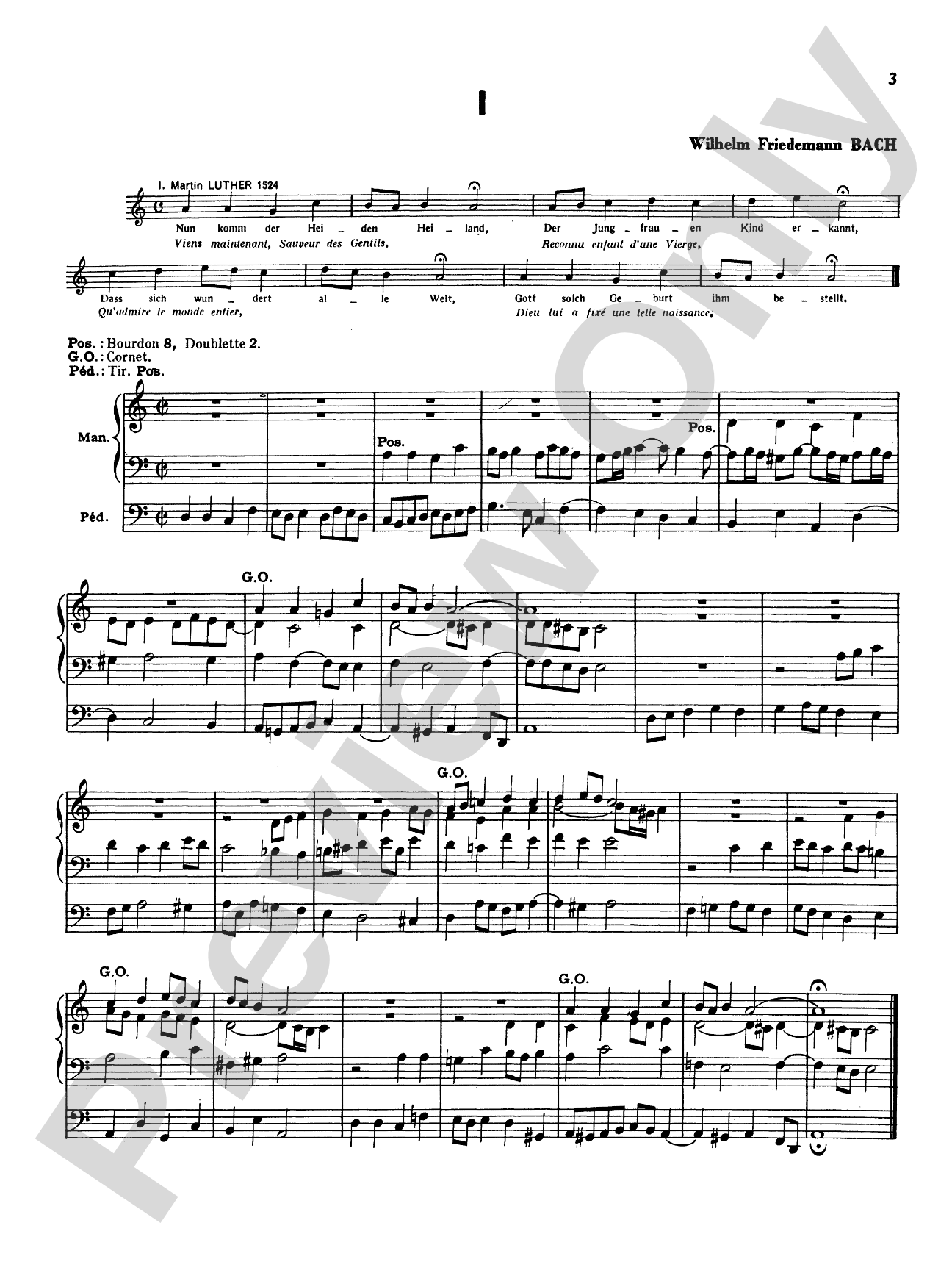

Bach: Organ Works: Organ Book
By Wilhelm Friedemann Bach
Item: 00-PK-0002886

$8.99
Pickup currently not available
Buy Extra Parts (Digital PDF Download)
| Product | Price | Quantity |
|---|---|---|
| Bach: Organ Works | $0.99 | |
| Bach: Organ Works | $0.99 | |
| Bach: Organ Works | $0.99 | |
| Bach: Organ Works | $0.99 | |
| Bach: Organ Works | $0.99 | |
| Bach: Organ Works | $0.99 | |
| Bach: Organ Works | $0.99 | |
| Bach: Organ Works | $0.99 | |
| Bach: Organ Works | $0.99 | |
| Bach: Organ Works | $0.99 | |
| Bach: Organ Works | $0.99 |
Parts Added to Cart!
Related Items
Organ Works: Organ Book |
$8.95
|
View |
Description
A collection of exercises, for Organ, composed by Wilhelm Friedemann Bach.


Don't just read it, hear it, play along with it, and watch your students grow with it. In MakeMusic Cloud, Bach: Organ Works: Organ Book comes alive with professional accompaniment, adjustable tempo, and built-in practice tools that turn solo practice into real progress.
Open in the Player
Jump straight in and assign it today.
Start Your Free Trial
Open this title and explore the full library in minutes.
Sample Audio
No sample audio found.
Sample Video
No sample videos found.
Additional Details
Series:
Kalmus Edition
Publisher:
Alfred Music
Page Count:
36
SKU:
00-PK-0002886
More about this title
About the Composer: Wilhelm Friedemann Bach
Wilhelm Friedemann Bach (1710, 1784) was the most accomplished keyboard player among J.S. Bach's sons and a composer of considerable gifts in his own right. He inherited his father's technical mastery and expanded it with his own expressive language, bridging the Baroque and emerging Classical styles. His organ works reveal a musician deeply engaged with the instrument's pedagogical possibilities alongside its artistic potential.
As the eldest son and a student of J.S. Bach himself, Friedemann held prestigious positions in Halle and Dresden, where he was expected to maintain the highest standards of keyboard performance and instruction. His compositional output, though smaller than some of his brothers', demonstrates a serious commitment to advancing organ technique through thoughtfully designed exercises that never sacrifice musical substance for mechanical drill.
Why we love this
These exercises strike a rare balance between disciplined contrapuntal training and genuinely musical material. Organists will find themselves developing secure technique while navigating Bach family counterpoint without the imposing scale of the complete Well-Tempered Clavier. The collection rewards serious practice with repertoire that sounds accomplished and sounds like Bach.
What to expect
These pages contain the disciplined refinement of a master's teaching materials. The writing balances geometric clarity in its counterpoint with moments of unexpected harmonic depth, creating a sense of intellectual rigor that never sacrifices musicality. Moving through the exercises, you encounter the voice of a composer thoroughly trained in tradition yet curious about contemporary expression.
Who it's for
Organists developing intermediate to advanced fluency with manual and pedal coordination will find substantial material here. Teachers seeking carefully graded exercises that maintain musical integrity for advanced students and those preparing for classical era organ repertoire will value this collection's pedagogical and artistic balance.
How to get the most out of it
- Establish the harmonic rhythm clearly through the pedal part; the feet must lead the interpretation even when the hands carry memorable lines.
- Attend to voice independence in passages with competing melodic strands; each voice should have distinct articulation and phrasing even at moderate tempos.
- Use registration changes between exercises to reinforce their pedagogical focus and maintain listener engagement through a longer study session.
- Practice hands separately before combining them, as the weight distribution between manual and pedal work differs significantly from much piano literature.
How to use it
Organists can extract individual pieces or brief sequences for student recitals, particularly when paired with larger Bach works to create a concert exploring father and son compositional approaches. The collection works effectively as assigned repertoire in an organ curriculum, supporting technique development alongside performance experience.
Skills your students will build
- Manual and pedal independence in four-part writing
- Contrapuntal clarity with multiple independent voices
- Harmonic analysis of Baroque and Classical voice leading
- Registration choices that enhance structural clarity
- Sight-reading fluency in keyboard score notation