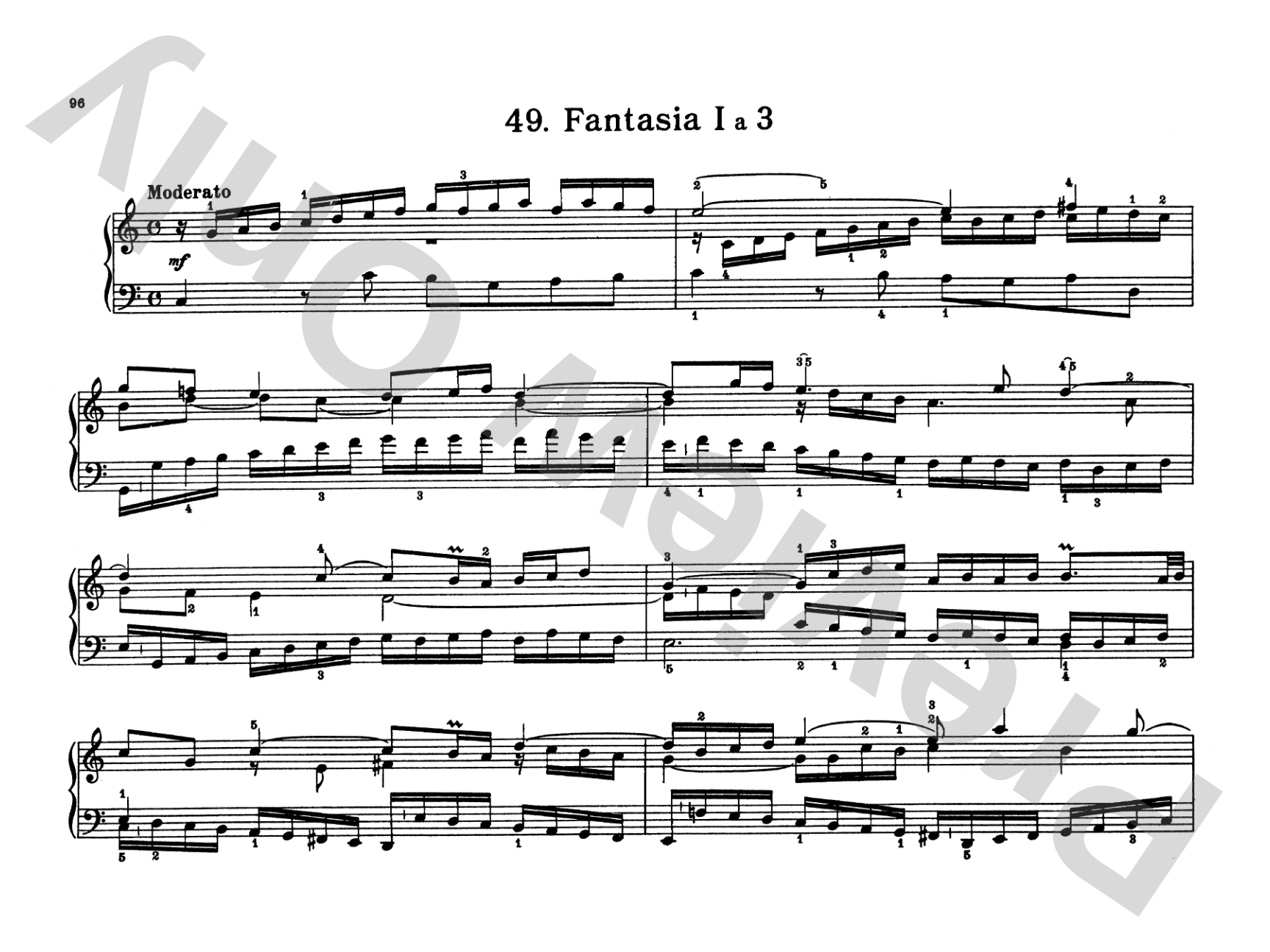
Bach: Notebook for Wilhelm Friedemann Bach Sheet Music Preview

Bach: Notebook for Wilhelm Friedemann Bach

By Johann Sebastian Bach

Level: Intermediate / Advanced

Item: 00-PC-0004477

Digital Download
$0.99
Description
Johann Sebastian Bach's "Notebook for Wilhelm Friedemann Bach" is a collection of keyboard music Bach began compiling in around 1720. Most of the pieces included are better known as parts of the Well-Tempered Clavier and the Inventions and Sinfonias. The authorship of some of the other works in the collection is debated. The comb binding creates a lay-flat book that is perfect for study and performance. 62 Selections, 123 pages.

Don't just read it, hear it, play along with it, and watch your students grow with it. In MakeMusic Cloud, Bach: Notebook for Wilhelm Friedemann Bach comes alive with professional accompaniment, adjustable tempo, and built-in practice tools that turn solo practice into real progress.

Sample Audio
No sample audio found.
Sample Video
Additional Details
Series: Kalmus Edition
Publisher: Alfred Music
Page Count: 120
SKU: 00-PC-0004477

More about this title

About the Composer: Johann Sebastian Bach

Johann Sebastian Bach (1685-1750) shaped Western music so fundamentally that later composers studied his works as a universal language of musical architecture. Working across multiple genres and positions throughout Germany, Bach synthesized centuries of keyboard tradition into music that remains technically demanding and spiritually profound. His keyboard works, in particular, became the foundation of piano pedagogy and remain central to understanding harmonic progression, counterpoint, and the capabilities of the instrument itself.

Why we love this

This collection captures Bach's keyboard writing at a critical pedagogical moment, when he was deliberately creating models for his son. The mix of preludes, inventions, and sinfonias offers intermediate to advanced pianists a curated pathway through some of Baroque music's most essential technical and musical challenges. The comb binding transforms what could be an intimidating folio into a practical, page-turning resource that stays open during practice and performance.

What to expect

These pieces balance intellectual clarity with deep musicality. You move through invention and sinfonias that feel almost conversational, their voices in constant dialogue, then into more elaborate preludes where harmonic progressions unfold with inevitable grace. There's a satisfaction in the mathematical perfection underlying the music; Bach's hand is always visible in the structure, yet the emotional weight remains.

Who it's for

Intermediate to advanced pianists preparing for serious repertoire study, students working through Bach's foundational keyboard works, and teachers seeking a portable, rehearsal-friendly edition of essential Baroque masterpieces. This collection is ideal for pianists ready to engage with genuine compositional architecture rather than simplified versions.

How to get the most out of it

  • Approach each piece's contrapuntal lines with the clarity of separate voices; Bach's keyboard writing asks you to voice inner parts with the same intention as outer ones.
  • Tempo stability matters more than speed. Use a metronome to establish a tempo where you can articulate the counterpoint cleanly, then hold it steady throughout.
  • Let the harmonic rhythm guide your phrasing rather than imposing Romantic-era rubato. Bach's harmonies speak clearly when aligned with his structural logic.
  • Mark the fugal entries and thematic returns in your score so you hear them as landmarks in the musical architecture, not just technical passages.

How to use it

Build recital programs around thematic groupings from this collection: pair inventions in related keys, or contrast a prelude with its corresponding fugal form. In a Bach-focused concert, these pieces function as both anchors (Inventions and Well-Tempered Clavier excerpts are audience-friendly) and vehicles for demonstrating technical growth across multiple selections. This edition also works well for pedagogical performances where the goal is showing repertoire depth rather than a single polished piece.

Skills your students will build

  • Reading and executing clear polyphonic texture with independent hand voices
  • Maintaining consistent tempi through contrapuntal passages without sacrificing articulation
  • Identifying fugal entries, inversions, and thematic transformations by ear and sight
  • Understanding Baroque phrasing shaped by harmonic rhythm rather than metric downbeats
  • Building finger independence and control across multiple simultaneous lines

You May Also Like