
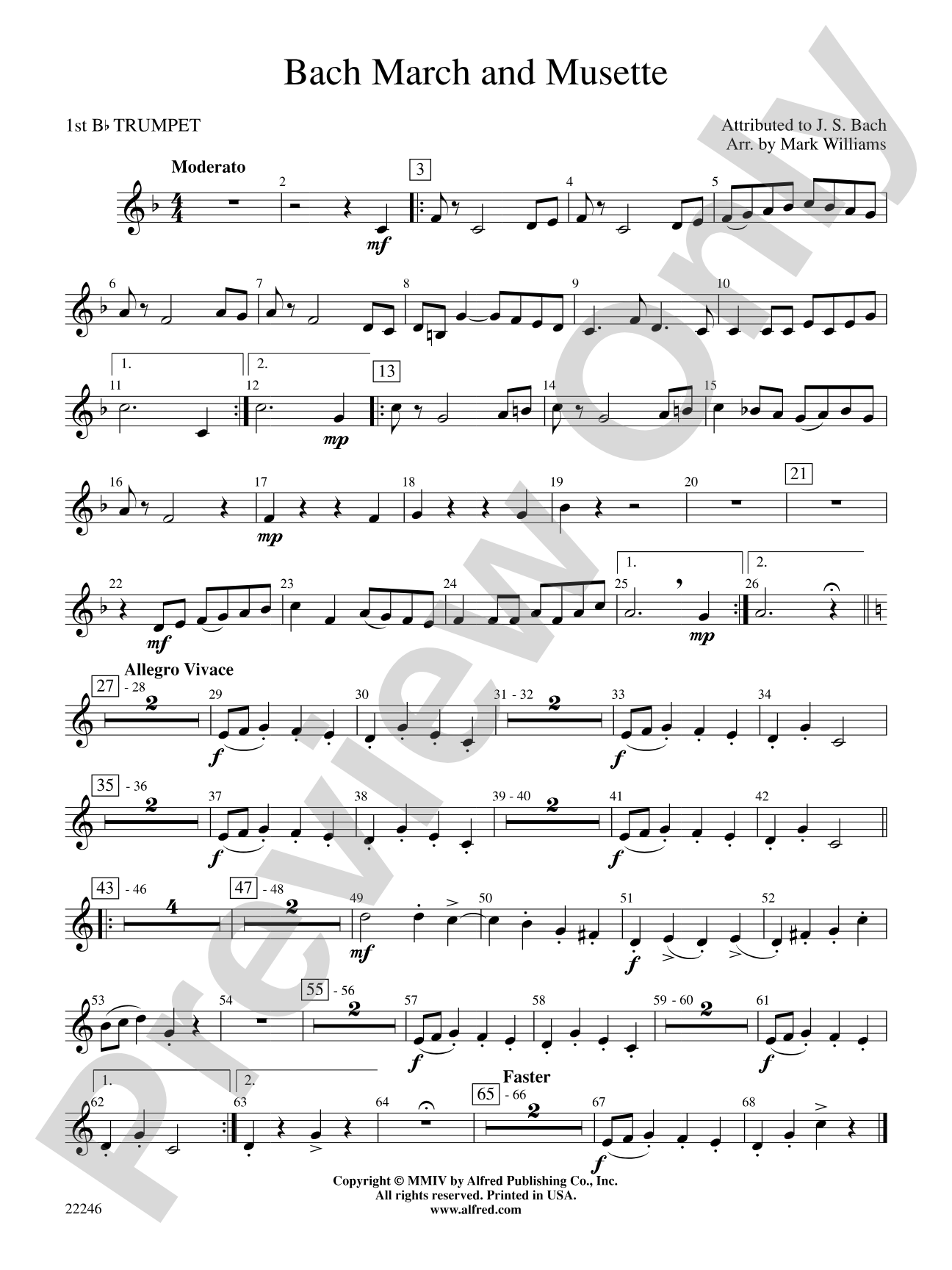

Bach March and Musette: 1st B-flat Trumpet
By Johann Sebastian Bach / arr. Mark Williams
Grade: 1.5 (Easy)
Item: 00-PC-0000500_T1
$3.00
Pickup currently not available
Description
These two pieces from the Notebook for Anna Magdalena Bach have been a favorite of keyboard players for centuries. This skillful arrangement finally brings these great classics well within the reach of the developing young band. Correlated with Accent on Achievement, Book 2, page 23, this two-movement work can serve as a vehicle for introducing your band to an important period of music history. This title is available in MakeMusic Cloud.


Don't just read it, hear it, play along with it, and watch your students grow with it. In MakeMusic Cloud, Bach March and Musette: 1st B-flat Trumpet comes alive with professional accompaniment, adjustable tempo, and built-in practice tools that turn solo practice into real progress.
Open in the Player
Jump straight in and assign it today.
Start Your Free Trial
Open this title and explore the full library in minutes.
Sample Audio
1
Audio File
--:--
0:00
0:00
Sample Video
No sample videos found.
Additional Details
Series:
Accent on Achievement
Publisher:
Alfred Music
Page Count:
120
SKU:
00-PC-0000500_T1
More about this title
About the Composer: Johann Sebastian Bach
Johann Sebastian Bach (1685-1750) stands as one of the most influential composers in Western music history. His mastery of counterpoint, fugal writing, and harmonic language shaped centuries of musical development that followed. Though he composed over 1,000 works across every major Baroque genre, Bach spent much of his career in modest church and court positions, gaining broader recognition only after his death. His music combines mathematical precision with profound emotional depth, making it foundational to music education at every level.
Why we love this
Mark Williams has captured the elegance of these keyboard pieces while preserving the exact character that made them teaching tools in their original form. The Grade 1.5 setting opens Bach to bands that wouldn't otherwise encounter genuine Baroque counterpoint and phrasing, and the pairing of March and Musette creates a complete concert statement that feels substantial without overwhelming developing players. Programming these pieces signals to your audience that your band engages with the musical canon, not just contemporary wind band repertoire.
What to expect
These pieces radiate the courtly grace and mathematical balance Bach brought to every composition he wrote. The March opens with noble simplicity while the Musette (a lighter, dance-inspired form) dances with transparent texture and gentle wit. Together they offer a window into the Baroque world where elegance meant clarity, not complexity.
Who it's for
Developing concert bands working at the Grade 1.5 level who are ready to engage with genuine Baroque literature. This arrangement serves as a bridge for young musicians who have mastered fundamental technique but need exposure to period-specific phrasing and part-writing that transcends contemporary method book material.
How to get the most out of it
- Shape each phrase with clear beginning, middle, and end rather than playing through without architectural intent. Bach's melodies breathe within their harmonic framework.
- Balance the upper voice melody against inner voices so that when a secondary line carries musical material, it emerges without drowning out the primary theme.
- Approach articulation with specificity; Baroque style requires crisp, even tonguing that brings rhythmic vitality to running passages without becoming mechanical.
- Use the concert band's full color palette to differentiate the two movements. Reserve brighter sonorities for the March and find a more intimate, dance-like lightness in the Musette.
How to use it
Anchor these pieces in a Baroque-era concert or pair them with other period literature to demonstrate how your band handles historical context alongside contemporary works. Their brief, memorable form makes them excellent opening selections that establish musicianship without fatiguing younger ensembles. The correlation to Accent on Achievement, Book 2 also positions them naturally within your curriculum's learning progression.
Skills your students will build
- Baroque phrasing and articulation conventions
- Transparent voice leading and part awareness
- Balance between primary and secondary melodic lines
- Recognizing and performing period-appropriate style markers
- Reading and interpreting works from the keyboard repertoire adapted for band