
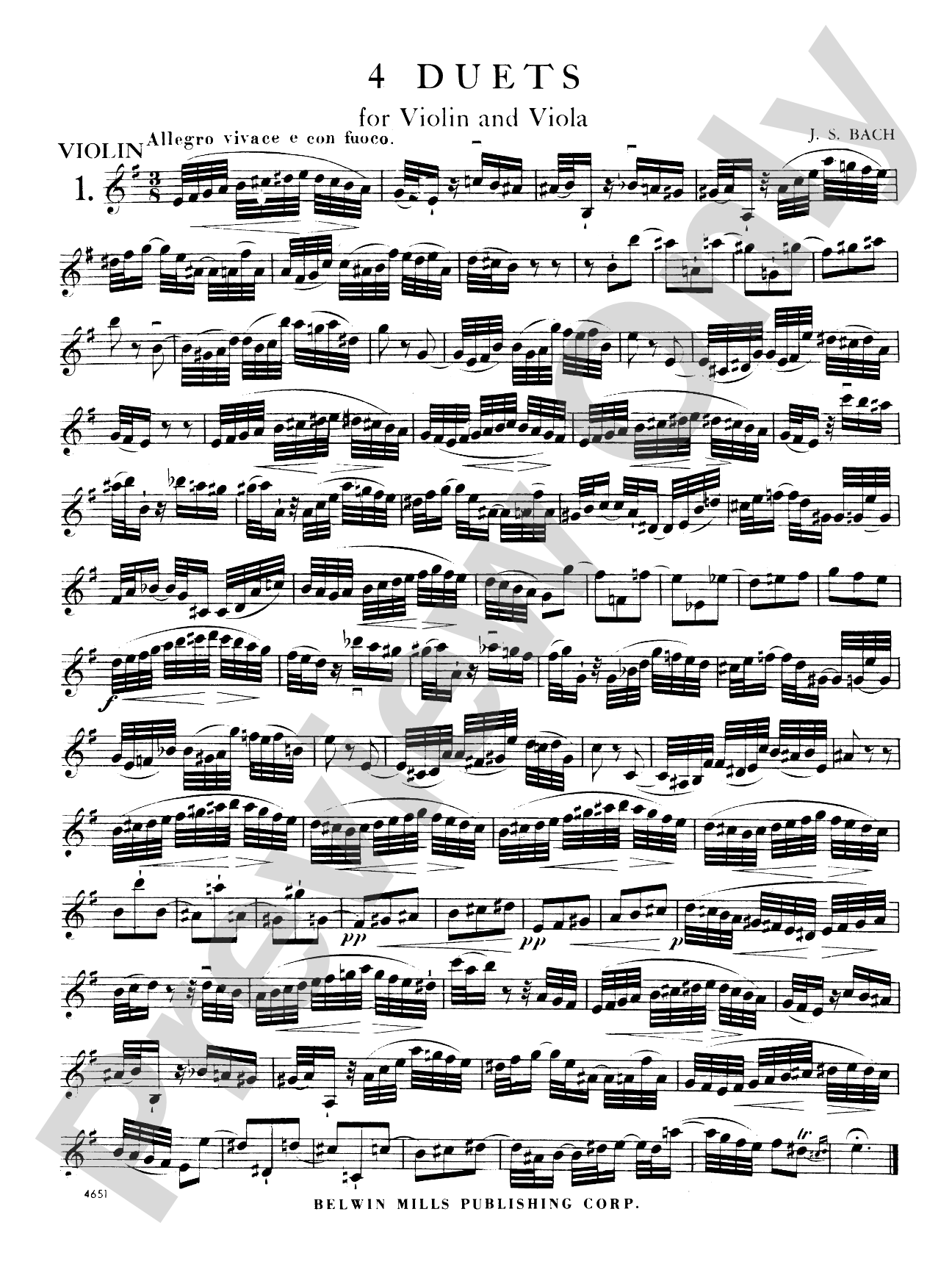

Bach: Four Duets for Violin and Viola: String Duo Book
By Johann Sebastian Bach
Item: 00-PK-0003582
$9.99
Pickup currently not available
Buy Extra Parts (Digital PDF Download)
| Product | Price | Quantity |
|---|---|---|
| Bach: Four Duets for Violin and Viola | $0.99 | |
| Bach: Four Duets for Violin and Viola | $0.99 | |
| Bach: Four Duets for Violin and Viola | $0.99 | |
| Bach: Four Duets for Violin and Viola | $0.99 | |
| Bach: Four Duets for Violin and Viola | $0.99 | |
| Bach: Four Duets for Violin and Viola | $0.99 | |
| Bach: Four Duets for Violin and Viola | $0.99 | |
| Bach: Four Duets for Violin and Viola | $0.99 |
Parts Added to Cart!
Description
A collection of String Duets for Violin and Viola, composed by Johann Sebastian Bach.


Bach: Four Duets for Violin and Viola: String Duo Book isn't in MakeMusic Cloud just yet...but it could be. Let us know you'd like to see it, and you'll help shape what comes next. In the meantime, start a free trial and dive into thousands of interactive titles your students can play along with today.
Request This Title
Tell us you want it.
Start Your Free Trial
Explore everything that's ready to play right now.
Sample Audio
No sample audio found.
Sample Video
No sample videos found.
Additional Details
Series:
Kalmus Edition
Publisher:
Alfred Music
Page Count:
16
SKU:
00-PK-0003582
More about this title
About the Composer: Johann Sebastian Bach
Johann Sebastian Bach (1685-1750) stands as one of history's most systematic composers, bringing mathematical rigor and expressive depth to every form he touched. His output spans cantatas, passions, concertos, keyboard works, and chamber music, each category demonstrating complete mastery of compositional technique. Bach's duets occupy a special place in his catalog: they strip away accompaniment to reveal the pure architecture of his counterpoint, making them invaluable for understanding how two independent melodic lines can serve both structural and emotional purposes simultaneously.
Why we love this
These duets distill Bach's contrapuntal language into its most essential form, eliminating distractions and forcing both players to listen with complete attention to each other. They work equally well as repertoire for students building ensemble awareness and as genuine concert material for advanced players, offering genuine musical substance at multiple levels of development.
What to expect
These pieces contain the crystalline clarity of Bach at his most economical, where every note earns its place through harmonic function or melodic consequence. The writing alternates between moments of intimate dialogue and sections where the two voices weave together so tightly they feel almost inseparable, creating a sense of intellectual beauty and emotional restraint characteristic of Baroque chamber music.
Who it's for
These duets serve advanced string students and chamber musicians preparing for youth orchestra placements, competitions, or recitals. They also work well for teachers seeking genuine Baroque literature that demands real listening skills without requiring a full chamber ensemble.
How to get the most out of it
- Balance the voices so that neither dominates; Bach wrote these lines with equal importance, and the dialogue should feel conversational rather than hierarchical.
- Pay careful attention to phrase breathing and articulation choices that clarify the harmonic structure underlying the two melodic lines.
- Practice sections separately in block chords to hear the vertical harmony Bach created, then return to the duet texture with that awareness intact.
- Shape phrases through dynamic contour and subtle tempo flexibility rather than mechanical metronomic steadiness; Baroque music lives in the flexibility of the line.
How to use it
Program these duets on chamber recitals or young artist competitions where serious Bach repertoire strengthens a student's profile among peers performing lighter fare. They also serve as excellent pedagogical performance pieces at honor ensemble festivals or string festivals that feature chamber music categories.
Skills your students will build
- Two-part counterpoint and voice independence
- Baroque articulation and phrasing conventions
- Listening and rhythmic precision in chamber settings
- Reading from score with equal attention to multiple lines
- Understanding harmonic function through melodic analysis