
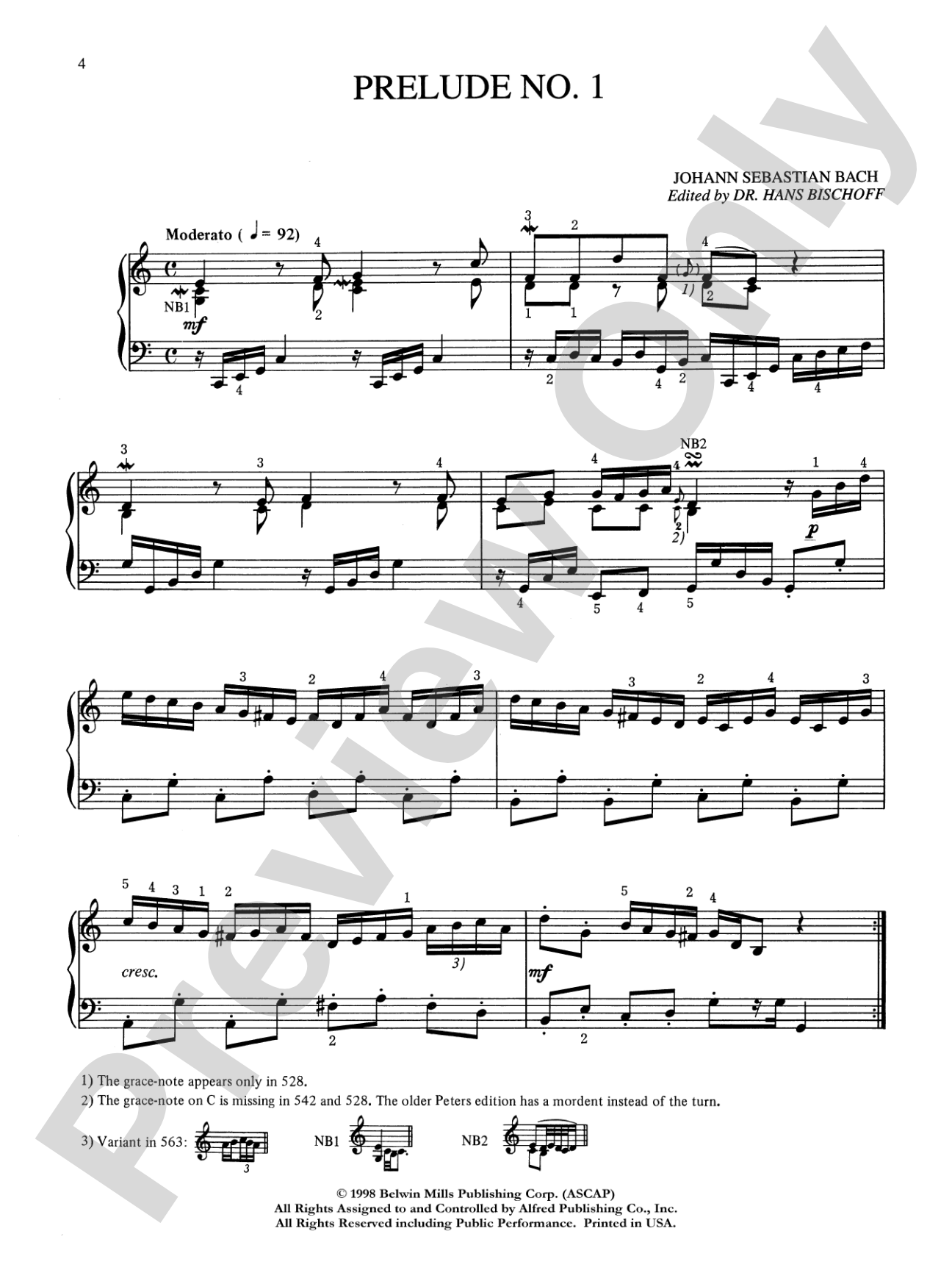
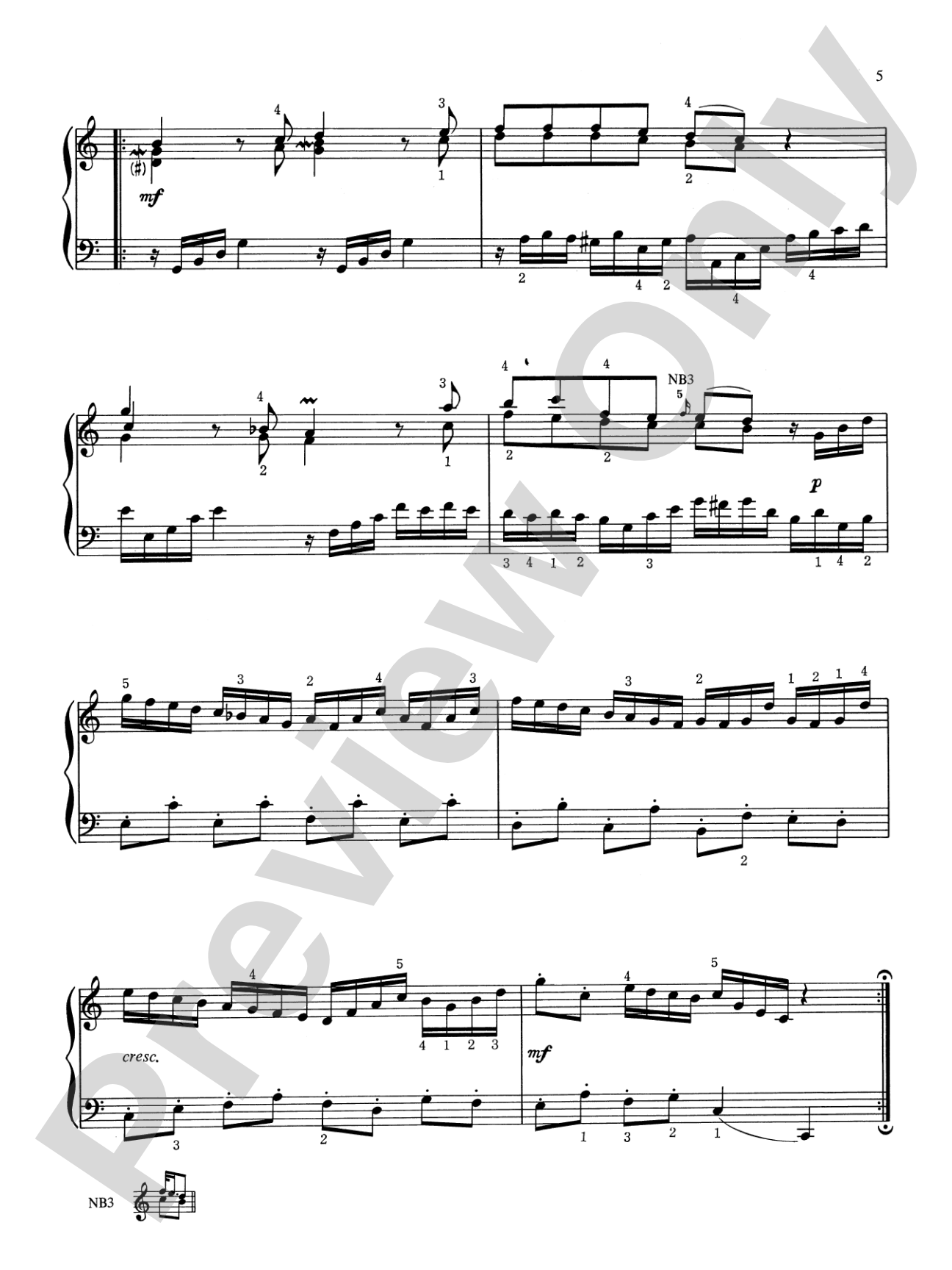

Bach: Eighteen Little Preludes (Ed. Hans Bischoff): Piano Book
By Johann Sebastian Bach / ed. Hans Bischoff
Item: 00-PK-0002704

$7.99
Pickup currently not available
Buy Extra Parts (Digital PDF Download)
Parts Added to Cart!
Description
This collection, edited by Dr. Hans Bischoff, consists of the "Six Little Preludes," BWV 933-938, along with twelve preludes taken from "The Little Piano Book" (Clavierbuchlein) of Wilhelm Friedemann Bach. Contains: Prelude No. 1 in C Major (BWV 933) * Prelude No. 2 in C Minor (BWV 934) * Prelude No. 3 in D Minor (BWV 935) * Prelude No. 4 in D Major (BWV 936) * Prelude No. 5 in E Major (BWV 937) * Prelude No. 6 in E Minor (BWV 938) * Prelude No. 7 in C Major * Prelude No. 8 in C Major * Prelude No. 9 in C Minor * Prelude No. 10 in D Major * Prelude No. 11 in D Minor * Prelude No. 12 in D Minor * Prelude No. 13 in E Minor * Prelude No. 14 in F Major * Prelude No. 15 in F Major * Prelude No. 16 in G Minor * Prelude No. 17 in G Minor * Prelude No. 18 in A Minor.


Don't just read it, hear it, play along with it, and watch your students grow with it. In MakeMusic Cloud, Bach: Eighteen Little Preludes (Ed. Hans Bischoff): Piano Book comes alive with professional accompaniment, adjustable tempo, and built-in practice tools that turn solo practice into real progress.
Open in the Player
Jump straight in and assign it today.
Start Your Free Trial
Open this title and explore the full library in minutes.
Sample Audio
No sample audio found.
Sample Video
No sample videos found.
Additional Details
Series:
Kalmus Edition
Publisher:
Alfred Music
Page Count:
32
SKU:
00-PK-0002704
More about this title
About the Composer: Johann Sebastian Bach
Johann Sebastian Bach (1685-1750) stands as one of the most influential composers in Western music history. His mastery of counterpoint, harmonic language, and keyboard writing established the foundation for classical music that followed. Bach's pedagogical works, including these Little Preludes, were written to train young musicians in fingering technique, voice leading, and the principles of musical construction that define his compositional legacy.
Why we love this
This collection bridges the gap between beginner and intermediate repertoire with remarkable efficiency. Each prelude tackles specific technical challenges while maintaining genuine musical substance, so students aren't wasting time on exercises that sound like exercises. The progression through varied keys and textures builds comprehensive keyboard facility without requiring years of preparation.
What to expect
These preludes capture a elegant clarity and purposefulness characteristic of Bach's keyboard writing. The music unfolds with logical progression and architectural balance, each prelude balancing figuration work with melodic purpose. You'll find moments of simple beauty alongside technical passages that build hand facility without sacrificing musical integrity.
Who it's for
Early intermediate pianists building technique and musical independence through keyboard literature. Students moving beyond method book exercises will find these pieces rewarding for developing baroque style and contrapuntal awareness. Teachers seeking authentic pedagogical repertoire that grows with their students will value this collection as a cornerstone of their teaching library.
How to get the most out of it
- Listen carefully to the natural phrasing implied by Bach's voice leading rather than imposing Romantic-era rubato; let the counterpoint speak clearly.
- Maintain even finger work in scalar passages by thinking of weight distribution rather than finger height, especially in the faster figurations.
- Shape each melodic line distinctly when voices overlap, using slight dynamic differentiation to clarify the counterpoint without disrupting the overall line.
- Approach hand position with flexibility; these pieces often require subtle shifts to accommodate chord spacing and maintain the legato Bach's texture demands.
How to use it
These pieces work beautifully as recital openers, either individually or in small groups from the same key area. Consider programming a single prelude as a transition piece between more contemporary works to remind audiences of the keyboard tradition. Distribute them throughout a teaching year as students progress through different technical levels, allowing stronger players to revisit earlier keys at a more mature interpretive level.
Skills your students will build
- Baroque fingering patterns and hand position
- Voice leading and counterpoint recognition
- Scale and arpeggio fluency across multiple keys
- Legato touch and tonal control on the keyboard
- Sight-reading in baroque notation and style
- Independence of melodic lines
- Pedal restraint and clarity of texture