
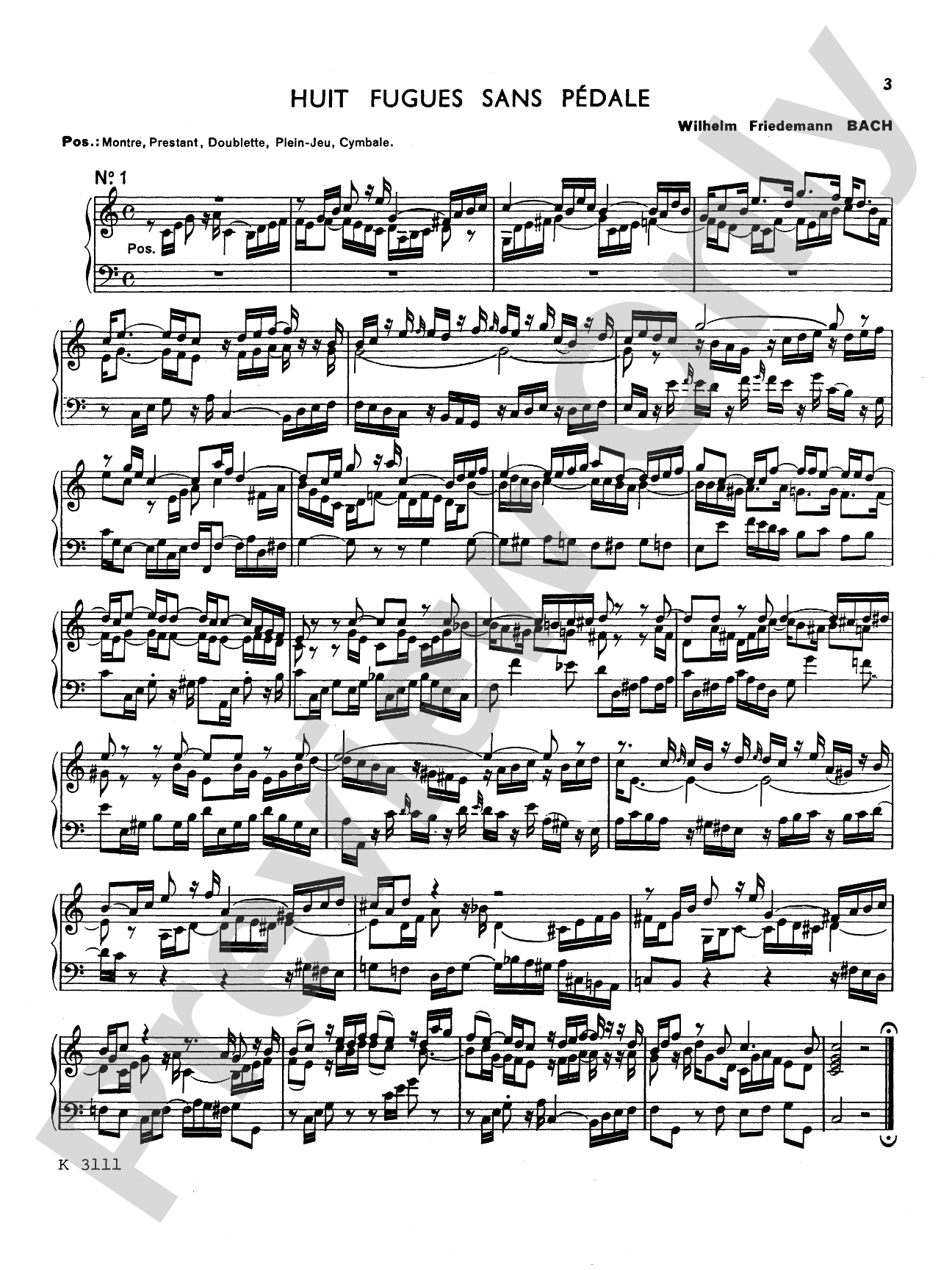

Bach: Eight Fugues without Pedal: Organ Book
By Wilhelm Friedemann Bach
Item: 00-PK-0002887

$5.99
Pickup currently not available
Buy Extra Parts (Digital PDF Download)
| Product | Price | Quantity |
|---|---|---|
| Bach: Eight Fugues without Pedal | $0.99 | |
| Bach: Eight Fugues without Pedal | $0.99 | |
| Bach: Eight Fugues without Pedal | $0.99 | |
| Bach: Eight Fugues without Pedal | $0.99 | |
| Bach: Eight Fugues without Pedal | $0.99 | |
| Bach: Eight Fugues without Pedal | $0.99 | |
| Bach: Eight Fugues without Pedal | $0.99 | |
| Bach: Eight Fugues without Pedal | $0.99 |
Parts Added to Cart!
Related Items
Eight Fugues Without Pedal: Organ Book |
$5.95
|
View |
Description
A collection of exercises, for Organ, composed by Wilhelm Friedemann Bach. A Federation Festivals 2020-2024 selection.


Don't just read it, hear it, play along with it, and watch your students grow with it. In MakeMusic Cloud, Bach: Eight Fugues without Pedal: Organ Book comes alive with professional accompaniment, adjustable tempo, and built-in practice tools that turn solo practice into real progress.
Open in the Player
Jump straight in and assign it today.
Start Your Free Trial
Open this title and explore the full library in minutes.
Sample Audio
No sample audio found.
Sample Video
No sample videos found.
Additional Details
Series:
Kalmus Edition
Publisher:
Alfred Music
Page Count:
16
SKU:
00-PK-0002887
More about this title
About the Composer: Wilhelm Friedemann Bach
Wilhelm Friedemann Bach (1710, 1784) was J.S. Bach's eldest son and a keyboard virtuoso in his own right. While often overshadowed by his famous father, W.F. Bach developed a distinctive compositional voice that bridged the contrapuntal rigor of the Baroque with the emerging galant style of the Classical era.
His organ works hold particular value for pedagogical contexts. Unlike many of his keyboard compositions, these fugues without pedal were conceived as exercises to build facility and contrapuntal thinking at the manuals alone. This collection demonstrates how serious technical study can emerge from genuine musical material rather than dry mechanical drills.
Why we love this
This collection offers organists a direct line to high-quality Baroque counterpoint without the technical demands of pedal writing, making it ideal for advancing intermediate players or as part of a Festival repertoire. The fugues balance pedagogical value with genuine musical substance, avoiding the trap of exercises that feel purely mechanical. Each piece rewards careful attention to voice leading and articulation, skills that serve organists well across all repertoire.
What to expect
Intellectually rigorous yet warmly Baroque, these fugues balance mathematical precision with lyrical voice writing. Each piece unfolds with clear logic, allowing performers and listeners alike to follow the architectural design while remaining engaged by the elegant counterpoint and frequent moments of harmonic surprise.
Who it's for
These fugues serve advancing organists preparing for competitions, festival performances, or recital programs who need solid Baroque material that doesn't demand pedal technique. They're equally valuable for students transitioning from piano to organ, as they build two-handed independence and contrapuntal awareness. Teachers seeking exercises that combine technical challenge with legitimate musical content will find this collection direct and purposeful.
How to get the most out of it
- Attend carefully to hand independence and voice clarity; since pedal support is absent, every voice must speak distinctly through articulation and phrasing alone.
- Shape phrases by varying touch slightly between voices rather than relying on dynamic extremes; the organ's nature rewards subtle control over tempo and accent.
- Practice each voice separately before combining, paying special attention to the inner voices that often carry motivic material in fugal writing.
- Let the harmonic rhythm guide your tempo; resist the temptation to rush through rapid figurations, as clarity always supersedes speed in Bach's counterpoint.
How to use it
Program these as part of a Baroque recital or festival performance, where they can anchor a thematic program around J.S. Bach's family or the development of the organ fugue. A single fugue works well as a substantial encore, and the collection as a whole suits competitions that emphasize standard classical repertoire. Consider pairing one with a larger work by J.S. Bach to highlight the stylistic conversation between father and son.
Skills your students will build
- Independent voice leading and hand coordination without pedal support
- Reading and executing two-part and three-part counterpoint clearly
- Baroque articulation and phrasing conventions
- Harmonic analysis and recognition of fugal structures
- Clarity and precision in rapid scalar passages and sequential figures
- Navigation of early-to-mid-Baroque keyboard notation and ornamentation