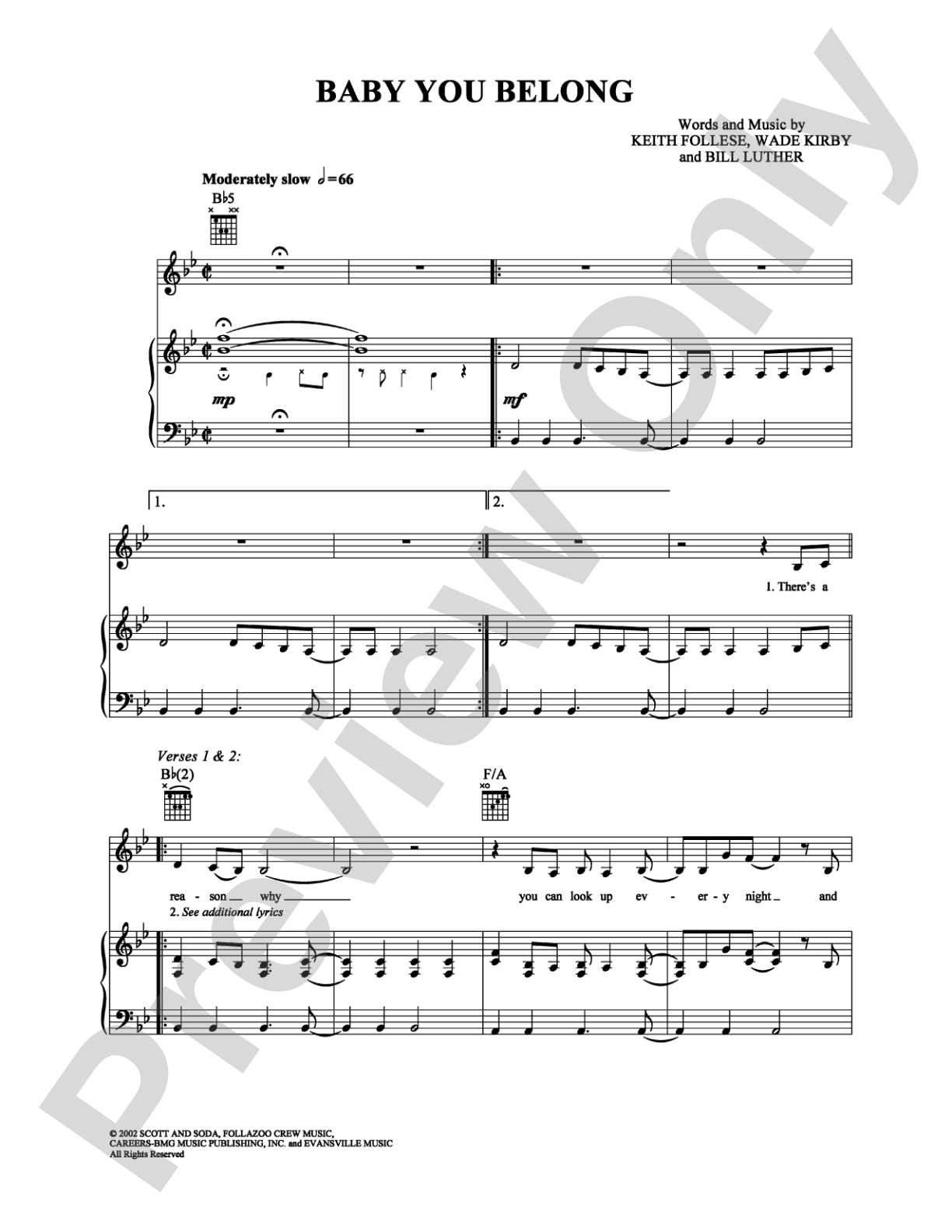
Baby You Belong: Piano/Vocal/Chords Digital Sheet Music

Baby You Belong: Piano/Vocal/Chords Digital Sheet Music

Wade Kirby, Faith Hill, Keith Follese, Bill Luther

Item: 00-PS-0001875

Digital Download
$3.99
Description

Baby You Belong: Piano/Vocal/Chords Digital Sheet Music isn't in MakeMusic Cloud just yet...but it could be. Let us know you'd like to see it, and you'll help shape what comes next. In the meantime, start a free trial and dive into thousands of interactive titles your students can play along with today.

Sample Audio
No sample audio found.
Sample Video
Additional Details
SKU: 00-PS-0001875

More about this title

About the Artist: Faith Hill

Faith Hill rose to prominence in the 1990s as one of country music's most successful crossover artists, bringing pop sensibility to country radio and earning multiple Grammy Awards and Academy of Country Music Awards. Her work spans country, pop, and rock idioms, making her catalog particularly valuable for programs exploring genre boundaries and contemporary songwriting.

Why we love this

This song sits comfortably in the pop-rock territory where many of your singers already live, making it an accessible entry point for students learning to blend contemporary styles with traditional vocal technique. The piano/vocal/chords format gives you flexibility to arrange around your accompanist's strengths, whether that means a full harmonic realization or a stripped-back accompaniment that lets the singer shine.

What to expect

Confident and grounded, with the kind of straightforward emotional directness that defines strong pop-country writing. The song sits naturally in the voice and doesn't demand pyrotechnics, which means the focus lands on interpretation and connection to the lyric.

Who it's for

Singers working on contemporary popular repertoire, whether for recital, audition, or ensemble contexts. This piece works well for students building confidence with pop-rock style while maintaining solid vocal technique.

How to get the most out of it

  • Pay attention to the rhythmic pocket in the piano part; locking the vocal phrasing to the accompaniment's groove makes the song feel intentional rather than tentative.
  • Shape the dynamics around the lyrical arc rather than pushing volume from start to finish. Let quieter moments create contrast and draw listeners in.
  • Experiment with the chord voicings on the piano. The chart gives you the harmony, but your accompanist can choose voicings that either brighten or warm the sound depending on your venue and overall program tone.

How to use it

Include this in a set exploring contemporary songwriting and genre crossover, or program it as a solo vehicle in a recital where you want to showcase your singers' ability to inhabit modern popular music with authenticity. It pairs well alongside both traditional art songs and other contemporary popular pieces.

Skills your students will build

  • Singing in contemporary pop-rock style with consistent vocal support
  • Reading and interpreting chord charts in real performance contexts
  • Coordinating vocal phrasing with piano accompaniment patterns
  • Balancing stylistic authenticity with classical vocal technique

You May Also Like