Babel Sheet Music Preview

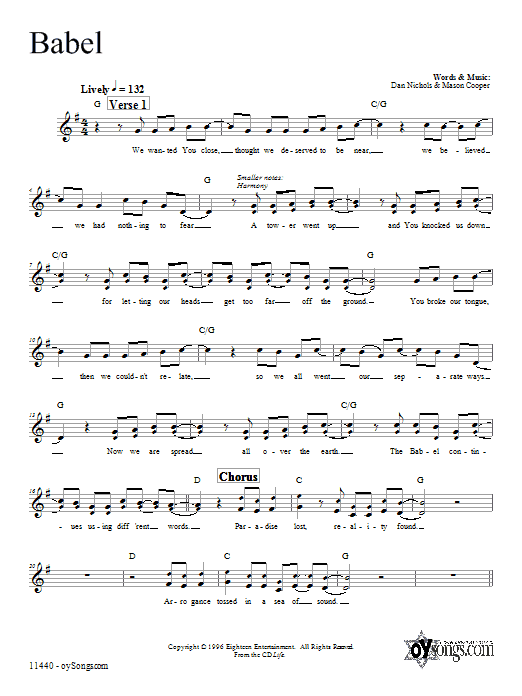
Babel: Lead Sheet / Fake Book

As performed by Dan Nichols

Item: 35-DS00090246

Digital Download
$3.99
Description

Babel: Lead Sheet / Fake Book isn't in MakeMusic Cloud just yet...but it could be. Let us know you'd like to see it, and you'll help shape what comes next. In the meantime, start a free trial and dive into thousands of interactive titles your students can play along with today.

Sample Audio
No sample audio found.
Sample Video
Additional Details
Publisher: Hal Leonard
Page Count: 3
SKU: 35-DS00090246

More about this title

About the Artist: Dan Nichols

Dan Nichols is a composer and arranger whose work spans liturgical music, congregational hymns, and accessible vocal literature. His compositions prioritize singability and emotional directness, making them staples in church music programs and community singing contexts.

Why we love this

This lead sheet gives you the harmonic and melodic essentials without dictating voicings or accompaniment texture, so whether you're accompanying a vocalist in rehearsal or building an arrangement from the ground up, you control the interpretation. The three-page format is substantial enough for a complete musical idea while staying manageable for transposition or quick reference at the keyboard.

What to expect

The piece carries the character of a traditional hymn or sacred song, built on clear melodic phrasing and harmonic foundation. There is an inviting, uncluttered quality that encourages both singer and accompanist to listen closely to one another.

Who it's for

Pianists and keyboardists who accompany singers in worship, community, or educational settings will find this format straightforward to work from. Vocalists preparing solo material also benefit from having the melody and harmonic framework in one clear document.

How to get the most out of it

  • Read through the melody and chord changes at a relaxed tempo first to internalize the harmonic rhythm before improvising or comping variations
  • Pay attention to how the lead line sits over the chord symbols; this relationship often reveals idiomatic voice-leading when you begin accompanying
  • Experiment with different left-hand textures (rootless voicings, stride, block chords) to find what supports the vocalist's delivery without cluttering the arrangement

How to use it

Use this as an accompaniment tool during warm-ups or as a teaching piece for students learning to read lead sheets and understand chord function. It also serves as a solid resource for pianists building their repertoire of congregational or community music literature.

Skills your students will build

  • Reading and interpreting lead sheet notation
  • Chord recognition and voice-leading from symbols
  • Improvising accompaniment textures within harmonic constraints
  • Sight-singing from melody with harmonic support

You May Also Like