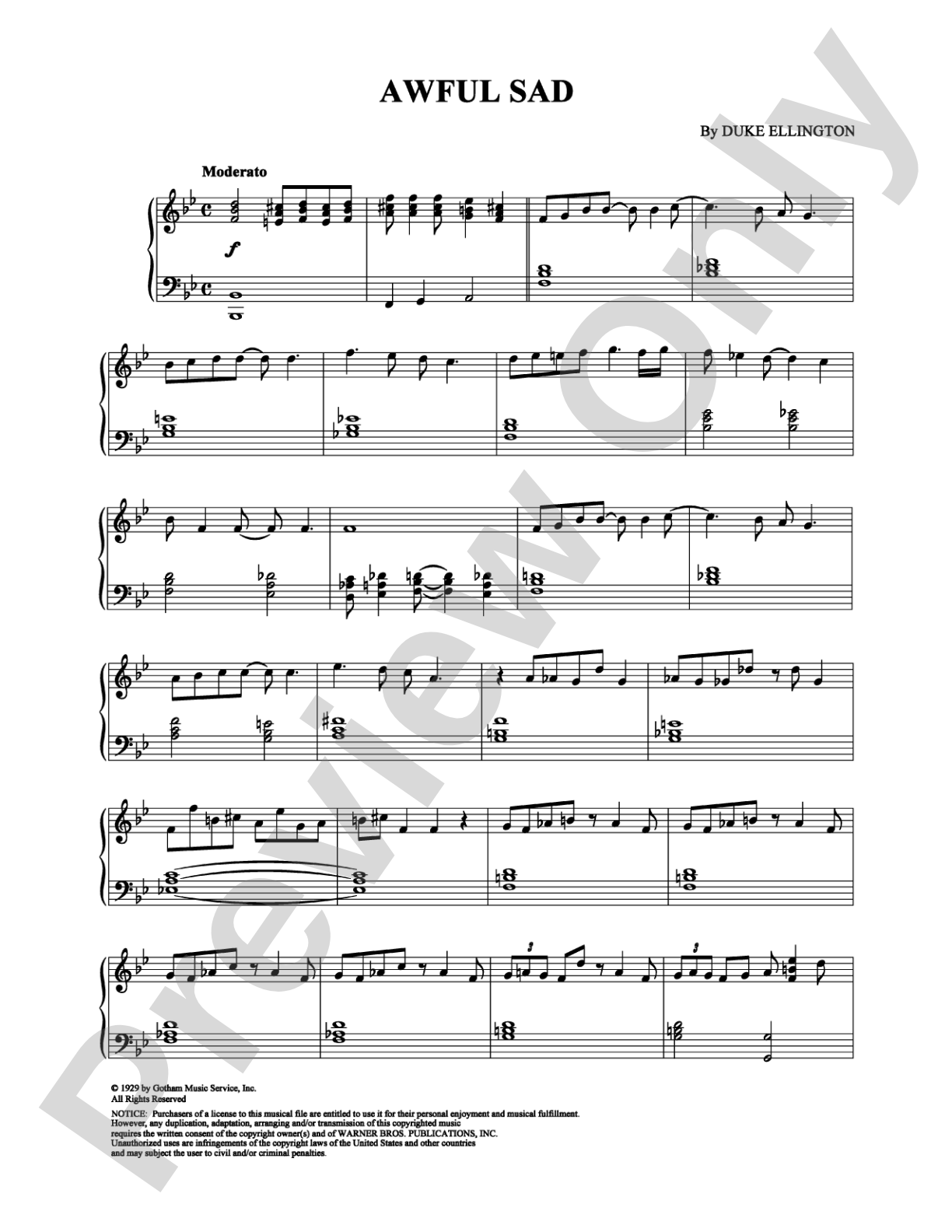
Awful Sad: Piano Digital Sheet Music

Awful Sad: Piano Digital Sheet Music

Duke Ellington

Item: 00-PS-0008182

Digital Download
$3.99
Description

Awful Sad: Piano Digital Sheet Music isn't in MakeMusic Cloud just yet...but it could be. Let us know you'd like to see it, and you'll help shape what comes next. In the meantime, start a free trial and dive into thousands of interactive titles your students can play along with today.

Sample Audio
No sample audio found.
Sample Video
Additional Details
SKU: 00-PS-0008182

More about this title

About the Artist: Duke Ellington

Duke Ellington stands as one of the twentieth century's most prolific composers and bandleaders, creating a body of work that redefined what jazz could express. His output, over a thousand compositions spanning five decades, demonstrates a composer equally at home writing for large ensemble, small combo, or solo piano, and his harmonic sophistication and structural innovation influenced musicians across every genre.

Why we love this

Ellington's standards offer pianists a masterclass in jazz harmony and touch. This piece gives students direct access to one of the twentieth century's most influential musical minds without requiring a full ensemble, making it ideal for solo recitals, jazz course material, or as a bridge between classical and improvisational study.

What to expect

The piece carries the emotional weight suggested by its title, moving through Ellington's sophisticated harmonic landscape with a melancholic grace. The writing balances vulnerability with compositional elegance, inviting the performer into intimate conversation rather than grand display.

Who it's for

Jazz pianists building their standards repertoire, music students exploring twentieth-century composition through jazz, and intermediate to advanced players seeking material that demands both technical command and harmonic understanding. Teachers looking to introduce Ellington's compositional voice in an accessible solo context will find this a valuable addition to the curriculum.

How to get the most out of it

  • Pay close attention to Ellington's harmonic substitutions and voice leading; the sophistication lies in how chords resolve, not just in flashy left-hand patterns.
  • Balance melody clarity with the rhythmic specificity of the accompaniment. Jazz piano demands that both layers breathe independently.
  • Explore the recorded versions by Ellington's own pianists to absorb the interpretive flexibility typical of the style; these standards reward subtle variations in touch and tempo.
  • Let the harmonic language guide your phrasing rather than imposing a purely classical rubato; Ellington's sophistication emerges from rhythmic precision.

How to use it

Program this alongside other jazz standards in a recital exploring mid-twentieth-century American composition, or use it in a music history unit examining Ellington's output beyond big-band arrangements. It works particularly well as a bridge in programs that mix classical and jazz literature, demonstrating continuity in serious musical intent across genres.

Skills your students will build

  • Reading jazz chord symbols and understanding Ellington's harmonic vocabulary
  • Interpreting swing feel and jazz articulation in a solo setting
  • Balancing melodic expression with rhythmic precision in jazz piano texture
  • Exploring touch variation and dynamic shaping in ballad-tempo material

You May Also Like