
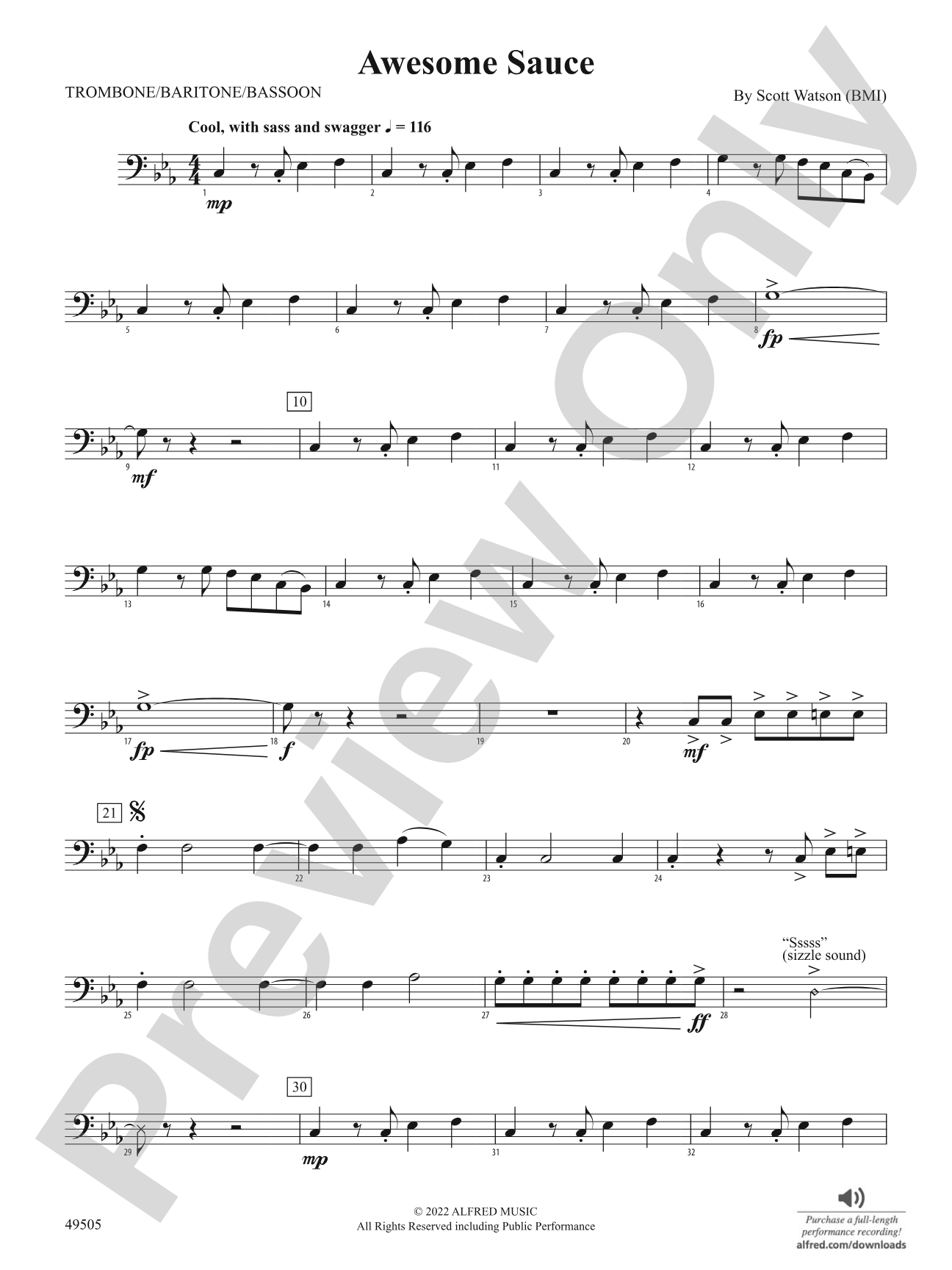

Awesome Sauce: 1st Trombone
By Scott Watson (BMI)
Grade: 1
Item: 00-PC-0018798_TN1
$3.00
Pickup currently not available
Description
You're cool, likeable, and confident. You don't walk, you strut. When you enter a party, a hush falls over the room and heads turn because you have a certain "je ne sais quoi!" People say you're "the bee's knees" and "the cat's meow." You're Awesome Sauce and this piece is the soundtrack of your life!
With its fun, blues-like melody and cool rock beat, Awesome Sauce by Scott Watson is sure to be a player favorite. The limited chromaticism, accessible jazz-esque rhythms, and style-important articulations offer excellent teaching moments for the director. (2:57) Awesome Sauce correlates to Book 1, Level 6 of Sound Innovations for Concert Band. This title is available in MakeMusic Cloud.


With its fun, blues-like melody and cool rock beat, Awesome Sauce by Scott Watson is sure to be a player favorite. The limited chromaticism, accessible jazz-esque rhythms, and style-important articulations offer excellent teaching moments for the director. (2:57) Awesome Sauce correlates to Book 1, Level 6 of Sound Innovations for Concert Band. This title is available in MakeMusic Cloud.
Don't just read it, hear it, play along with it, and watch your students grow with it. In MakeMusic Cloud, Awesome Sauce: 1st Trombone comes alive with professional accompaniment, adjustable tempo, and built-in practice tools that turn solo practice into real progress.
Open in the Player
Jump straight in and assign it today.
Start Your Free Trial
Open this title and explore the full library in minutes.
Sample Audio
1
Audio File
--:--
0:00
0:00
Sample Video
Additional Details
Series:
Sound Innovations for Concert Band
Publisher:
Alfred Music
SKU:
00-PC-0018798_TN1
More about this title
About the Composer: Scott Watson

Scott Watson spent 35 years in the Parkland School District (Allentown, PA) as an instrumental music educator, leading the high school band program before overseeing the elementary band and strings curriculum across the district. His work as a teacher directly shaped his compositional voice, which draws equally from contemporary concert music and the practical realities of the rehearsal room.
Now Associate Professor of Music at Cairn University, Watson has established himself as one of the most performed composers in the concert band world, with over 120 published works across band, string orchestra, and chamber settings. His music has appeared at major venues including the Academy of Music in Philadelphia, the Midwest Clinic in Chicago, and the White House. Watson serves as exclusive composer/clinician for Alfred Publications and has authored the influential text Using Technology to Unlock Musical Creativity (Oxford University Press, 2011).
Why we love this
Watson writes with genuine understanding of what makes students want to play. The blues inflection and rock-solid groove here have immediate appeal, while the limited chromatic material and clear articulation requirements give you real pedagogical footholds without sacrificing style or fun. It's the kind of piece that builds ensemble cohesion because everyone in the band feels the attitude.
What to expect
Walking in with total confidence, turning heads, owning the room. The blues-tinged melody carries swagger while the driving rock beat keeps everything grounded and tight. It's a piece that lets your band feel cool while they're learning.
Who it's for
Any concert band director looking for a grade 1 piece with genuine style and attitude. Students at this level respond to the confident groove and contemporary idiom, while directors appreciate the teaching value embedded in the jazz-influenced rhythms and the controlled harmonic vocabulary.
How to get the most out of it
- Nail the rhythmic feel first. The rock beat won't groove unless your section leaders lock in the subdivision; spend rehearsal time on precision with the hi-hat pattern and bass drum coordination.
- Clarify the articulation style with your brass. The 'cool' character depends on clean tonguing and purposeful note releases; mark your parts clearly and listen for consistency across the section.
- Let the blues melody breathe. This isn't classical phrasing. The slight rubato and swagger in the soloists' lines will emerge once the ensemble foundation is solid, so don't over-conduct the small moments.
How to use it
Program this as a first-half closer or opener when you want to shift the energy and show your audience (and your students) that concert band music lives in multiple worlds. It pairs well alongside traditional classical repertoire as evidence of the genre's modern range, and works particularly well in informal concerts, pep rallies, or festival settings where attitude and approachability matter.
Skills your students will build
- Executing rock and blues rhythmic feels at tempo
- Coordinating articulation across sections to establish style
- Reading and performing jazz-influenced syncopation
- Balancing ensemble blend with style-appropriate independence
- Interpreting dynamic and tonal shaping within a contemporary idiom