
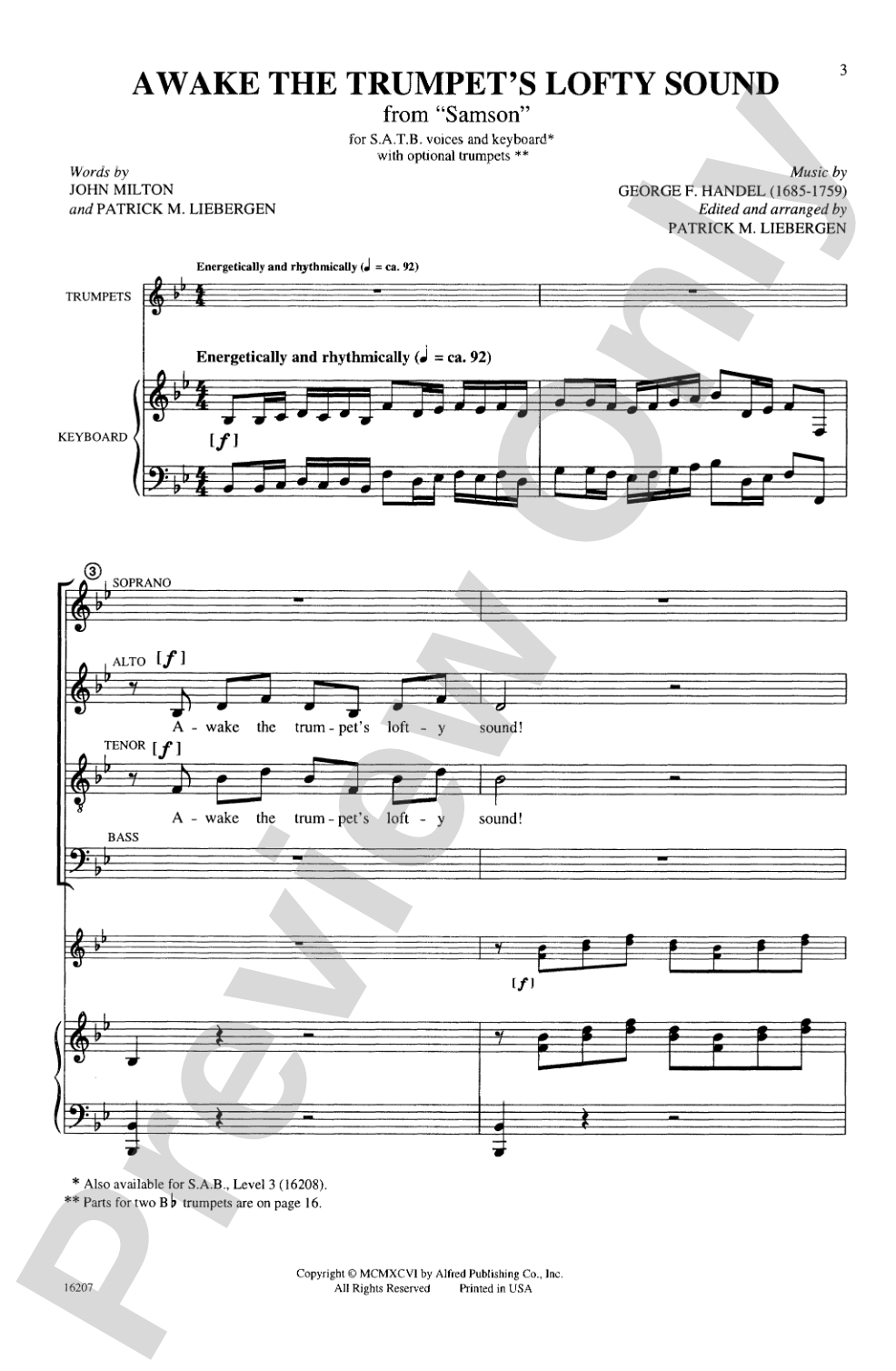
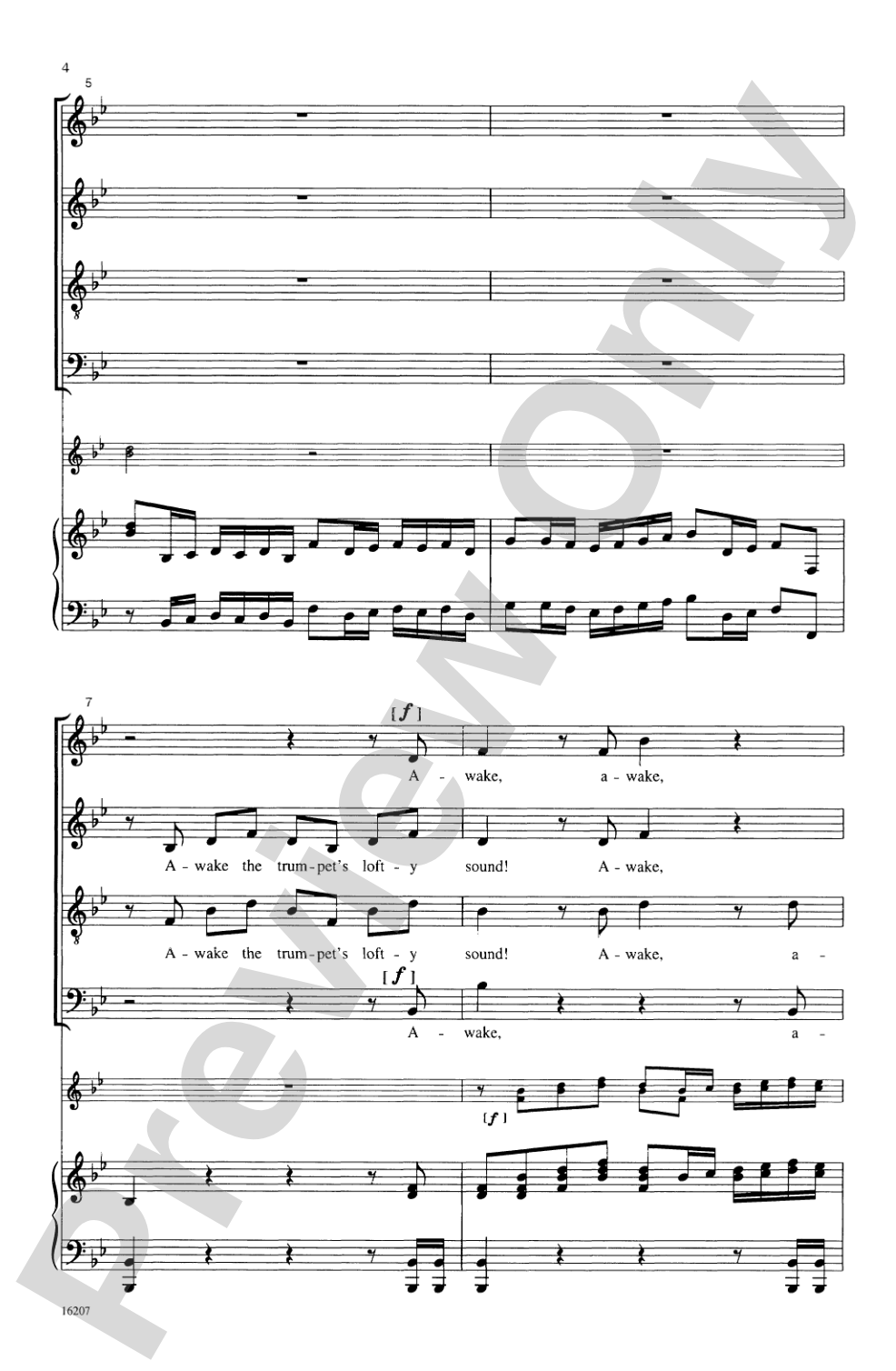

Awake the Trumpet's Lofty Sound (from Sampson): SATB Choral Octavo
From Samson
Music by George Frideric Handel / arr. Patrick M. Liebergen
Item: 00-PO-0002852
$3.50
Minimum order quantity: 20 copies
Pickup currently not available
Related Items
Awake the Trumpet's Lofty Sound: SATB Choral Octavo |
$3.50
|
View |
Description
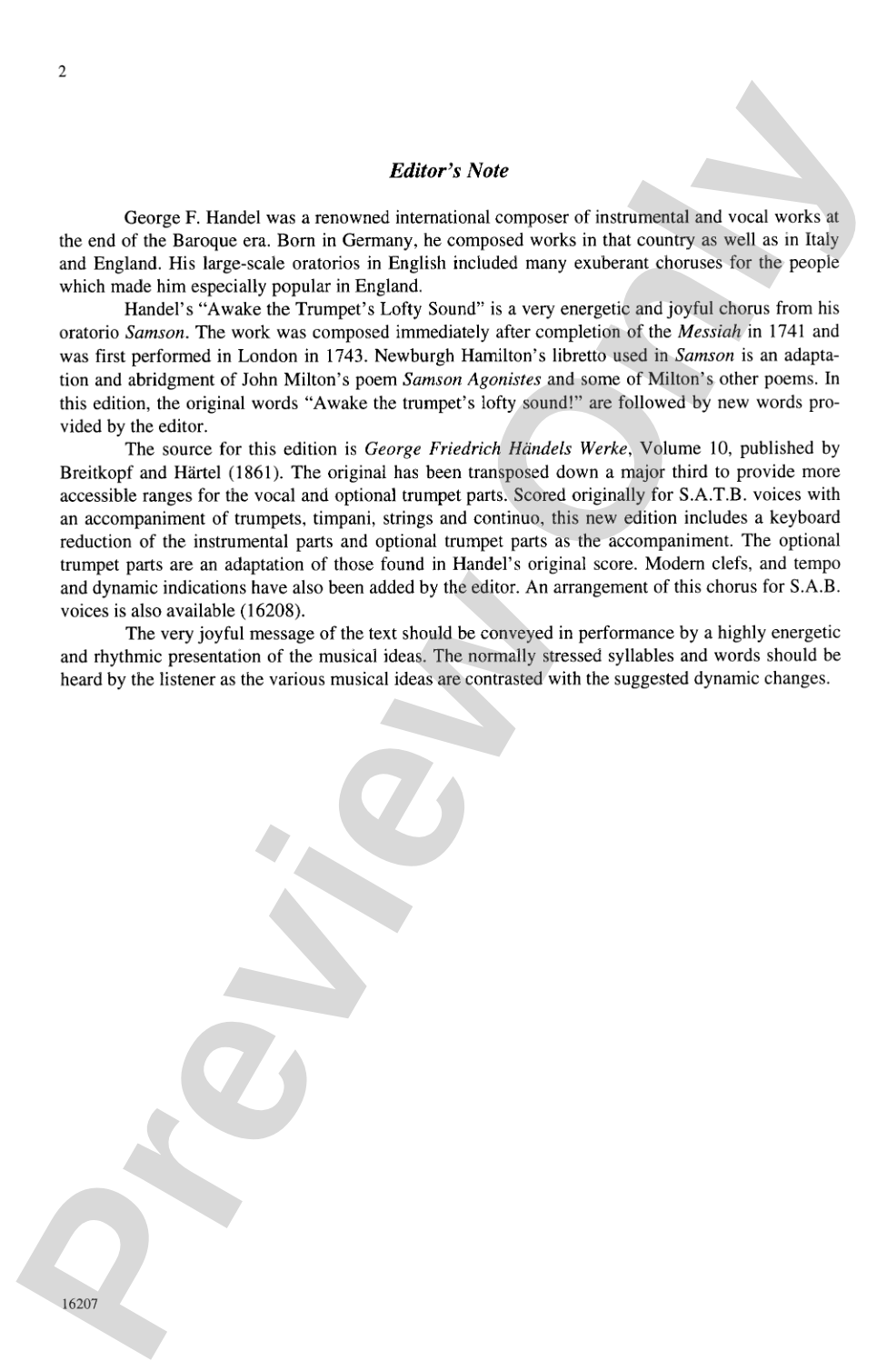
Handel's "Awake the Trumpet's Lofty Sound" is a very energetic and joyful chorus from his oratorio Samson. The work was composed immediately after completion of the Messiah in 1741 and was first performed in London in 1743. Newburgh Hamilton's libretto used in Samson is an adaption and abridgment of John Milton's poem Samson Agonistes and some of Milton's other poems. In this edition, the original words "Awake the trumpet's lofty sound!" are followed by new words provided by the editor.


Awake the Trumpet's Lofty Sound (from Sampson): SATB Choral Octavo isn't in MakeMusic Cloud just yet...but it could be. Let us know you'd like to see it, and you'll help shape what comes next. In the meantime, start a free trial and dive into thousands of interactive titles your students can play along with today.
Request This Title
Tell us you want it.
Start Your Free Trial
Explore everything that's ready to play right now.
Sample Audio
No sample audio found.
Sample Video
No sample videos found.
Additional Details
Series:
Alfred Archive Edition: Alfred Choral Designs
Publisher:
Alfred Music
Page Count:
20
SKU:
00-PO-0002852
Instrumentation:
Opt. 2 Trumpets
More about this title
About the Composer: George Frideric Handel
George Frideric Handel (1685-1759) was a German-born composer who spent most of his career in England, where he became a defining figure of the Baroque era. His mastery of large-scale vocal forms—operas, oratorios, and sacred music—set the standard for dramatic musical storytelling across Europe. Handel composed with both grandeur and intimacy, creating works that moved audiences then and continue to command attention in concert halls and rehearsal rooms today.
Handel's oratorios, including Samson, were written for English audiences and marked a shift away from Italian opera toward works with English-language libretti. These compositions showcase his gift for combining choral brilliance with memorable melody, making them enduringly valuable for choral programs seeking repertoire that is both historically significant and genuinely stirring to perform.
Why we love this
This chorus pulses with infectious energy that rarely fails to energize a rehearsal room. Handel's part-writing balances clarity of text with driving rhythmic momentum, so even when the piece demands full vocal engagement, the architecture remains transparent enough for students to hear themselves and their section mates.
What to expect
Joyful and declarative, with the character of a fanfare that opens out into choral splendor. The energy is celebratory and almost martial in its forward momentum, yet Handel's harmonic language keeps it grounded in warmth rather than mere bombast. You feel the weight of baroque tradition alongside the thrill of living music.
Who it's for
This octavo suits advanced high school and college choirs, as well as community and professional ensembles seeking Baroque repertoire that combines accessibility with genuine musical substance. The piece works equally well for singers with some experience with period style and those encountering Handel for the first time.
How to get the most out of it
- Anchor the rhythmic drive with a strong pulse from your rhythm section; the optional trumpet parts will lock in more securely when the harmonic foundation feels inevitable rather than tentative.
- Shape the text with consistent articulation across all four parts. Handel's syllabic setting means every consonant and vowel change registers, so align your choir's diction choices from the start.
- Balance the soloistic moments that emerge in individual lines against the collective power of full voice. This piece asks both of the ensemble, and the contrast between them clarifies the form.
How to use it
Program this as a concert opener or as part of a Baroque-focused set where it can anchor a stronger section of your program. It pairs naturally with other sacred or secular choruses from the Baroque era and provides an excellent counterweight to more intimate choral works, giving audiences a full sense of the period's range.
Skills your students will build
- Baroque phrasing and articulation conventions
- Part independence within a four-part harmonic texture
- Text projection in syllabic settings
- Rhythmic precision in driving allegro tempos
- Blending with optional instrumental parts