Avenue Swing: 3rd Trombone Sheet Music Preview

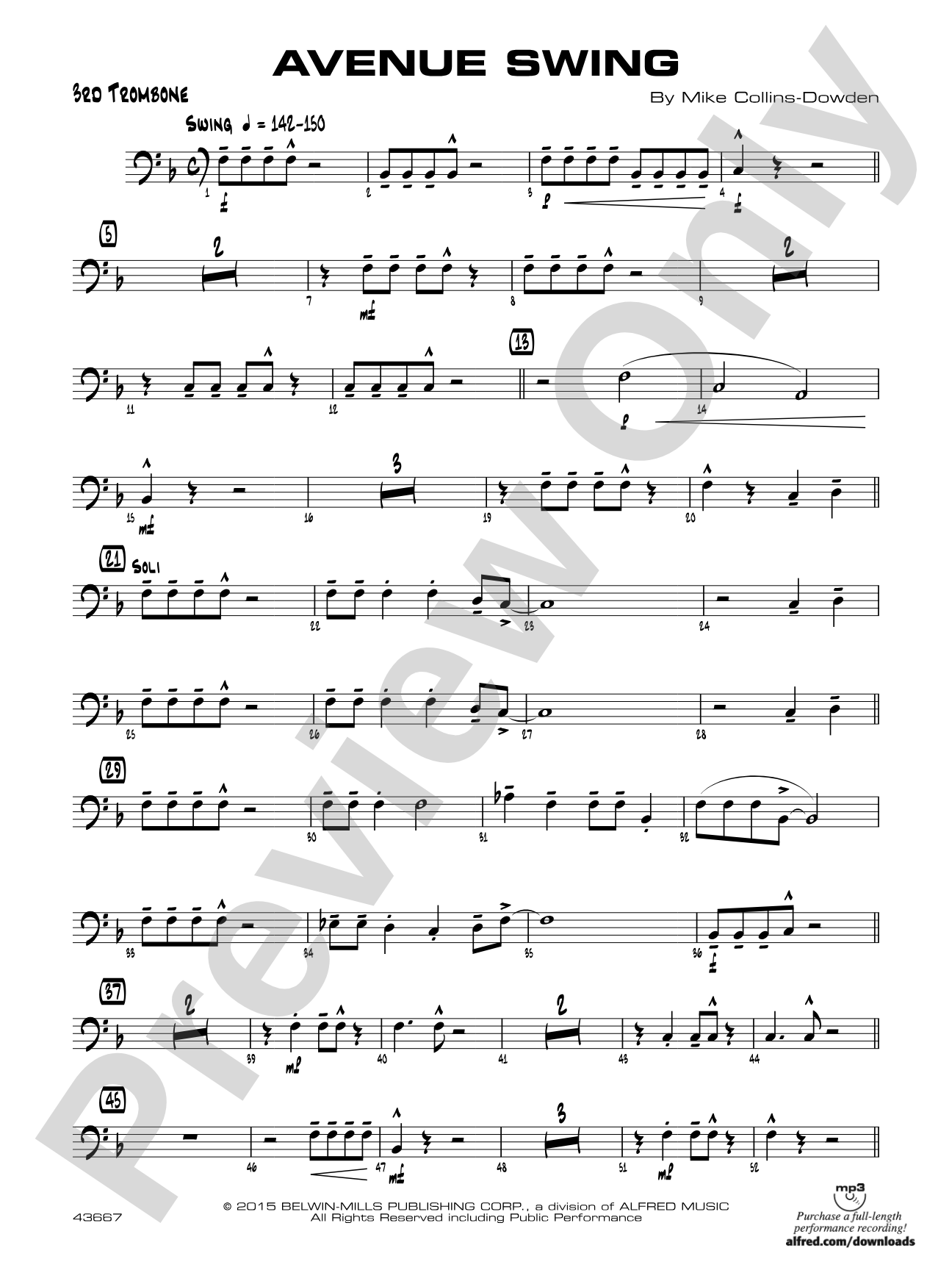
Avenue Swing: 3rd Trombone

By Mike Collins-Dowden

Grade: 1 (Easy)

Item: 00-PC-0016809_TN3

Digital Download
$3.00
Description
A swing chart at 144 BPM, Avenue Swing features a written-out tenor sax solo, trumpet 1 range to written E top space, and a few section solis. Add in the fine ensemble writing of Mike Collins-Dowden, along with flute, clarinet, and vibes parts---it's all you need. (2:43)

Don't just read it, hear it, play along with it, and watch your students grow with it. In MakeMusic Cloud, Avenue Swing: 3rd Trombone comes alive with professional accompaniment, adjustable tempo, and built-in practice tools that turn solo practice into real progress.

Sample Audio
0:00
0:00
Sample Video
Additional Details
Series: First Year Charts for Jazz Ensemble
Publisher: Alfred Music
Page Count: 86
SKU: 00-PC-0016809_TN3

More about this title

About the Composer: Mike Collins-Dowden

Mike Collins-Dowden

Mike Collins-Dowden has been teaching fourth and fifth grade band at Pleasant Ridge School in Glenview, Illinois, since 2007. He holds a B.M. in music education and trombone performance from the Eastman School of Music (2003), where he performed with the Eastman Wind Ensemble's 2004 Japan tour, and an M.M. in music education from Temple University (2007).

As a composer, Collins-Dowden writes regularly for young concert and jazz ensembles, drawing directly from his classroom experience. His catalog exceeds 30 published works with Alfred/Belwin, FJH, and Jalen Music. When not teaching, composing, or raising a family, he performs on trombone and guitar.

Why we love this

Collins-Dowden understands the rhythmic and technical demands of Grade 1 ensembles because he writes for them every day. Avenue Swing delivers authentic swing feel without sacrificing accessibility; the written-out tenor sax solo and section solis give strong players showcase moments while the ensemble writing remains manageable. At 2:43, it fits naturally into a festival program or concert set without requiring extensive rehearsal time.

What to expect

Avenue Swing grooves with the energy of classic big band swing, propelled by a steady 144 BPM and driven by intuitive ensemble writing. The written tenor sax solo gives the piece a focal point of personality; the flute, clarinet, and vibes textures add warmth and definition without complexity. It's a chart that feels accomplished and complete within its Grade 1 scope.

Who it's for

First-year and second-year jazz ensembles ready to tackle swing repertoire with a solid foundation. This chart works for students learning to read jazz notation and feel swing rhythms, and it offers enough solos and section work to keep advanced students engaged within an accessible ensemble texture.

How to get the most out of it

  • Lock the ensemble on the swing eighth-note feel in the opening bars before layering in the solo sections; this establishes the pocket that carries the whole chart.
  • Balance the tenor sax solo so it sits forward without drowning out the section behind it; the supporting voices have plenty of movement.
  • Keep the vibes articulate and bright throughout; their rhythmic precision helps anchor the groove, especially during hits and section breaks.
  • Use the 144 BPM as a steady reference point, but allow small breathing room on sustained chords to let the ensemble settle into the swing feel together.

How to use it

Program this as a strong mid-set selection at a jazz festival or concert; its length and energy make it a natural centerpiece. Pair it with a ballad or Latin chart to show your ensemble's range, or use it as a capstone piece for a Grade 1 group to demonstrate how far they've come in understanding swing style and ensemble balance.

Skills your students will build

  • Reading swing eighth-note feel and maintaining it over two-and-a-half minutes
  • Responding to written solo sections while maintaining ensemble cohesion
  • Balancing section parts with a featured soloist
  • Tuning chord voicings within a jazz context
  • Playing with rhythmic precision in a groove-based chart

You May Also Like