Ave Verum Corpus Sheet Music Preview

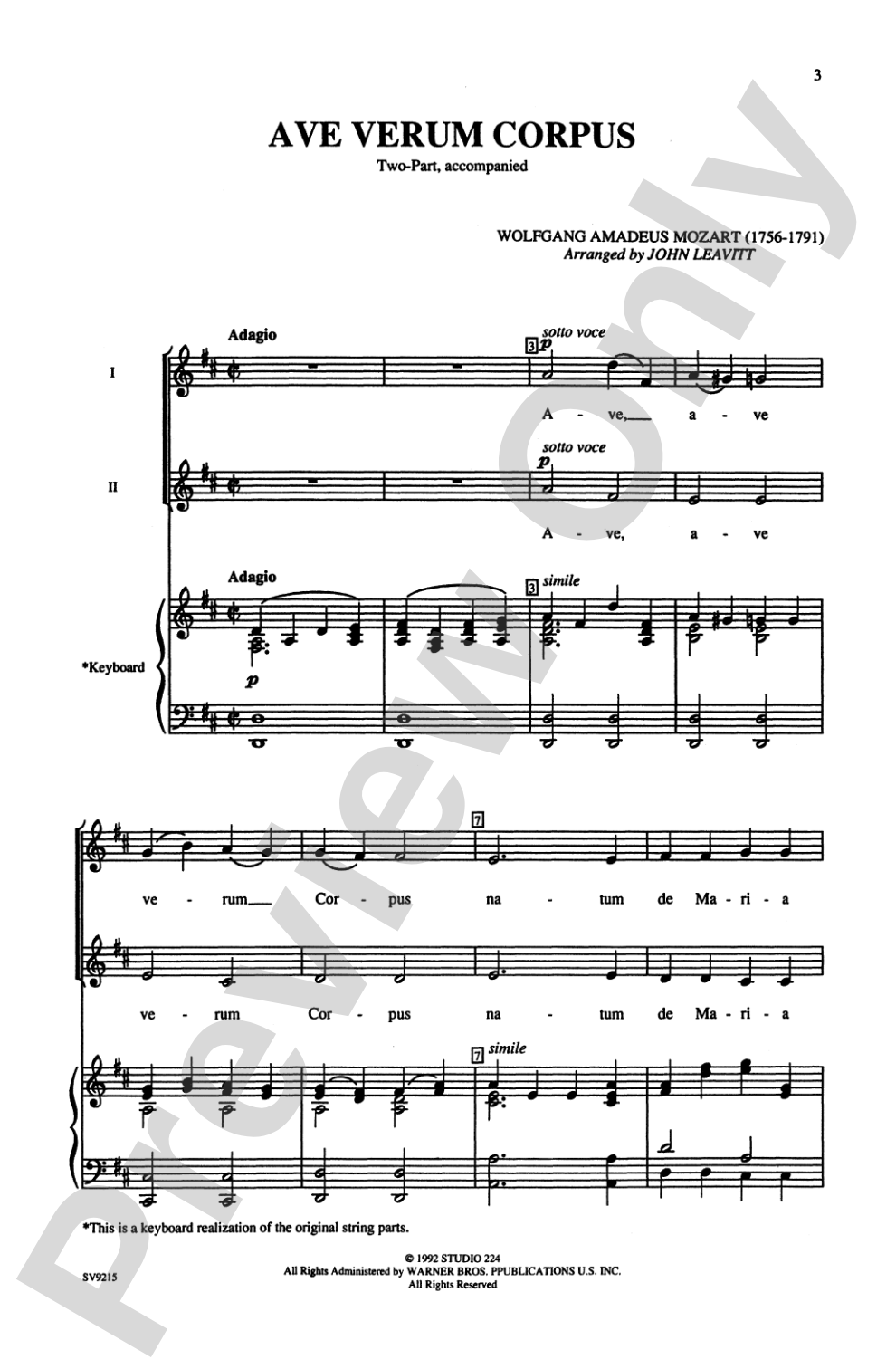
Ave Verum Corpus: 2-Part Choral Octavo

By Wolfgang Amadeus Mozart / arr. John Leavitt

Level: Moderately Easy

Item: 00-PO-0002744

Digital Download
$2.25

Minimum order quantity: 20 copies

Description
One of today's most popular talents on both the school and church music scenes has arranged Mozart's beloved AVE VERUM CORPUS for two-part voices. Although scored for treble voices, performance would be equally effective by male or mixed choruses.

Ave Verum Corpus: 2-Part Choral Octavo isn't in MakeMusic Cloud just yet...but it could be. Let us know you'd like to see it, and you'll help shape what comes next. In the meantime, start a free trial and dive into thousands of interactive titles your students can play along with today.

Sample Audio
No sample audio found.
Sample Video
Additional Details
Series: Alfred Archive Edition: Studio PR Catalog
Publisher: Alfred Music
Page Count: 8
SKU: 00-PO-0002744

More about this title

About the Composer: Wolfgang Amadeus Mozart

Wolfgang Amadeus Mozart (1756-1791) was an Austrian composer whose output spanned virtually every musical genre of his time. His sacred music, written across multiple decades, reveals a gift for combining formal clarity with profound emotional depth. Ave Verum Corpus, composed in 1791 near the end of his life, distills this mastery into a brief, luminous work that has remained central to choral repertoires worldwide.

For music educators, Mozart's sacred works offer students direct access to the Classical era's harmonic language and structural elegance. His melodies are memorable without being simplistic, and his textures reward careful listening and nuanced interpretation.

Why we love this

John Leavitt's two-part arrangement strips away nothing essential from Mozart's original; instead, it clarifies the architecture and makes this masterwork genuinely singable for younger or developing choirs. The flexibility to perform with treble voices, male voices, or mixed sections means you can program this across multiple ensembles and still maintain the same edition. Contest and festival directors recognize this piece instantly, and audiences respond to its spiritual authenticity.

What to expect

The texture is transparent and intimate, with Mozart's harmonic language creating moments of quiet radiance. The piece feels meditative without being slow or difficult; singers experience the satisfaction of performing a genuine masterwork at an achievable level, and listeners encounter something timeless.

Who it's for

This arrangement opens Ave Verum Corpus to grade 2 choirs, including middle school groups or first-year high school singers just building ensemble experience. It works equally well for church choirs seeking accessible yet authentic sacred repertoire, or for elementary schools programming a spring concert around themes of reverence or reflection.

How to get the most out of it

  • Shape the long lines with subtle dynamic gradations rather than sudden changes; Mozart's phrases breathe naturally when singers think in measures rather than individual notes.
  • Balance the two parts so neither dominates; the arrangement's strength lies in its harmonic completeness, which demands equal voice weight.
  • Approach the Latin text with clarity of diction without sacrificing legit; this music transcends linguistic barrier when sung with conviction and precision.
  • Let silence matter as much as sound; the brief rests between phrases create the contemplative quality that makes this arrangement work at its modest eight pages.

How to use it

Place this near the end of a concert to create a reflective transition or as a closing moment of peace; its brevity and emotional restraint make it an ideal pairing with more energetic or substantial works. For spring programming, it fits naturally into Holy Week services or Lenten observances, where its reverence matches the liturgical season. Consider doubling it as an opening piece for a sacred music recital or finale for a festival concert.

Skills your students will build

  • Singing sustained lines with consistent tone and breath management
  • Balancing two-part harmony while maintaining melodic independence
  • Reading and singing Latin sacred text with proper pronunciation
  • Interpreting dynamic subtlety and phrasing in Classical-era music
  • Ensemble blend and listening to vertical harmony

You May Also Like