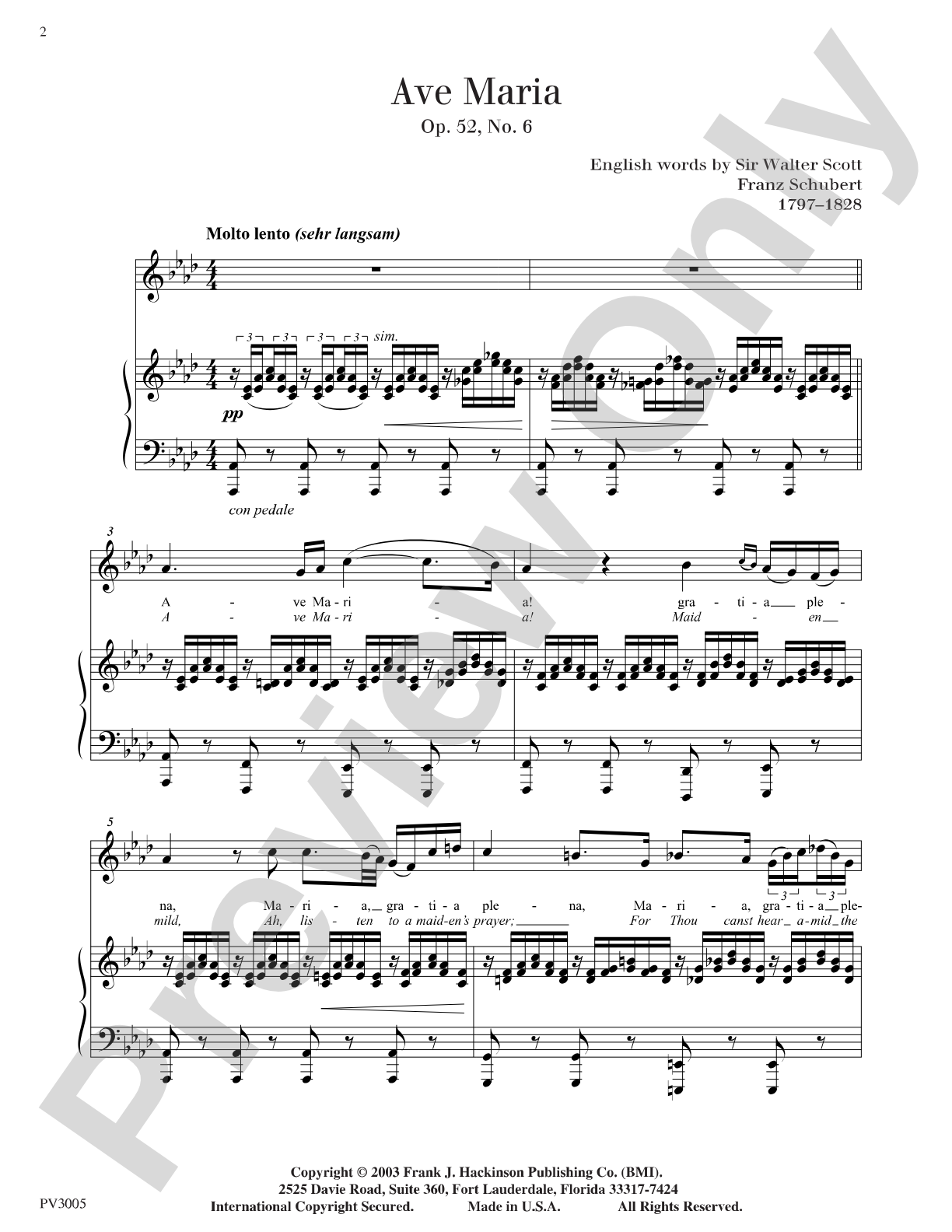
Ave Maria Op. 52, No.6, For Medium Voice and Piano: Piano/Vocal
By Franz Schubert
Item: 98-DPV3005
Pickup currently not available
Related Items
Ave Maria Op. 52, No.6, For Medium Voice and Piano: Piano Sheet |
$7.95
|
View |
Description
Ave Maria Op. 52, No.6, For Medium Voice and Piano: Piano/Vocal isn't in MakeMusic Cloud just yet...but it could be. Let us know you'd like to see it, and you'll help shape what comes next. In the meantime, start a free trial and dive into thousands of interactive titles your students can play along with today.
Tell us you want it.
Explore everything that's ready to play right now.
Sample Audio
Sample Video
Additional Details
More about this title
About the Composer: Franz Schubert
Franz Schubert (1797-1828) composed over 600 works during his short life, establishing himself as a master of lyrical melody and harmonic innovation. His gift for song (lied) shaped Romantic music profoundly; he understood how to set text to music with unprecedented emotional directness, making complex feelings accessible through singable lines.
Schubert's Ave Maria stands among his most performed compositions worldwide. Composed in 1825, it transcends its original context as an arrangement of a poem by Walter Scott to become a meditation on faith and beauty that resonates across denominations and cultures. Music educators value it both as a window into Schubert's genius and as a gateway work for singers developing interpretive maturity.
Why we love this
Schubert's Ave Maria works at every level because the vocal line feels inevitable once you hear it, yet requires genuine artistry to perform meaningfully. The piano part, often underestimated, creates the emotional foundation; the interplay between voice and accompaniment teaches singers that they are part of an integrated musical texture, not performing over it. For recitals and ceremonies alike, this piece delivers immediate impact while rewarding deeper preparation.
What to expect
A prayer set to music that feels both intimate and universal. The arpeggiated piano figures drift beneath a vocal line of crystalline simplicity, creating space for listeners to project their own devotion or longing into the familiar melody. Schubert achieves transcendence through understatement; every note feels necessary.
Who it's for
Medium voice singers preparing for recitals, wedding ceremonies, or vocal competition programs will find this transposition accessible and musically fulfilling. Pianists accompanying this work deepen their understanding of how accompaniment shapes vocal interpretation and emotional storytelling.
How to get the most out of it
- Shape the vocal phrases through the piano's arpeggiated figures rather than against them. The accompaniment pattern establishes the emotional heartbeat; sing through it, not independently of it.
- Approach the text (whether in Latin, English, or German) with clarity of diction without sacrificing legit legato. Each syllable serves the line's arc, not vice versa.
- Allow the dynamic arch to unfold gradually across the full length; resist the urge to swell emotionally at every textual emphasis. Schubert's restraint is what makes the piece's moments of intensity land.
- Coordinate with your pianist on the rubato. This piece lives in small, breathing gestures within a steady underlying pulse; discuss where time flexes and where it holds firm.
How to use it
Program this as a centerpiece in a recital devoted to Romantic song, or pair it with contrasting vocal repertoire to showcase interpretive range. In ceremonial contexts (weddings, memorials, religious services), its familiarity actually deepens its power; audiences come with emotional readiness that the music meets with grace. It works equally well as a solo encore or as part of a larger vocal program demonstrating command of art song literature.
Skills your students will build
- Legit legato singing across a wide range without relying on vibrato for expression
- Coordinating rubato with an accompanist while maintaining harmonic integrity
- Interpreting text in multiple languages (Latin, English, German) with appropriate diction and phrasing
- Understanding how an accompaniment pattern functions as an emotional anchor rather than background
- Building interpretive maturity through restraint and long-phrase thinking