Ave Maria Op. 52, No.6, For Low Voice and Piano: Piano/Vocal
By Franz Schubert
Item: 98-DPV3004
Pickup currently not available
Related Items
Ave Maria Op. 52, No.6, For Low Voice and Piano: Piano Sheet |
$2.95
|
View |
Description
Ave Maria Op. 52, No.6, For Low Voice and Piano: Piano/Vocal isn't in MakeMusic Cloud just yet...but it could be. Let us know you'd like to see it, and you'll help shape what comes next. In the meantime, start a free trial and dive into thousands of interactive titles your students can play along with today.
Tell us you want it.
Explore everything that's ready to play right now.
Sample Audio
Sample Video
Additional Details
More about this title
About the Composer: Franz Schubert
Franz Schubert (1797–1828) was an Austrian composer who wrote over 600 songs during his brief lifetime, fundamentally transforming the art song (Lied) into a vehicle for profound emotional expression. His gift for melody and harmonic innovation made him one of the most influential composers of the Romantic era, and his sacred vocal works remain central to both liturgical and concert repertoire.
Schubert's approach to text setting was revolutionary for his time. He understood how to marry poetic language with music in ways that deepened meaning rather than simply decorating words. Ave Maria, written late in his career, exemplifies this mastery: a work of apparent simplicity that conceals sophisticated harmonic language and an intuitive sense of vocal phrasing that singers continue to discover across generations.
Why we love this
This is the version that belongs in every vocalist's repertoire. The low voice arrangement opens the piece to baritones and bass-baritones who might otherwise reach for arrangements that sit too high, and Schubert's harmonic language remains luminous regardless of transposition. The parallel text underlay in Latin, English, and German means you can program it flexibly depending on your concert context and audience.
What to expect
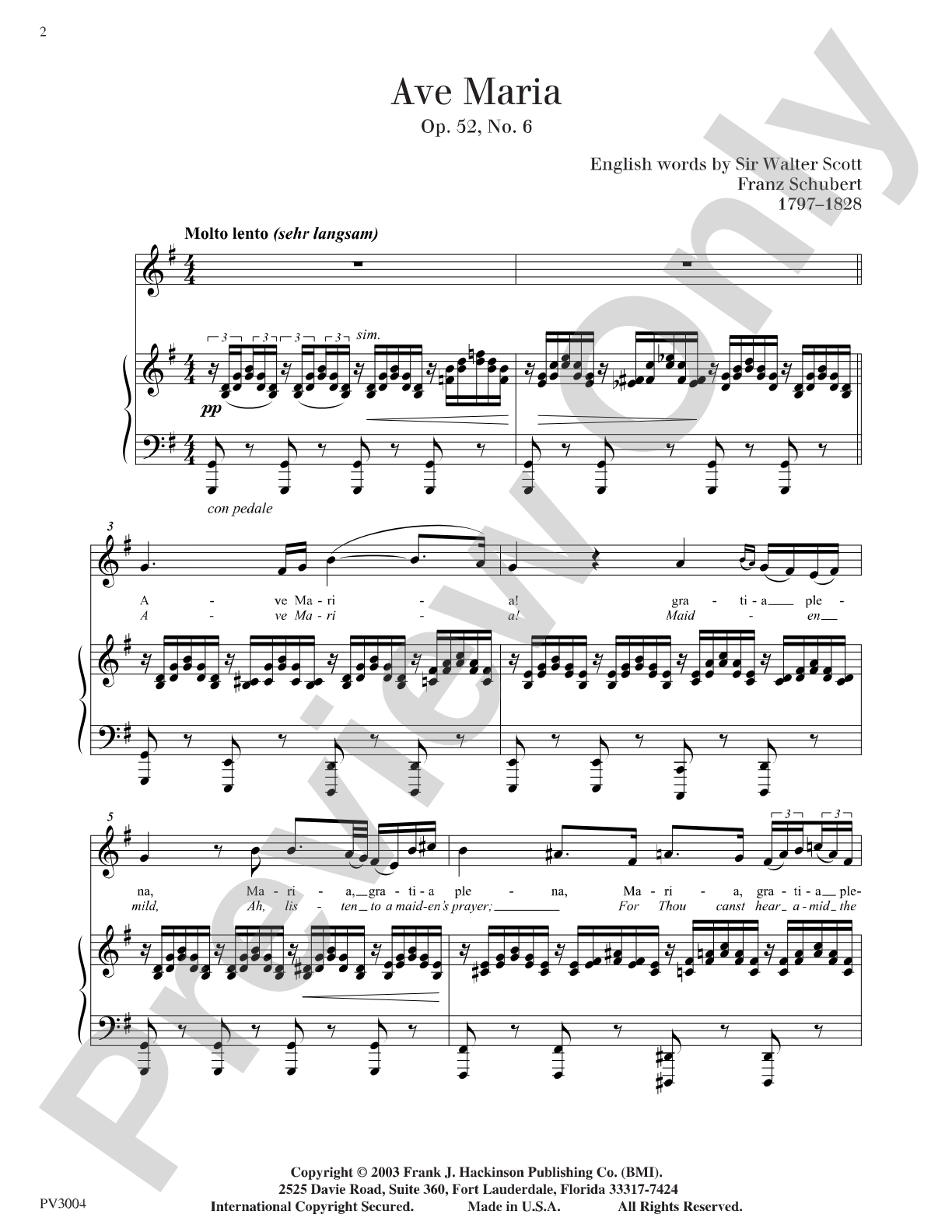
The opening piano figuration creates an atmosphere of quiet devotion before the voice enters. Once it does, the melody unfolds with an almost inevitable quality, as if the prayer were already waiting to be sung. The harmonic progressions feel both ancient (grounded in sacred music tradition) and deeply personal, suggesting prayer as an intimate conversation rather than formal recitation.
Who it's for
Low voice singers preparing wedding, memorial, or concert repertoire will find this the definitive standard rather than a simplified adaptation. Baritones and bass-baritones working toward recital programming benefit from a piece that is both technically accessible and artistically profound. Voice teachers use this to develop sustained legit tone and the ability to accompany oneself emotionally as well as textually.
How to get the most out of it
- Shape the melody with long, connected phrases rather than marking every bar line. The piece breathes as a song, not as a sequence of measures.
- Find the emotional temperature early. This is not background music; from the opening piano figuration, establish that listeners are entering a space of genuine reverence.
- Balance vocal tone with transparency. The voice must be heard clearly over the arpeggiated accompaniment, but overpowering the piano's delicate figuration will destroy the work's intimacy.
- Honor the text in whichever language you perform. Each version carries its own sonic and spiritual weight; commit fully to one rather than hedging between them.
How to use it
This functions equally well as a standalone recital piece or as part of a thematic program exploring sacred vocal literature. Its presence on a wedding ceremony program signals depth and intention; in a concert setting, it can anchor a group of sacred works or provide a moment of stillness between more dramatic pieces. The availability of multiple language texts makes it versatile across different communities and liturgical contexts.
Skills your students will build
- Sustained legit vocal tone across a wide range
- Phrasing across long melodic lines without breath interruption
- Coordination of text clarity with smooth vocal production
- Interpretation of sacred or devotional character in singing
- Piano accompaniment technique for arpeggiated figurations