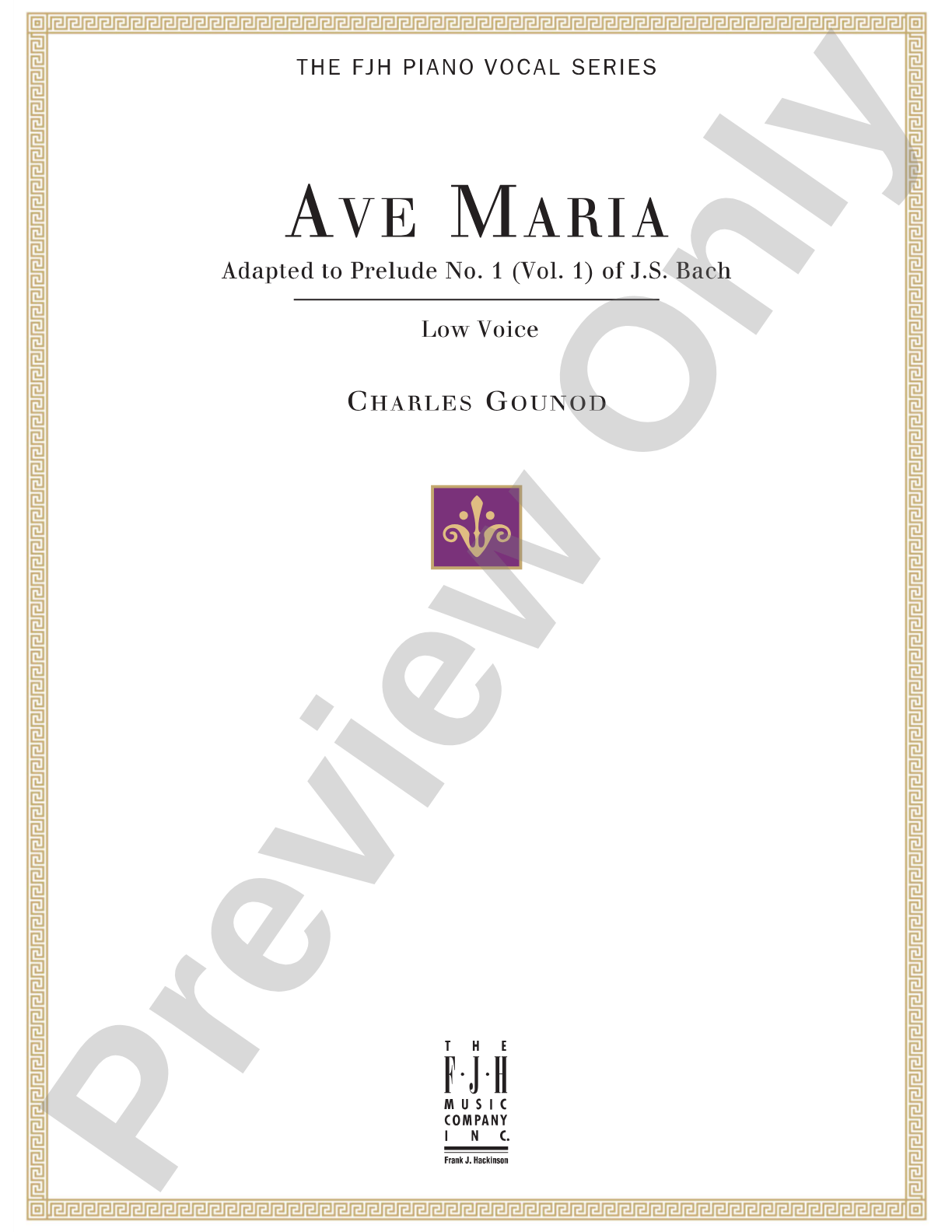
Ave Maria, For Low Voice and Piano Sheet Music Preview

Ave Maria, For Low Voice and Piano: Piano/Vocal

By J.S. Bach, Charles Gounod / ed. Edwin McLean

Item: 98-DPV3007

Digital Download
$2.95
Description
For Low Voice and Piano - An extremely expressive and beautiful piece, Ave Maria has been a traditional favorite for church performance. This timeless masterpiece by Bach-Gounod is presented in low voice.

Ave Maria, For Low Voice and Piano: Piano/Vocal isn't in MakeMusic Cloud just yet...but it could be. Let us know you'd like to see it, and you'll help shape what comes next. In the meantime, start a free trial and dive into thousands of interactive titles your students can play along with today.

Sample Audio
No sample audio found.
Sample Video
Additional Details
Series: The FJH Piano Vocal Series
Publisher: The FJH Music Company, Inc.
SKU: 98-DPV3007

More about this title

About the Composer: J.S. Bach

Johann Sebastian Bach (1685-1750) was a master of counterpoint and harmonic language whose works remain central to music education and performance across all levels. His compositions span sacred and secular genres, and his harmonic innovations continue to influence how musicians understand voice leading, chord progression, and musical architecture. Charles Gounod (1818-1893), a French composer and conductor, created this famous arrangement by adding his own melodic line over Bach's Prelude in C Major from the Well-Tempered Clavier, transforming it into one of the most recognizable religious songs in Western music.

Why we love this

This arrangement has earned its place in sacred music literature because it bridges Bach's architectural mastery with a vocal line that sits naturally for lower voices, making it accessible to singers who might otherwise feel limited in standard soprano-range repertoire. The piece rewards careful attention to harmonic balance and allows both singer and pianist to create genuine emotional depth without excessive technical difficulty.

What to expect

Ave Maria unfolds with a contemplative grace, the piano's steady harmonic progression creating a spiritual foundation while the vocal line floats above it with quiet dignity. The piece feels timeless and restrained, inviting the performer to find depth in simplicity rather than virtuosic display.

Who it's for

This edition serves low voice singers (baritone, bass, mezzo-soprano, or contralto) who need accessible sacred repertoire for recitals, church services, or auditions. It's equally valuable for pianists and singers building their chamber music partnership, since the piece requires careful listening and musical communication between both players.

How to get the most out of it

  • Allow the piano line (Bach's original prelude) to establish the harmonic foundation; the voice should sit within this framework rather than dominate it, creating an integrated sound.
  • Shape the vocal line with long phrases and gentle legato, avoiding the tendency to sing it as a hymn. The melody unfolds gradually, so plan your breath points carefully.
  • Listen closely to the harmonic rhythm of the accompaniment; your entrances and phrase endings should align naturally with the piano's voice-leading, not fight against it.
  • Balance dynamic contrast subtly. The piece is inherently intimate, so "softer" often means more expressive rather than literally quieter.

How to use it

This works beautifully as a concert centerpiece for an all-sacred program, a gentle interlude between more dramatic works, or as the emotional anchor of a recital. It's also a natural choice for church services during the Advent or Easter seasons, and performs equally well in formal recital settings and worship contexts.

Skills your students will build

  • Singing long, connected phrases over steady harmonic accompaniment
  • Balancing the vocal line with accompaniment textures rather than competing with them
  • Interpreting Bach-influenced harmonic progressions and recognizing voice-leading patterns
  • Building interpretive depth in a piece without complex technical demands
  • Chamber music collaboration and listening between singer and pianist

You May Also Like