Ave Maria (arr. John Leavitt) Sheet Music Preview

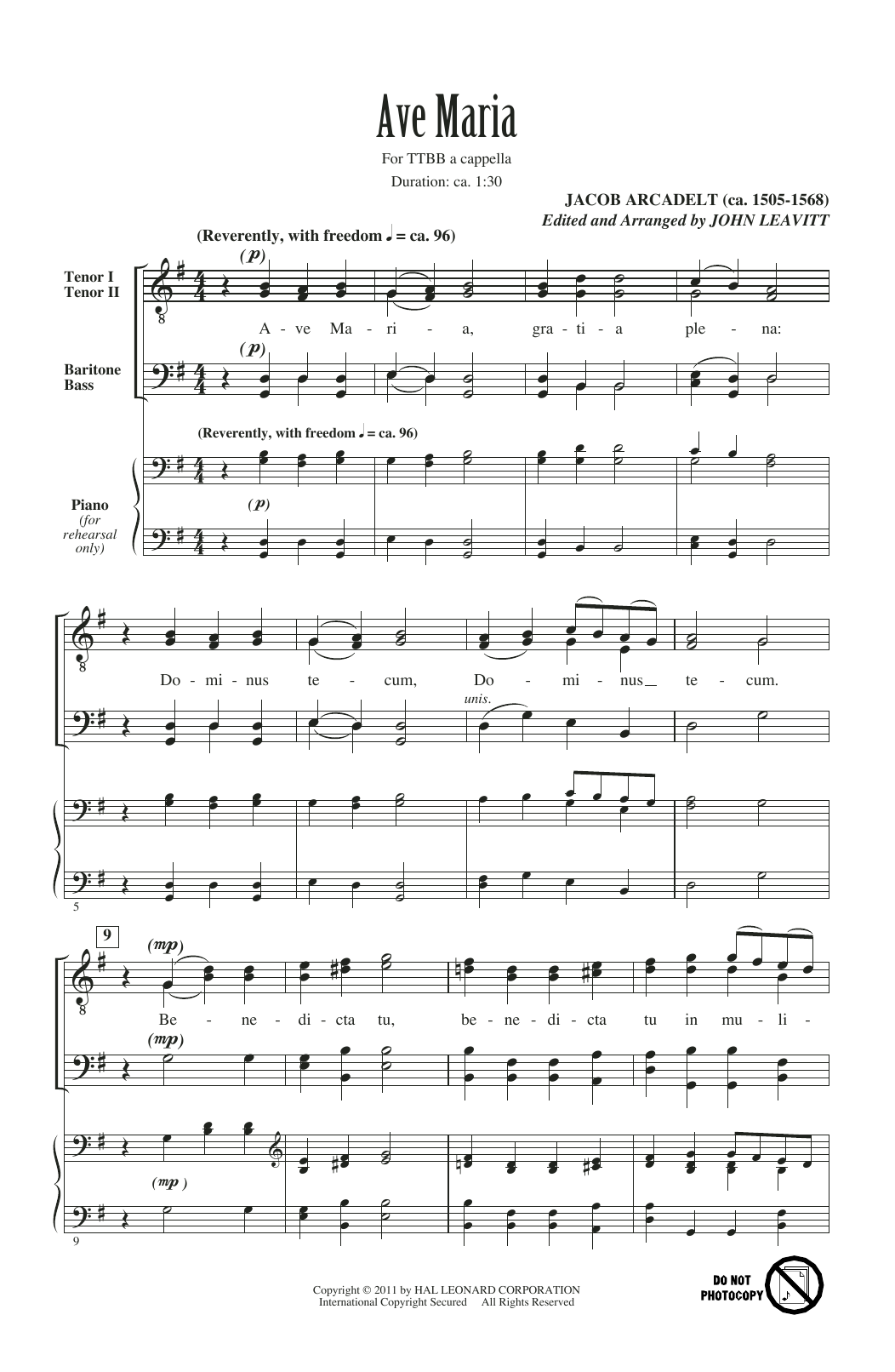
Ave Maria (arr. John Leavitt): TTBB Choral Octavo

By Jacob Arcadelt / Arranged by John Leavitt

Item: 35-DS01558951

Digital Download
$2.65

One moment…

Description

Ave Maria (arr. John Leavitt): TTBB Choral Octavo isn't in MakeMusic Cloud just yet...but it could be. Let us know you'd like to see it, and you'll help shape what comes next. In the meantime, start a free trial and dive into thousands of interactive titles your students can play along with today.

Sample Audio
No sample audio found.
Sample Video
Additional Details
Publisher: Hal Leonard
Page Count: 3
SKU: 35-DS01558951

More about this title

About the Composer: Jacob Arcadelt

Jacob Arcadelt was a Franco-Flemish composer of the Renaissance whose output spanned sacred and secular music across multiple genres. Active primarily in the 16th century, he composed motets, masses, and secular vocal works that circulated widely throughout Europe, establishing him as a significant figure in the development of polyphonic choral writing. His Ave Maria remains one of his most enduring works, valued for its elegant contrapuntal writing and expressive simplicity.

Arcadelt's music exemplifies Renaissance ideals of balance and clarity in four-part harmony. His compositions have remained central to choral education for centuries because they reward singers with musical lines that feel natural to sing while maintaining the sophisticated harmonic language of the period.

Why we love this

John Leavitt's arrangement strips this Renaissance jewel down to its essential beauty while ensuring it sits comfortably for men's voices. The TTBB voicing preserves the transparency of the original while giving each voice part melodic interest, making this an excellent choice for male choirs seeking repertoire that sounds both accessible and refined.

What to expect

Contemplative and intimate, like a moment of private devotion. The gentle harmonic progressions and straightforward melodic motion create space for the text to resonate, while the Renaissance harmonic language gives it an inherent dignity that feels both timeless and unfamiliar to modern ears.

Who it's for

Male choirs seeking sacred repertoire that balances musical substance with reasonable technical demands. This works equally well for mixed ensembles wishing to feature their tenors and basses, or as a concert opener that establishes a reverent tone without requiring elaborate staging.

How to get the most out of it

  • Approach the text declamation with care; each syllable should land naturally on the harmonic structure rather than feeling forced into the melody.
  • Let the inner voices breathe independently, especially in the second section where harmonic movement intensifies. Avoid blending them into a wash.
  • Shape the phrases according to the text arc rather than bar lines. The prayer-like quality emerges when singers sense where Arcadelt's harmonies want to resolve.

How to use it

Position this as a thoughtful complement to other Renaissance or early sacred works, or use it as a concert centerpiece that allows singers to explore the expressive possibilities of restrained, elegant writing. The three-page length makes it ideal for a Sacred Classics concert or as part of a Christmas program alongside more elaborate arrangements.

Skills your students will build

  • Singing independent lines in Renaissance four-part harmony
  • Balancing ensemble blend while maintaining line clarity
  • Text underlay and syllabic declamation in sacred music
  • Shaping phrases according to harmonic rhythm rather than hypermeter

You May Also Like