Ave Maria Sheet Music Preview

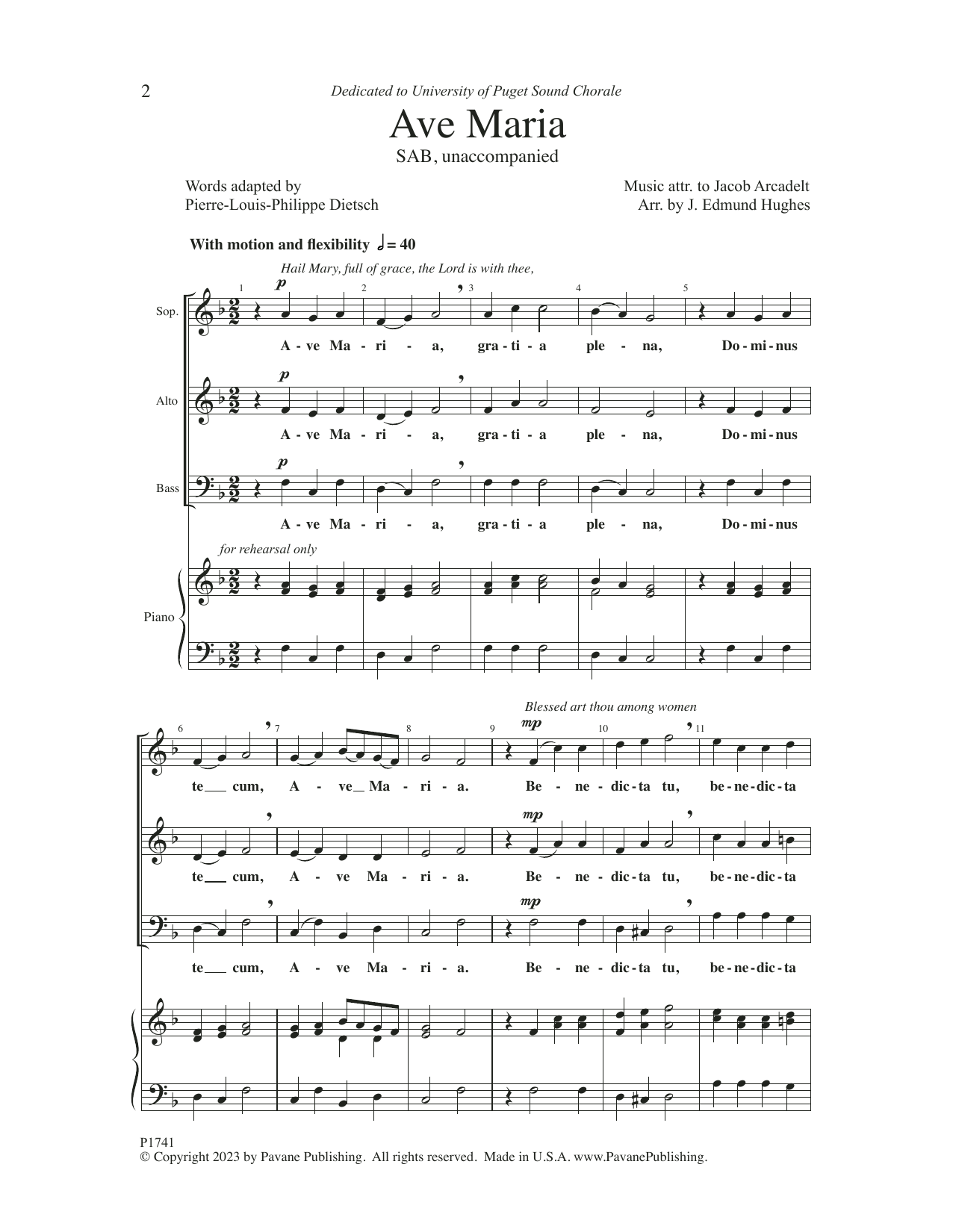
Ave Maria: SAB Choral Octavo

By Jacob Arcadelt / Arranged by J. Edmund Hughes

Item: 35-DS01223873

Digital Download
$2.60
Description

Ave Maria: SAB Choral Octavo isn't in MakeMusic Cloud just yet...but it could be. Let us know you'd like to see it, and you'll help shape what comes next. In the meantime, start a free trial and dive into thousands of interactive titles your students can play along with today.

Sample Audio
No sample audio found.
Sample Video
Additional Details
Publisher: Hal Leonard
Page Count: 3
SKU: 35-DS01223873

More about this title

About the Composer: Jacob Arcadelt

Jacob Arcadelt (circa 1507–1568) was a Franco-Flemish composer whose sacred and secular works shaped the musical language of the Renaissance. He spent much of his career in Italy, where his motets and madrigals gained widespread popularity and influence across Europe. His gift for lyrical melody and clear harmonic writing made his compositions ideal vehicles for both liturgical use and courtly performance.

Arcadelt's Ave Maria survives in multiple versions, testament to its enduring appeal among singers and congregations. The piece exemplifies his skill at balancing textural clarity with emotional directness, qualities that continue to make his work accessible to performers across skill levels.

Why we love this

This arrangement captures the serene lyricism that made Arcadelt's Ave Maria a repertoire staple while fitting it perfectly into the practical voicing needs of mixed choirs. The SAB setting preserves the piece's meditative character without demanding the range or balance challenges of fuller voicings, making it ideal for ensembles with developing singers or limited baritone sections.

What to expect

The piece unfolds with quiet reverence, its gentle melodic contours inviting introspection rather than display. Arcadelt's voice leading creates moments of harmonic warmth that feel both intimate and timeless, as if the prayer itself shapes the music's flow.

Who it's for

This three-part setting works well for developing choirs, sacred music programs seeking a shorter devotional piece, or ensembles with uneven voice distributions. The moderate difficulty and compact length make it suitable for both concert programming and liturgical use.

How to get the most out of it

  • Shape the melody through the sopranos with legit tone production; avoid oversinging despite the prayer text's emotional weight.
  • Treat phrase endings with restraint, allowing the alto and bass voices to support without intruding on the soprano line.
  • Let the harmonic rhythm dictate your pacing rather than imposing a rigid tempo; Renaissance music breathes through its voice leading.
  • Balance the lower voices carefully during tutti sections so the piece retains its transparency and the text remains intelligible.

How to use it

Consider pairing this with other Renaissance sacred works to create a thematic concert segment, or use it as a contemplative anchor in a mixed program of secular and sacred repertoire. Its brevity and spiritual focus also make it valuable as a concert opener or closer.

Skills your students will build

  • Sustaining long phrases without breath interruption
  • Balancing three-part harmony while maintaining blend
  • Reading Renaissance notation and understanding historical context
  • Shaping dynamic and expressive content through text interpretation
  • Developing legit tone production for a cappella singing

You May Also Like