Ave Maria Sheet Music Preview

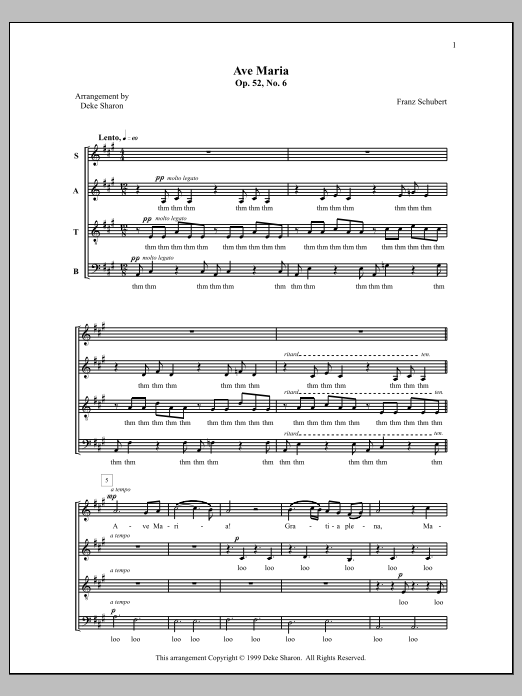
Ave Maria: SATB Choral Octavo

As performed by Franz Schubert / As performed by Anne Raugh / Arranged by Deke Sharon

Item: 35-DS00294972

Digital Download
$2.99
Description

Ave Maria: SATB Choral Octavo isn't in MakeMusic Cloud just yet...but it could be. Let us know you'd like to see it, and you'll help shape what comes next. In the meantime, start a free trial and dive into thousands of interactive titles your students can play along with today.

Sample Audio
No sample audio found.
Sample Video
Additional Details
Publisher: Hal Leonard
Page Count: 9
SKU: 35-DS00294972

More about this title

About the Artist: Franz Schubert

Franz Schubert (1797–1828) was an Austrian composer whose output shaped the Romantic era despite his tragically short life. His gift for melody and harmonic innovation appears across symphonies, chamber music, and songs, but his choral works remain central to the repertoire that choirs return to year after year. Schubert's Ave Maria stands as one of the most recognizable sacred melodies in Western music, a testament to his ability to distill spiritual feeling into deceptively simple, unforgettable lines.

Why we love this

Deke Sharon's arrangement opens this eternal melody to a cappella choirs without compromising its devotional character. The piece sits well for mixed voices across a reasonable range, making it accessible for choirs that want to claim a genuine masterwork without requiring accompaniment or soloists.

What to expect

Contemplative and intimate. The melody unfolds with quiet certainty, supported by warm harmonic movement that feels almost inevitable. Singing this piece often feels like participating in something larger than yourself, a shared moment of reflection rather than display.

Who it's for

Choirs seeking a beloved, singable sacred piece that works well as an encore, concert opener, or service music. This arrangement suits intermediate to advanced groups comfortable with a cappella singing and sustained tones.

How to get the most out of it

  • Shape the familiar melody with clear long-line phrasing rather than stopping at every phrase mark. Allow the text underlay to guide breath placement, not punctuation.
  • Balance the inner voices so the harmonic progression supports rather than obscures the soprano line. The beauty emerges from transparency, not blend.
  • Approach the final cadence with restraint. Let it settle gently rather than swell, allowing the prayer to resolve rather than conclude dramatically.

How to use it

Consider this for interfaith concerts, holiday programs, or any occasion that calls for a moment of collected calm. It pairs naturally with other Renaissance or Romantic sacred works, or stands alone as a meaningful close to an evening.

Skills your students will build

  • Sustaining pure vowels and legit tone in a cappella settings
  • Balancing soprano-driven melodies with supportive inner harmonies
  • Controlling breath placement within longer musical phrases
  • Singing with intonational security in four-part vertical sonorities

You May Also Like