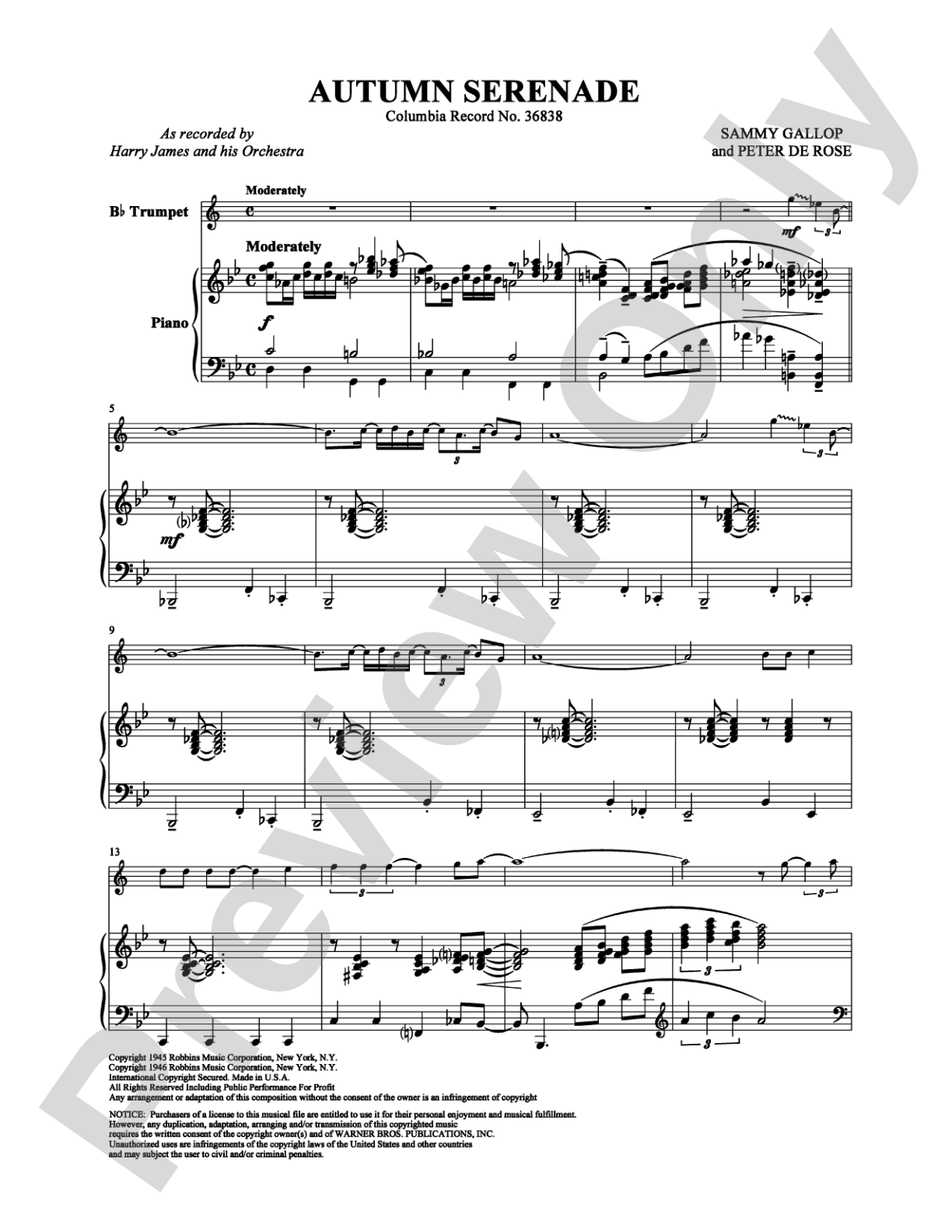
Autumn Serenade: Solo & Small Ensemble Digital Sheet Music

Autumn Serenade: Solo & Small Ensemble Digital Sheet Music

Peter de Rose, Sammy Gallop, Harry James and His Orchestra

Item: 00-PS-0000730

Digital Download
$2.99
Description

Autumn Serenade: Solo & Small Ensemble Digital Sheet Music isn't in MakeMusic Cloud just yet...but it could be. Let us know you'd like to see it, and you'll help shape what comes next. In the meantime, start a free trial and dive into thousands of interactive titles your students can play along with today.

Sample Audio
No sample audio found.
Sample Video
Additional Details
SKU: 00-PS-0000730

More about this title

About the Artist: Harry James and His Orchestra

Harry James (1916-1983) was a trumpeter and bandleader whose virtuosic playing and accessible style made him one of the most commercially successful jazz musicians of the swing era. His orchestra became known for polished, radio-friendly arrangements that balanced technical sophistication with popular appeal, earning him a devoted following that extended well beyond jazz circles.

Why we love this

Autumn Serenade captures the elegance of swing-era orchestration in a format that works for smaller ensembles and soloists. The piece gives student musicians a chance to experience the warmth and controlled virtuosity that defined James's sound without requiring a full big band.

What to expect

Autumn Serenade unfolds with the unhurried sophistication of a late afternoon. The melody has a gentle melancholy tinged with warmth, supported by the kind of ensemble voicing that lets a soloist sound their very best.

Who it's for

Jazz students exploring swing-era repertoire, small jazz combos looking to expand their literature, and soloists who want to develop their ability to phrase over chord changes in a stylistically authentic setting.

How to get the most out of it

  • Balance the solo line against the ensemble; the accompaniment should support rather than compete with the featured voice.
  • Aim for a warm, singing tone throughout. This arrangement rewards sustained phrasing over rapid articulation.
  • Let the harmonic movement breathe. Resist rushing the changes, especially in sections where the ensemble provides cushion for the soloist.

How to use it

This works well on a jazz recital or chamber concert where you want to represent the swing tradition with genuine historical repertoire. It also serves as a bridge piece for students transitioning from classical to jazz contexts.

Skills your students will build

  • Phrasing over jazz changes and harmonic movement
  • Listening and balancing in a small ensemble setting
  • Interpreting swing-era style and articulation
  • Reading chord charts and ensemble voicings

You May Also Like