
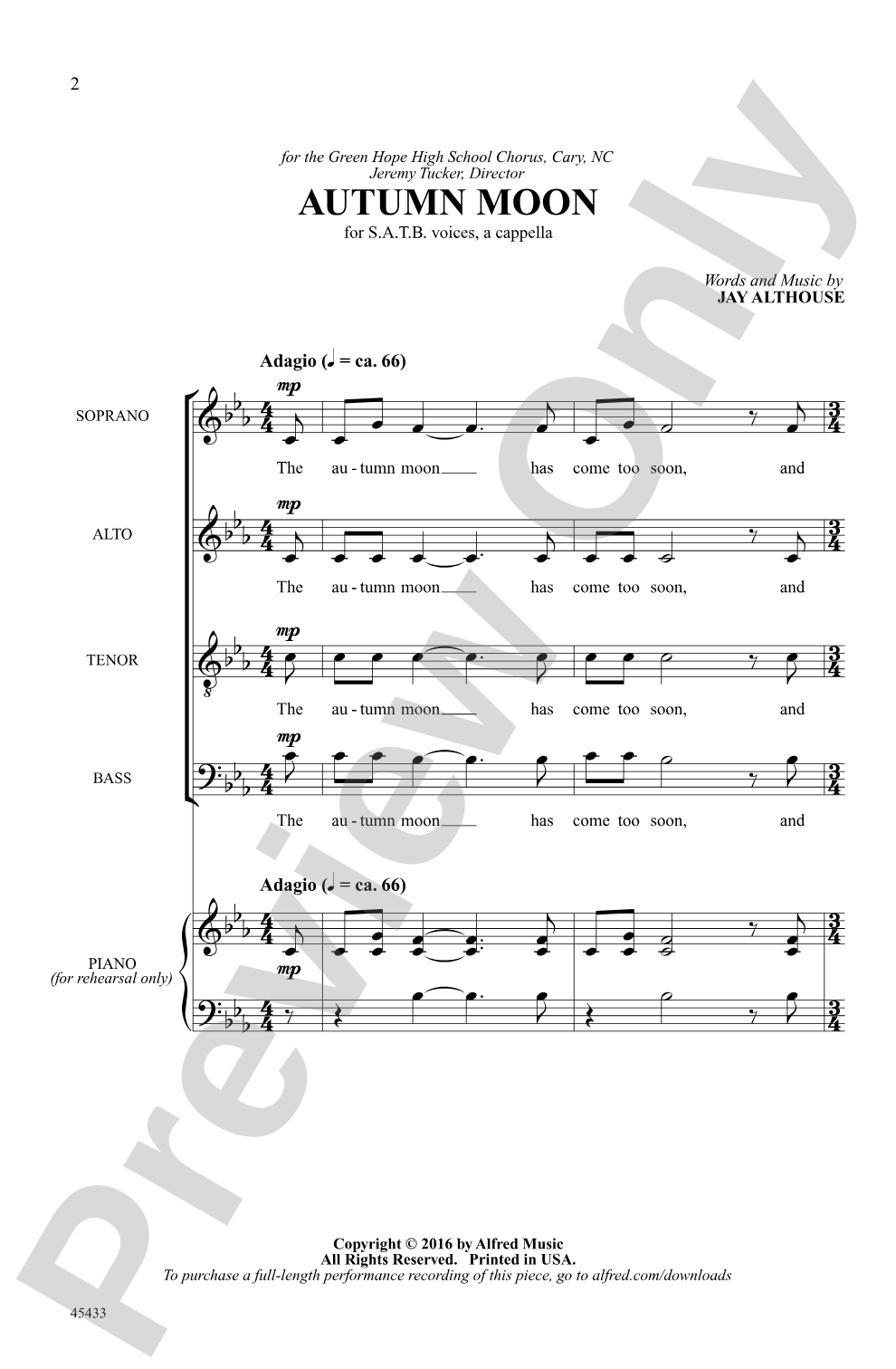

Autumn Moon: SATB, a cappella Choral Octavo
Words and music by Jay Althouse
Item: 00-PO-0003670
$1.90
Minimum order quantity: 20 copies
Pickup currently not available
Related Items
Autumn Moon: SATB, a cappella Choral Octavo |
$1.90
|
View |
Description
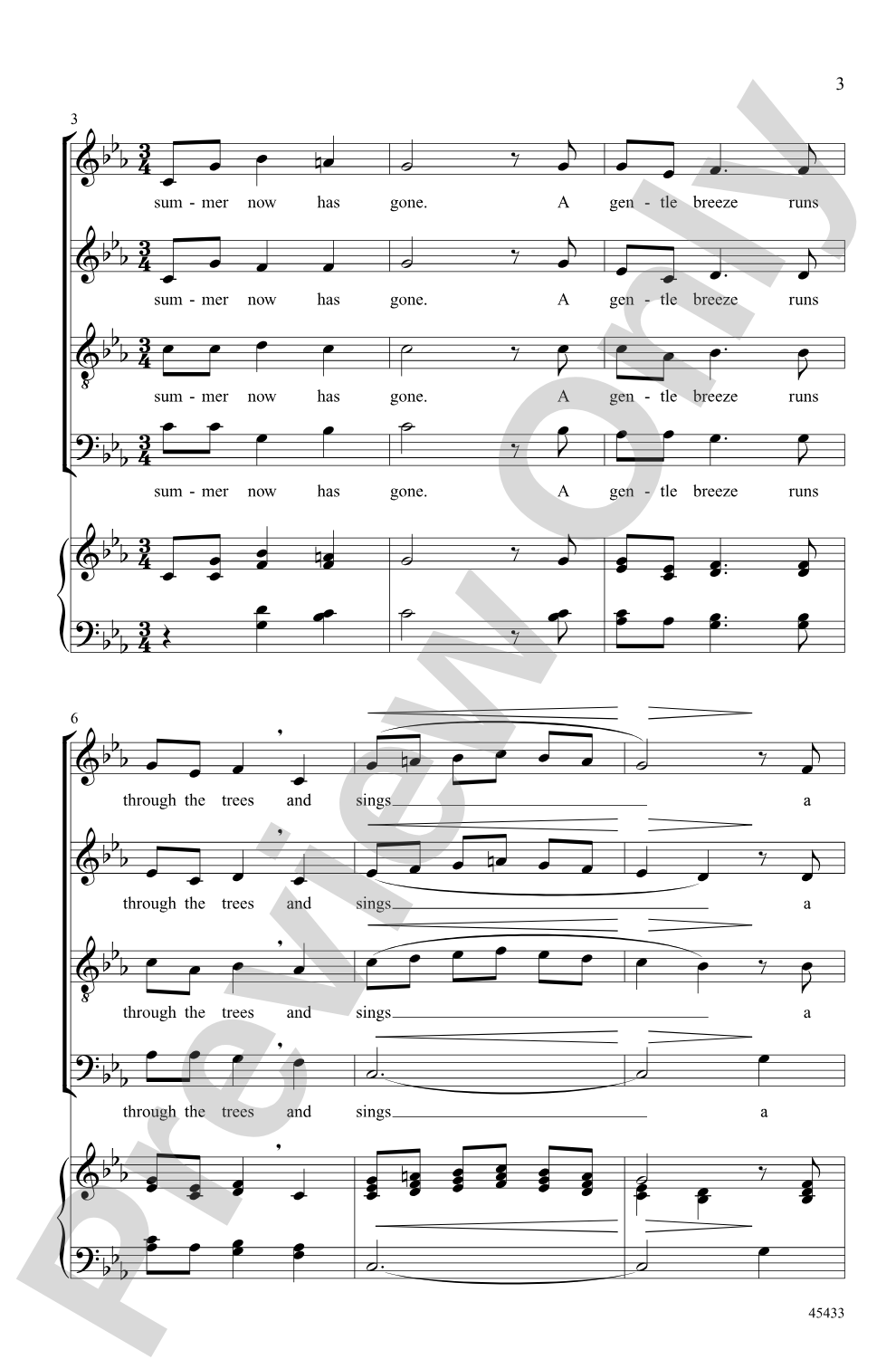
This haunting contemporary work features a wistful text about the departure of summer and the coming of winter. Rich, a cappella harmonies and thoughtful dynamics heighten the mood of this stunning piece. Impressive.


Autumn Moon: SATB, a cappella Choral Octavo isn't in MakeMusic Cloud just yet...but it could be. Let us know you'd like to see it, and you'll help shape what comes next. In the meantime, start a free trial and dive into thousands of interactive titles your students can play along with today.
Request This Title
Tell us you want it.
Start Your Free Trial
Explore everything that's ready to play right now.
Sample Audio
1
Audio File
--:--
0:00
0:00
Sample Video
Additional Details
Series:
Alfred Choral Designs
Publisher:
Alfred Music
Page Count:
12
SKU:
00-PO-0003670
More about this title
About the Composer: Jay Althouse

Jay Althouse studied music education and music at Indiana University of Pennsylvania, where he later received the Distinguished Alumni award. Early in his career, he worked for eight years in music publishing as a rights and licenses administrator and served on the Executive Board of the Music Publishers Association of America.
Althouse has composed over 800 choral works performed regularly across the English-speaking world. Beyond composition, he has collaborated with his wife, Sally K. Albrecht, on children's musicals and vocal collections, co-authored widely used resources like The Complete Choral Warm-up Book and Accent on Composers, and created classroom materials including Ready to Read Music and One-Page Composer Bios. He is a writer member of ASCAP and a multiple recipient of the ASCAP Special Award. Althouse has served on the board of the North Carolina Master Chorale and currently advises the National Advisory Board of the Folk Art Society of America.
Why we love this
Althouse crafts a contemporary setting that honors classical choral writing without sacrificing accessibility. The a cappella texture demands genuine voice leading and musical maturity, yet the emotional directness of the text about seasonal change resonates immediately with singers and audiences alike. This is the kind of piece that sounds impressive on concert programs while remaining genuinely rewarding to rehearse.
What to expect
The text paints a melancholy farewell to warmth and light. Althouse's harmonies capture that wistfulness through deliberate voice movements and thoughtful dynamic shaping, creating an intimate quality despite the four-part texture. Singers often describe this piece as contemplative and emotionally grounded, less about spectacle and more about honest expression.
Who it's for
This piece works beautifully for intermediate to advanced high school and college choirs, as well as adult community groups comfortable with contemporary harmony. Directors looking for fall concert material that balances accessibility with musical substance will find a dependable choice here.
How to get the most out of it
- Balance the voices carefully during chord progressions; rich harmonies can easily mask individual lines if sopranos and altos dominate. Check intonation frequently in rehearsal, especially on sustained passages.
- Shape the dynamics according to the text's emotional arc. The wistful quality depends on restraint in the opening sections and only gradually building intensity where Althouse marks it.
- Since the piece is unaccompanied, establish a secure harmonic foundation by rehearsing roots and fifths separately before adding full voicing.
- Pay close attention to breath placement. The 12 pages reward singers who think through phrasing as one cohesive musical statement rather than measure-by-measure.
How to use it
Autumn Moon belongs on fall concerts and festival programs where it can anchor a set of seasonal or contemporary choral works. It also serves well as a quieter moment in mixed programs, offering contrast to energetic pieces or larger ensemble pieces. The modest page count makes it approachable for festivals and contests that require shorter selections.
Skills your students will build
- Balancing four independent harmonic lines in a cappella texture
- Reading and executing dynamic nuance in contemporary choral writing
- Sustaining focused intonation over longer phrases without instrumental support
- Interpreting text-driven phrasing and shaping in secular choral literature