
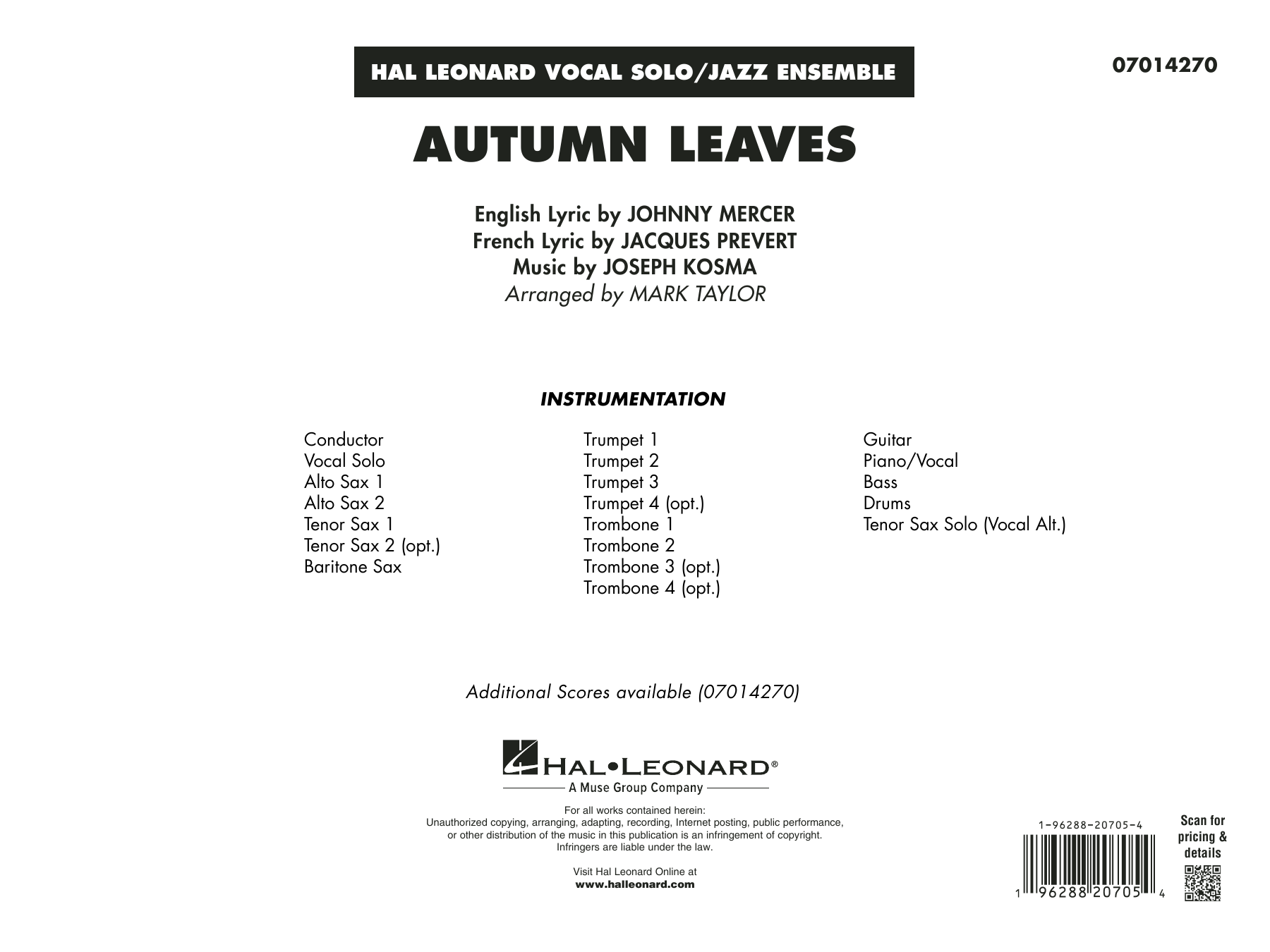

Autumn Leaves (Key: C minor) (arr. Mark Taylor): Jazz Ensemble Conductor Score & Parts
By Joseph Kosma / Arranged by Mark Taylor
Grade: 3-4
Item: 35-PK01483668
$55.00
Pickup currently not available
Buy Extra Parts (Digital PDF Download)
Parts Added to Cart!
Description
This standard tune from 1945 has consistently remained a favorite with jazz musicians. Featuring a timeless melody, beautifully scored background parts, and a medium swing style, this standout chart for vocal soloist belongs in every library.


Autumn Leaves (Key: C minor) (arr. Mark Taylor): Jazz Ensemble Conductor Score & Parts isn't in MakeMusic Cloud just yet...but it could be. Let us know you'd like to see it, and you'll help shape what comes next. In the meantime, start a free trial and dive into thousands of interactive titles your students can play along with today.
Request This Title
Tell us you want it.
Start Your Free Trial
Explore everything that's ready to play right now.
Sample Audio
No sample audio found.
Sample Video
No sample videos found.
Additional Details
Publisher:
Hal Leonard
SKU:
35-PK01483668
More about this title
About the Composer: Joseph Kosma
Joseph Kosma (1905–1969) was a Hungarian-born composer who became essential to the French film music tradition. Working across operetta, ballet, and cinema, Kosma developed a gift for writing melodies that felt both sophisticated and instantly memorable. His film scores shaped the sound of French cinema in the 1940s and 1950s, and his compositions continue to define the jazz standard repertoire.
Kosma's influence on jazz education runs deep because his melodies translate beautifully across contexts. Autumn Leaves, co-written with lyricist Jacques Prévert, exemplifies his ability to craft a tune with harmonic depth that rewards serious musicians while remaining accessible to developing ensembles.
Why we love this
Mark Taylor's arrangement captures what makes this standard endure: a melody that sings, changes that challenge, and a swing feel that sits naturally in the ensemble. The background parts are voiced with real care, giving your section players something substantial to anchor rather than filler lines. This is the kind of chart that works equally well as a feature for a confident soloist or as a vehicle for teaching your ensemble how jazz standards actually function.
What to expect
There's a bittersweet nostalgia to this arrangement. The minor key and the melody's contour suggest reflection without melancholy, the kind of mood that makes autumn feel both beautiful and transient. When your ensemble locks into the swing feel, the tune becomes conversational, almost like overhearing a story being told.
Who it's for
Jazz ensembles at the Grade 3-4 level will find this both musically rewarding and technically manageable. It works for groups developing their solo culture and for directors who want to teach how a real standard is built. Vocalists looking for a legitimate jazz vehicle with ensemble support will appreciate the professional context Taylor provides.
How to get the most out of it
- Lock the rhythm section into a relaxed swing before bringing in the full ensemble. The groove matters more than precision here; if your drums and bass are pushing too hard, the whole chart feels rushed.
- Shape the melody with space. Autumn Leaves survives on its lyricism, so resist the urge to phrase every bar identically. Let your soloist breathe and let the ensemble respond with dynamic listening.
- Attend to the voicing clarity in the background parts. Taylor's writing rewards blend and balance; make sure inner voices aren't drowning out the harmonic definition you need at Grade 3-4.
- Explore the minor tonality as an emotional anchor. C minor gives this tune a reflective quality that distinguishes it from the brighter readings. Lean into that character.
How to use it
Pair this with other standards to build a jazz program that shows repertoire continuity and arranging variety. It also serves as an excellent teaching tool mid-year when your ensemble has enough foundation to handle harmonic sophistication. Consider featuring it early in the set if you have a vocalist who can carry the lyrical weight; it establishes a reflective tone that other pieces can build from.
Skills your students will build
- Swing articulation and phrasing in a minor key context
- Listening to and supporting a soloist within an ensemble texture
- Reading jazz chord symbols and understanding functional harmony in a standard
- Balance and blend in four-part jazz voicings
- Rhythmic entrances and releases in medium-tempo swing