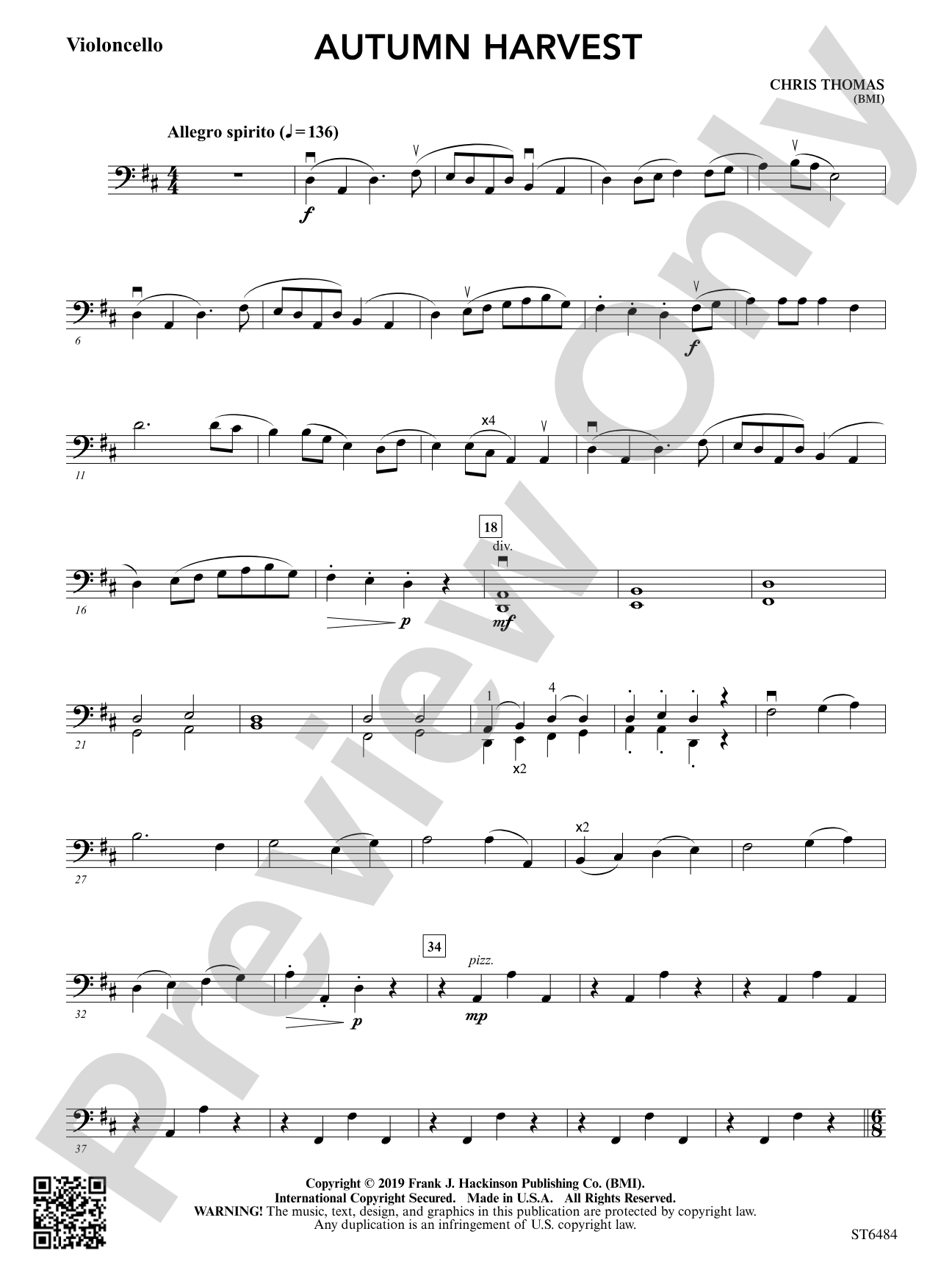
Autumn Harvest: Violoncello Sheet Music Preview

Autumn Harvest: Violoncello

By Chris Thomas

Grade: 3.5

Item: 98-PC-DST6484_VC1

Digital Download
$7.00
Description
Fall is a glorious time of year! The air cools, streets smell of fireplaces, and the trees burst into a one final display of loud amber and gold before they disappear into the silence of winter. Several variations of the main theme explore varying keys, time signatures and styles. The piece builds to a joyous finale, when all the variations overlap in a cacophony of jubilant counterpoint. Upbeat and festive! (3:45)

Don't just read it, hear it, play along with it, and watch your students grow with it. In MakeMusic Cloud, Autumn Harvest: Violoncello comes alive with professional accompaniment, adjustable tempo, and built-in practice tools that turn solo practice into real progress.

Sample Audio
0:00
0:00
Sample Video
Additional Details
Series: FJH String Orchestra
Publisher: The FJH Music Company, Inc.
SKU: 98-PC-DST6484_VC1

More about this title

About the Composer: Chris Thomas

Chris Thomas

Chris Thomas composes for film, television, theme parks, and concert halls with equal fluency. His accolades include a Hollywood Music in Media Award, two American Prize placements (2nd place), a Global Music Award, and the Gold Medal Prize at the Park City Film Music Festival. His concert works have been performed at Carnegie Hall, the Sydney Opera House, and the Hollywood Bowl.

In media, Thomas has scored Emmy-nominated films and orchestrated for major studios including Sony, ABC, FOX, CBS, and HBO. His theme park commissions span Evermore Adventure Park, Knott's Berry Farm, The Void, and venues across the UK and North America. His Malheur Symphony was the subject of his 2019 TED Talk, reflecting his commitment to meaningful musical storytelling.

Why we love this

Thomas captures autumn's visual splendor and emotional arc in a single arc that feels both intimate and grand. The architectural clarity of the piece—variations that shift tonality and meter without losing melodic coherence, followed by a genuine contrapuntal finale—makes it a teaching opportunity that doesn't sacrifice musical substance for seasonal appeal. String orchestras at this level rarely get material this satisfying to conduct.

What to expect

Warm amber light and movement. The piece opens with the sensory richness of autumn, then unfolds through multiple musical lenses before erupting into a joyous tangle of voices at the end. There's a sense of gathering energy and celebration, grounded in accessible but sophisticated string writing.

Who it's for

String orchestras at the intermediate level (Grade 3.5) looking for concert or festival repertoire with genuine musical substance. Directors seeking fall programming that moves beyond novelty arrangements and offers real compositional challenge and reward.

How to get the most out of it

  • Rehearse the contrapuntal finale in isolated voice combinations first. Lock the independence of each line before bringing layers together, so the cacophony reads as jubilant rather than muddy.
  • Use the meter and key changes as interpretive signposts. Each variation should feel like a distinct seasonal moment, not just a repetition. Adjust articulation and vibrato intensity to match the character shift.
  • Balance the overlapping melodic lines in the final section by emphasizing the conductor's gestures rather than written dynamics alone. The interplay of themes needs clear phrasing to shine through the texture.

How to use it

Position this as the centerpiece of a fall concert or regional festival submission. Its modest length (3:45) and clear structure make it an ideal pairing with a contrasting work, whether baroque, romantic, or contemporary. The seasonal timing and festive character also suit family-friendly community performances.

Skills your students will build

  • Reading and performing multiple key signatures within a single piece
  • Executing meter changes (variations in time signature across sections)
  • Balancing independent melodic lines in counterpoint without sacrificing ensemble unity
  • Stylistic flexibility (responding to compositional shifts across variations)
  • Phrasing and articulation as interpretive tools within a thematic framework

You May Also Like