
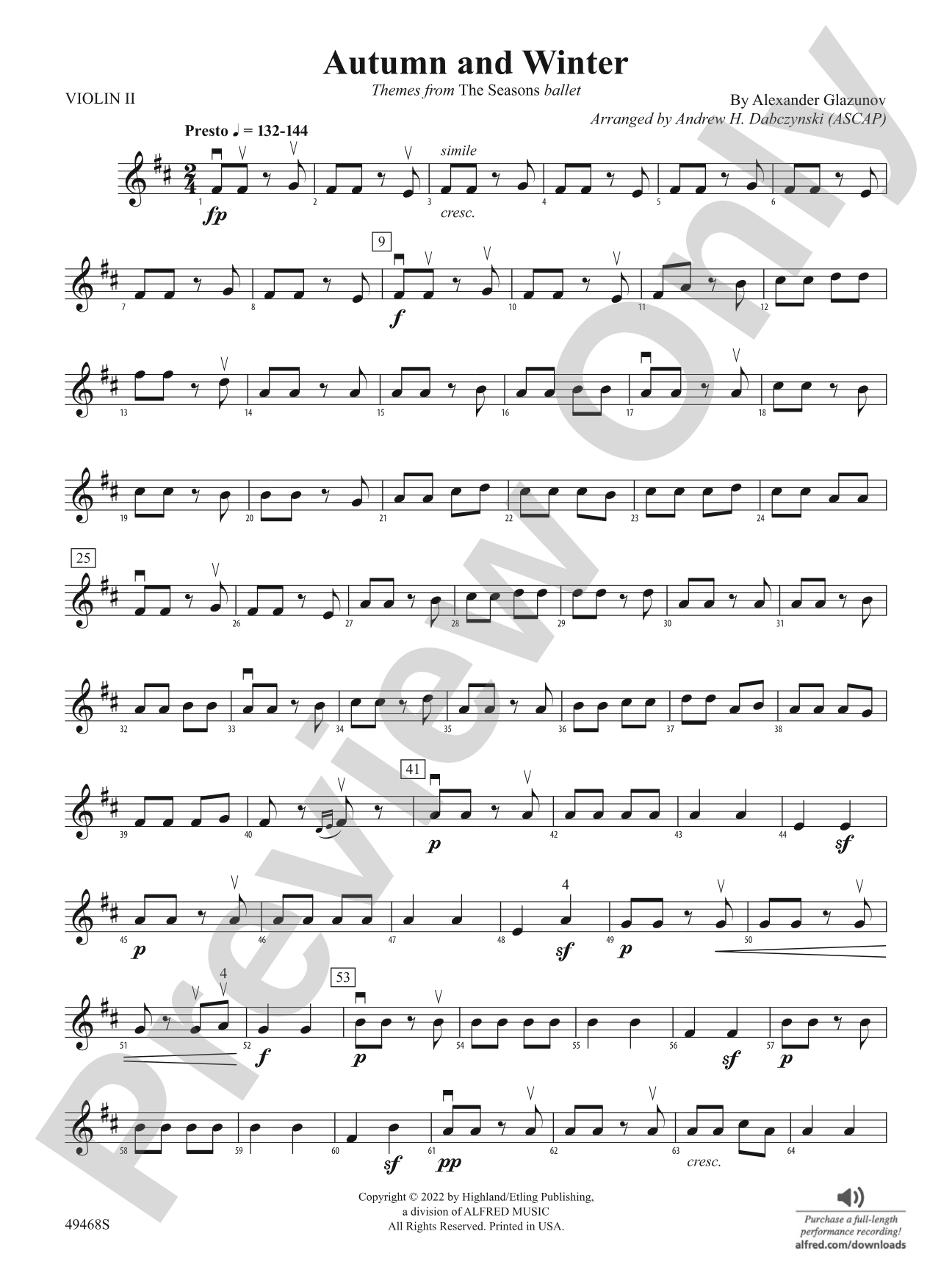

Autumn and Winter: 2nd Violin
By Alexander Glazunov / arr. Andrew H. Dabczynski
Grade: 2.5
Item: 00-PC-0018786_VN2
$3.00
Pickup currently not available
Description
Both the bleak Russian midwinter landscape and the joyful celebration of a fall harvest festival are conveyed in this string arrangement by Andrew H. Dabczynski, of Autumn and Winter from Alexander Glazunov's ballet The Seasons. The expressive contrasts in this motivating set will make it a favorite of all. Optional parts for more advanced students, as well as supplementary percussion and piano parts make it an excellent concert choice for intermediate or even upper-level orchestras. (3:30) This title is available in MakeMusic Cloud.


Don't just read it, hear it, play along with it, and watch your students grow with it. In MakeMusic Cloud, Autumn and Winter: 2nd Violin comes alive with professional accompaniment, adjustable tempo, and built-in practice tools that turn solo practice into real progress.
Open in the Player
Jump straight in and assign it today.
Start Your Free Trial
Open this title and explore the full library in minutes.
Sample Audio
1
Audio File
--:--
0:00
0:00
Sample Video
Additional Details
Series:
Highland String Orchestra (HSO)
Publisher:
Alfred Music
SKU:
00-PC-0018786_VN2
More about this title
About the Composer: Alexander Glazunov
Alexander Glazunov (1865-1936) was a Russian composer whose gift for melodic writing and orchestral color made him one of the most performed composers of the late Romantic era. His ballet The Seasons, written in 1900, remains a cornerstone of classical ballet and a rich source for educational orchestration. Glazunov's music combines lyrical expressiveness with structural clarity, making his work exceptionally valuable for developing musicians who benefit from both emotional engagement and formal understanding.
Why we love this
Dabczynski's arrangement captures the full emotional arc of Glazunov's original without overwhelming an intermediate ensemble. The interplay between the bleakness of winter and the warmth of harvest celebration gives students something genuinely moving to convey, and the optional advanced parts and percussion additions mean you can scale the piece up for contest or down for a solid concert performance without loss of integrity.
What to expect
The opening evokes a hushed, snow-covered landscape with sparse but haunting beauty. As the piece unfolds, warmth seeps in through richer harmonies and more active rhythms, building toward a celebratory close that feels earned rather than forced. The contrast between winter's isolation and autumn's harvest joy gives the piece narrative weight.
Who it's for
Intermediate to upper-level string orchestras seeking substantial programmatic repertoire that sits comfortably on the page but engages audiences emotionally. Directors working with mixed-ability ensembles will appreciate the optional parts, which allow advanced players to contribute fuller textures without sidelining developing musicians.
How to get the most out of it
- Shape the opening Russian winter theme with clear dynamic contours; the mood shifts from desolate to introspective, so resist the urge to play it uniformly dark.
- Balance the harvest festival section so the joy doesn't overwhelm the lyrical lines underneath. This is where optional parts shine, but make sure the core melody remains audible.
- Use the percussion and optional piano parts strategically. They enhance texture and drive in the finale, but rehearse the string foundation first so players understand what they're supporting.
- Mark phrase endings with slight ritardandos to honor the songlike quality of Glazunov's original; rushing through the cadences flattens the emotional weight.
How to use it
Program this as a concert centerpiece in fall or winter concerts when you want to showcase the orchestra's lyrical depth and dynamic range. Its contest-ready credentials also make it a solid choice for festival appearances where judges value both technical security and musical maturity. The piece works particularly well paired with shorter, brighter selections that balance its reflective opening.
Skills your students will build
- Sustaining legato phrasing across multiple measures
- Executing dynamic contrasts that support narrative structure
- Balancing ensemble sonority when optional parts are added
- Reading and responding to programmatic cues in string writing
- Coordinating with percussion and keyboard parts